Collector guide
PSA Grading Cost: Tiers, Fees, and Break-Even Math
What PSA grading really costs: service tiers, declared value caps, upcharges, shipping, and a break-even checklist to decide which cards are worth it.
By Matteo G.
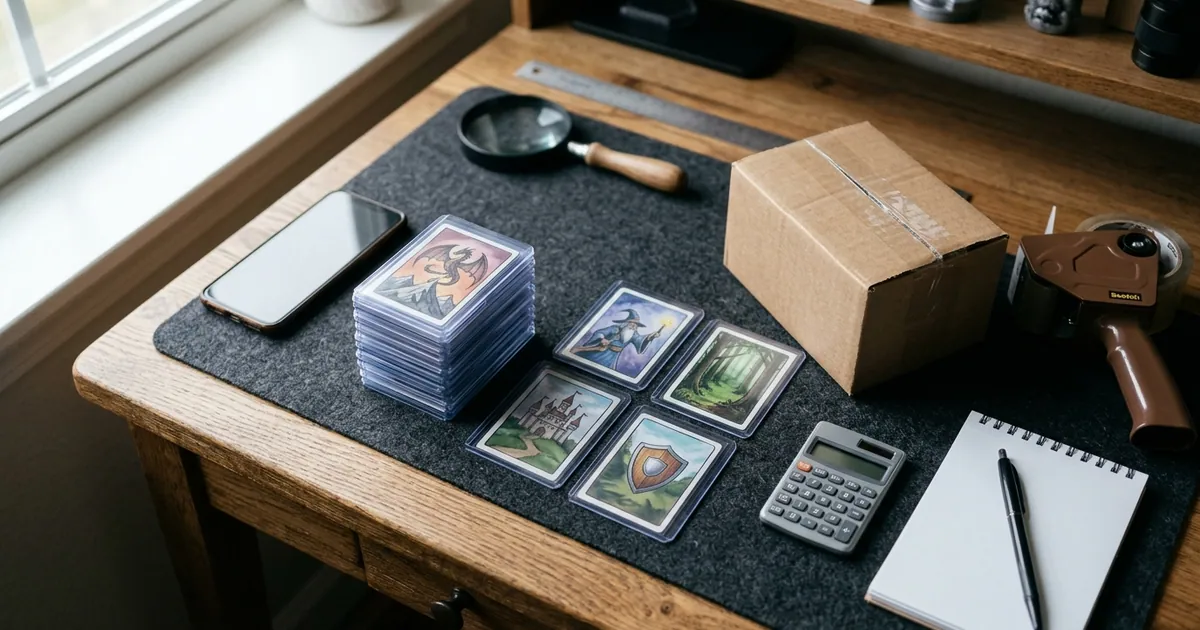
PSA grading cost is the per-card service fee for the tier you choose, plus shipping, insurance, supplies, and possibly an upcharge if your card turns out to be worth more than your tier allows. The cheapest bulk tiers have generally cost a few tens of dollars per card in recent years, while express and walk-through tiers run into the hundreds. PSA changes its prices and tier rules regularly, so treat any number you see, including the ones here, as a starting point and confirm on PSA’s official pricing page before you ship.
The more useful question isn’t what PSA charges. It’s whether a specific card earns that fee back. That’s what this guide is for.
Key takeaways
- Your real cost per card is the tier fee plus your share of two-way shipping and insurance, supplies, and any upcharge, not just the advertised price.
- PSA tiers are defined by maximum declared value and turnaround. If you pick a tier that’s too cheap for the card’s value, expect an upcharge.
- A card is worth grading only when the expected graded sale price, after selling fees, beats the raw sale price by more than your total cost.
- Condition decides the math. PSA’s published Gem Mint 10 standard calls for centering of roughly 55/45 to 60/40 or better on the front and 75/25 or better on the back, and most cards don’t get there.
- Pre-screen before paying. An AI pre-grade from Card Grading AI won’t tell you what PSA will decide, but it helps you leave obvious 8s at home.
How PSA prices its service tiers
PSA doesn’t charge one flat price. It sells service levels, and each level is defined by three things:
- Price per card. Lower tiers cost less.
- Maximum declared value. Each tier caps how much a single card in that tier can be worth. Bulk and value tiers have the lowest caps. Premium and walk-through tiers cover cards worth thousands or more.
- Estimated turnaround. Cheaper tiers wait longer. PSA’s turnaround estimates are targets, not promises, and they’ve swung a lot in recent years.
Some tiers also have extra conditions. The lowest bulk tier has historically required a minimum number of cards per order, and some tiers have been limited to PSA Collectors Club members or specific card eras. These rules change, so check them each time you submit.
Here’s how the tier families compare in general terms. Exact dollar amounts are left out on purpose because they go stale fast.
| Tier family | Relative fee | Declared value cap | Turnaround | Best for |
|---|---|---|---|---|
| Bulk / value | Lowest | Lowest (low hundreds) | Longest | Batches of modest cards you’re confident in |
| Mid tiers (regular-type) | Moderate | Mid (low thousands) | Medium | Single key cards worth hundreds to low thousands |
| Express / super express | High | Higher | Short | Time-sensitive flips, higher-value cards |
| Walk-through / premium | Highest | Highest | Shortest | High-end cards where the fee is a small share of value |
A practical rule: if the tier fee is more than about 10-20% of what the card is realistically worth graded, the margin is thin and your grade estimate has to be right.
Declared value and the upcharge trap
When you submit, you declare a value for each card. PSA uses that number for tier eligibility, insurance, and return shipping costs. Collectors often get caught here.
If PSA grades your card and decides it’s worth more than your tier’s cap, it can move the card to the correct tier and bill you the difference. Say you put a card in a tier with a low cap, and it comes back as a high grade that sells for several times that cap. You’ll get an invoice for the price gap between the two tiers. That’s PSA working as documented, but it can double or triple your expected cost on one card.
How to declare sensibly:
- Base the value on recent sold prices at the grade you realistically expect, not on asking prices or the PSA 10 dream.
- If a PSA 10 of the card would sell well above your tier’s cap, consider the next tier up, or accept that you’ll pay an upcharge if it gems.
- Don’t lowball to save on insurance. If a package is lost, your coverage generally follows what you declared.
The hidden costs beyond the per-card fee
The fee on PSA’s pricing page is the smallest number you’ll pay attention to and often not the whole cost. Add these up:
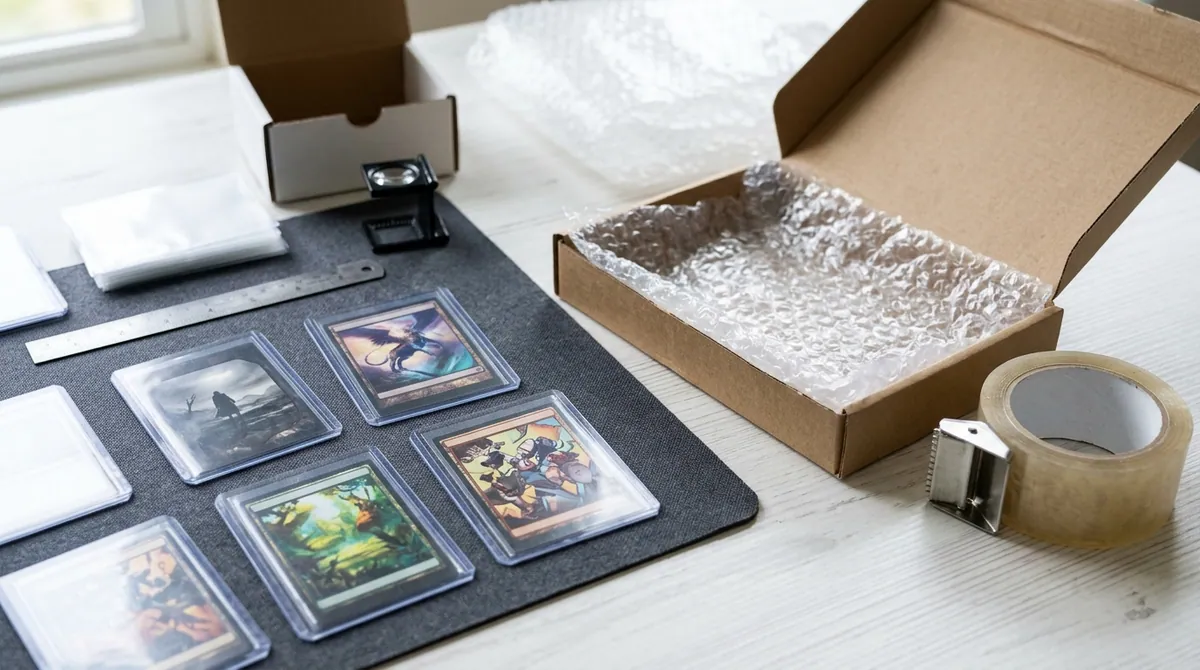
- Outbound shipping and insurance. You pay to get cards to PSA. Insured, tracked shipping for a small box usually costs more than first-class postage.
- Return shipping and insurance. PSA bills this, and it scales with your order’s total declared value. One expensive card can raise return shipping for the whole box.
- Supplies. Penny sleeves and semi-rigid holders. PSA has long asked for semi-rigid holders like Card Saver I rather than rigid top loaders. Check the current packing instructions.
- Membership. If the tier you want requires a Collectors Club membership, spread that annual cost across the cards you’ll realistically submit that year.
- Upcharges. See above.
- Selling fees. If you plan to sell, marketplace fees take a cut of the graded price. On eBay, many card categories have run around 13% plus a small per-order fee, but check current rates.
- Time. Money stuck in a long bulk queue is money you can’t use elsewhere. If you flip cards, that matters.
Also keep in mind that the fee generally pays for the evaluation, not the outcome. If a card comes back with a low grade, or PSA won’t grade it because of alteration or authenticity concerns, expect to still pay. Confirm the current terms before you submit.
Checklist: price out one card before you submit
Do this with the card in front of you and a phone or laptop open to sold listings.

- Identify the exact card. Set, year, card number, parallel or variant. A wrong ID ruins every number that follows.
- Pull raw sold comps. Look at recent sold listings for ungraded copies in similar condition. This is your do-nothing price.
- Pull graded sold comps for PSA 8, 9, and 10. Use sold prices, not asking prices. Note how wide the gap is between 9 and 10. Our PSA 10 vs PSA 9 breakdown explains why that gap drives most of the decision.
- Check centering front and back. Measure the borders. PSA’s published standard for a 10 is roughly 55/45 to 60/40 or better on the front and 75/25 or better on the back. For a 9 it’s roughly 60/40 to 65/35 front and 90/10 back. Our card centering tool can help.
- Inspect corners and edges under a bright, single light. Use a loupe or your phone’s macro mode. Any whitening, softness, or chipping usually takes a 10 off the table.
- Inspect the surface with raking light. Hold an LED lamp low and to the side, then tilt the card slowly. Look for scratches, print lines, indents, and haze, especially on holo and chrome.
- Assign honest odds. Estimate rough chances of a 10, 9, and 8 or lower. If you can’t name a flaw but haven’t looked under raking light, you’re not ready to guess.
- Pick the tier that matches the realistic graded value, including the upcharge risk if it gems.
- Run the break-even math below. Grade only if it clears with room to spare.
Before you pack anything, go through our card prep guide so careless handling doesn’t cost you a grade.
Break-even math with a worked example
This example is hypothetical. The numbers show the method and aren’t current market prices.
A card sells raw for $40. Recent sold comps: PSA 8 at $45, PSA 9 at $70, PSA 10 at $220. Assume a $25 tier fee, $5 as this card’s share of shipping and insurance both ways, and $1 in supplies. Total cost: $31. Assume selling fees of about 13%.
Scenario A: the card looks clean. You estimate a 30% chance of a 10, 60% of a 9, and 10% of an 8.
- Expected graded sale: (0.30 × 220) + (0.60 × 70) + (0.10 × 45) = $112.50
- After 13% fees: about $97.90
- Minus $31 cost: about $66.90
- Selling raw after fees: about $34.80
Grading comes out about $32 ahead. That’s worth doing.
Scenario B: same card, but there’s a faint surface scratch you saw under the lamp. Now the odds are 5% for a 10, 70% for a 9, and 25% for an 8.
- Expected graded sale: (0.05 × 220) + (0.70 × 70) + (0.25 × 45) = $71.25
- After fees: about $62
- Minus $31 cost: about $31
- Selling raw: about $34.80
Now grading loses money. One flaw flipped the decision. That’s why the condition check matters more than shaving a few dollars off the tier fee.
When paying for PSA grading is not worth it
Skip the fee, or at least wait, when:
- The PSA 9 sale price is below your total cost. For most modern base cards, the realistic outcome is a 9, so a 9 has to pay for itself.
- You can see a flaw with the naked eye. Visible whitening, a soft corner, a crease, or clear off-centering usually caps the grade well below where the math works.
- The card’s value depends on a hot market. Long bulk turnarounds mean you may get your slab back after prices drop.
- Your declared value forces a pricey tier for a modest return. If a gem would trigger a big upcharge and the 9 is barely profitable, the risk and reward are lopsided.
- You want protection, not resale. A good semi-rigid holder or magnetic case protects a card for a fraction of the cost.
Some good reasons to grade even when the math is close: authentication for a card that’s often faked, a personal collection piece you want slabbed, or a card you plan to hold long term where liquidity matters. Just make that choice on purpose.
If you’re still on the fence about a Pokemon card, our guide on whether to grade your Pokemon cards walks through that decision in more depth.
Lower your cost per card without cutting corners
- Batch submissions. Shipping and insurance are partly fixed costs, so ten cards in one box cost much less per card than one card alone.
- Match tier to card, not to impatience. Put modest cards in value tiers and pay for speed only on cards where timing changes the sale price.
- Consider group submitters carefully. Some dealers and group submitters combine orders to reach bulk pricing. Vet their reputation, insurance, and how they handle upcharges before handing over cards.
- Filter ruthlessly before you pay. The cheapest submission is the card you didn’t send. Every obvious 8 you leave home is a fee saved.
Where Card Grading AI fits
We built Card Grading AI for step 7 of the checklist, when you need to decide which cards are worth a fee. Photograph the front and back, and the app gives you an AI-assisted pre-grade estimate that flags centering, corners, edges, and surface issues so you can sort contenders from cards to keep raw. There are focused workflows for Pokemon cards and sports cards.
To be clear: a pre-grade is an estimate, not an official grade, an appraisal, or a prediction of what PSA will assign. PSA’s graders make that call. What a pre-grade does well is catch the flaws that sink your break-even math before you’ve paid shipping both ways.
If you’re preparing a batch, check the plans on our pricing page and screen your cards before you choose a PSA tier. Then confirm current fees, declared value caps, and packing rules on PSA’s official site, and submit only the cards that clear the math.
FAQ
What is the cheapest way to get a card graded by PSA?
Usually PSA's lowest bulk or value tier, which carries the lowest per-card fee but also the lowest declared value cap, the longest turnaround, and sometimes a minimum card count or membership requirement. Submitting several cards together spreads shipping across more cards. Check PSA's official pricing page for current fees and requirements, because they change.
Do I still pay if my card grades low or comes back ungradable?
In general, the grading fee pays for the evaluation, not for a specific result. That means you should expect to pay even if the card comes back with a low grade or can't be graded because of alteration or authenticity concerns. Confirm the current policy in PSA's terms before you submit.
What is a PSA upcharge?
Each PSA service tier has a maximum declared value. If PSA decides your card is worth more than your tier's cap after grading, it can move the card to the tier that matches that value and bill you the difference. To avoid surprises, declare an honest value based on what the card would sell for at its likely grade.
Is it worth paying for PSA grading on a $20 card?
Usually not, unless a high grade sells for several times the total cost and you have a strong reason to think the card can reach that grade. Many low-value modern cards sell for less in PSA 9 than the fee plus shipping. Run the break-even math in this article first.
Can Card Grading AI tell me what grade PSA will give?
No. Card Grading AI gives an AI-assisted pre-grade estimate based on your photos, which helps you spot centering, corner, edge, and surface issues before you pay a fee. It is not an official grade, an appraisal, or a guarantee of any PSA result.
Keep reading
Related guides
Ready to inspect your next card?
Scan your cards instantly with Card Grading AI
Capture a clear front-and-back photo, review an AI-assisted condition estimate, and keep standout cards organized in your collection.