Collector guide
TAG Card Grading: How It Works and When to Use It
Learn how TAG card grading works: the 1000-point TAG Score, Pristine vs Gem Mint 10, imaging reports, and when TAG beats PSA or BGS for your cards.
By Matteo G.
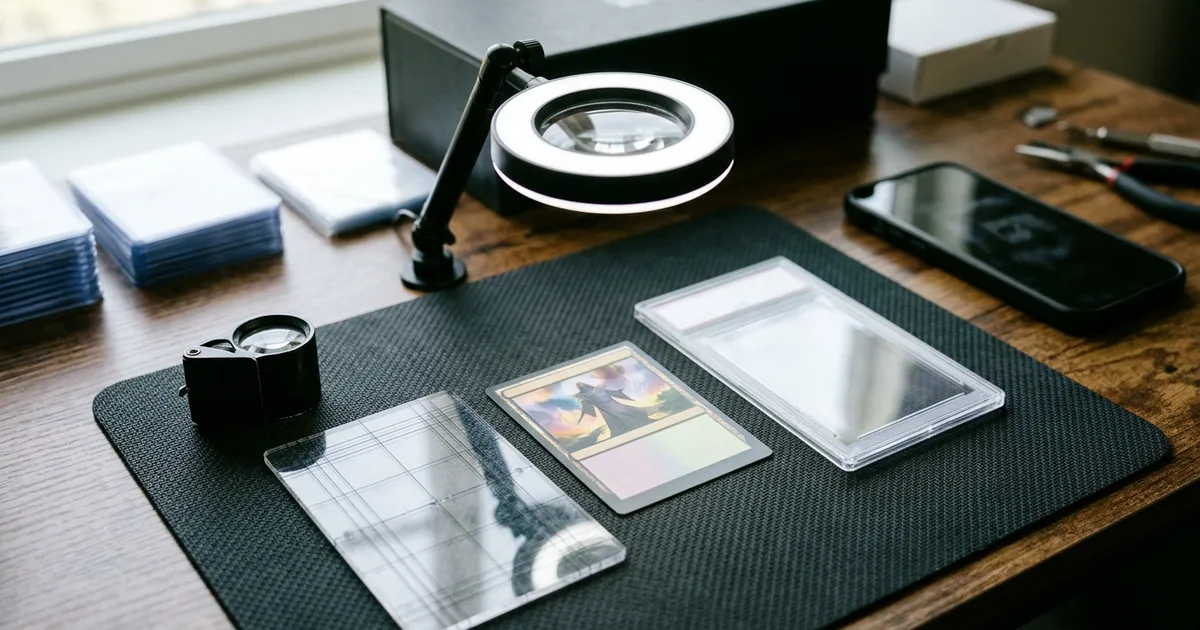
TAG card grading is a third-party grading service (Technical Authentication & Grading) that uses high-resolution imaging and computer vision to detect, measure, and score card defects. Instead of returning only a number on a label, TAG gives each card a score on a 1000-point scale, maps it to a 1-10 grade, and publishes a digital report showing where the defects are. If you care about objective, documented grading, TAG is worth a serious look. If you care mostly about maximum resale value today, PSA usually still wins.
Key takeaways
- TAG grades with imaging technology plus human oversight and attaches a 1000-point TAG Score to every card, then maps that score to a familiar 1-10 grade.
- The top of the scale is split into Pristine 10 and Gem Mint 10, so two TAG 10s are not automatically equal. Check the score.
- The digital defect report is TAG’s biggest differentiator: you can see what the grader saw, which helps when buying or selling.
- Resale liquidity for TAG slabs is generally thinner than for PSA, so TAG makes most sense for modern cards, high-condition cards, or collectors who value transparency.
- Pre-screen centering, corners, edges, and surface before paying any fee. Imaging-based grading is unforgiving of tiny flaws.
What TAG grading is and how it differs
Most grading companies rely primarily on trained human graders looking at a card under magnification and light. TAG’s pitch is different: capture the card with specialized imaging, let software detect and quantify defects, and keep humans in the loop to review and finalize. The idea is that the same flaw should produce the same deduction every time, regardless of which grader picks up the card on which day.
In practice that means three things for you as a collector:
- Consistency over intuition. A fleck of whitening is measured, not eyeballed. That cuts both ways. You lose some of the human tendency to give a beautiful card the benefit of the doubt.
- A paper trail. Each graded card has a report you can look up by cert number, showing the detected issues on the front and back. Buyers can verify why a card got its grade.
- A more granular score. A 1000-point scale separates cards that would otherwise share the same whole-number grade.
TAG grades Pokémon, sports, and other TCG cards. Supported categories, service levels, turnaround times, and fees change, so confirm current options on TAG’s official site rather than relying on any blog post, this one included.
How the TAG Score and grade tiers work
Every card gets a TAG Score, a number up to 1000. That score converts into a grade on the familiar 1-10 scale. Two details matter most:

- Two kinds of 10. TAG’s top tier, Pristine 10, is reserved for the highest scores. Gem Mint 10 sits just below it. A Pristine 10 is a statement that the imaging found essentially nothing, and it’s the label serious TAG buyers look for.
- The score inside the grade. Two cards labeled with the same grade can have meaningfully different scores. When you buy a TAG slab, look up the report and compare the score, not just the label.
TAG publishes its score-to-grade ranges and grading standards on its website, including how centering, corners, edges, and surface factor in. Those thresholds have been revised before and may be again, so pull them up directly before you set expectations for a submission.
What tends to cost points
Because defects are detected by imaging, the usual suspects show up clearly:
- Corner wear: white flecks or softening at the tip, often only visible on the back of the card.
- Edge whitening: chipping along dark-bordered backs, which modern Pokémon and many chrome sports cards are prone to.
- Surface issues: print lines, scratches, dimples, roller marks, and indentations that a quick glance misses but raking light reveals.
- Centering: measured border-to-border on both front and back.
If you want a deeper look at any single category, our guides on card edge whitening and card centering break down what to look for.
What you get in the TAG report
The report is the reason many collectors try TAG in the first place. Based on TAG’s published sample reports, it typically includes high-resolution front and back images with detected defects marked, a breakdown of how the card performed across grading categories, centering measurements, and the overall TAG Score. Exact layout and fields can change, so check a current cert lookup on TAG’s site to see the format.
Why that matters:
- For buyers: you can see whether a 9 lost points to a single corner ding or to a pile of small surface issues. The first might look better in hand.
- For sellers: you have documentation to put in a listing instead of asking buyers to trust a label.
- For learning: comparing your own pre-submission notes with the report is one of the fastest ways to calibrate your eye.
TAG vs PSA, BGS, and CGC at a glance
| TAG | PSA | BGS | CGC | |
|---|---|---|---|---|
| Core approach | Imaging and computer vision with human review | Human graders | Human graders | Human graders |
| Top grade(s) | Pristine 10, Gem Mint 10 | Gem Mint 10 | Pristine 10 / Black Label, Gem Mint 9.5 | Pristine 10, Gem Mint 10 |
| Extra detail | 1000-point score plus digital defect report | Single grade on label | Four subgrades (centering, corners, edges, surface) | Subgrades available on some services |
| Resale liquidity | Growing, thinner than PSA | Deepest for most cards | Strong, especially for high-end modern | Solid, varies by category |
Company policies, tiers, and label formats change, so treat this as a snapshot and verify on each official site. For a full breakdown of the big three, see PSA vs BGS vs CGC.
One useful reference point: PSA’s published standard for a PSA 10 allows roughly 55/45 to 60/40 centering on the front (the tolerance has been revised before) and about 75/25 on the back. Imaging-based grading tends to be at least that strict at the top end, so if your card is borderline for a PSA 10, don’t expect TAG’s top tier.
When TAG makes sense (and when it doesn’t)
TAG is a good fit when:
- You have a modern card in exceptional condition. If it’s a real Pristine candidate, the TAG label plus report can be a strong selling point among buyers who follow TAG.
- You want documentation. Personal collection cards, cards you plan to hold long term, or cards where you want to know exactly what’s wrong.
- You’re buying. A TAG slab with a public report lets you evaluate a card remotely with more confidence than a label alone.
- You’re curious how your eye compares to a measured standard. A few submissions can teach you a lot.
Skip TAG, or skip grading entirely, when:
- You’re flipping for maximum short-term resale. For most mainstream cards, a PSA 10 still sells for more than an equivalent TAG 10. Check recent sold listings for your exact card in both slabs before choosing.
- The card is worth less than the total cost. Add the grading fee, shipping both ways, insurance, and marketplace fees. If a top grade barely covers that, keep it raw.
- The card has a visible flaw. A soft corner or obvious print line will be measured precisely. Grading won’t hide it, and a mid-grade slab often isn’t worth more than the raw card.
- Vintage cards where buyers expect PSA or BGS. Some vintage markets are strongly anchored to legacy companies. Research the specific card’s sales history.
Pre-submission checklist: inspect your card like an imaging system
Do this with the card in hand before you pay any fee. You need a microfiber cloth, a penny sleeve, a 10x loupe, a small LED lamp you can angle low, and a centering overlay or millimeter ruler.
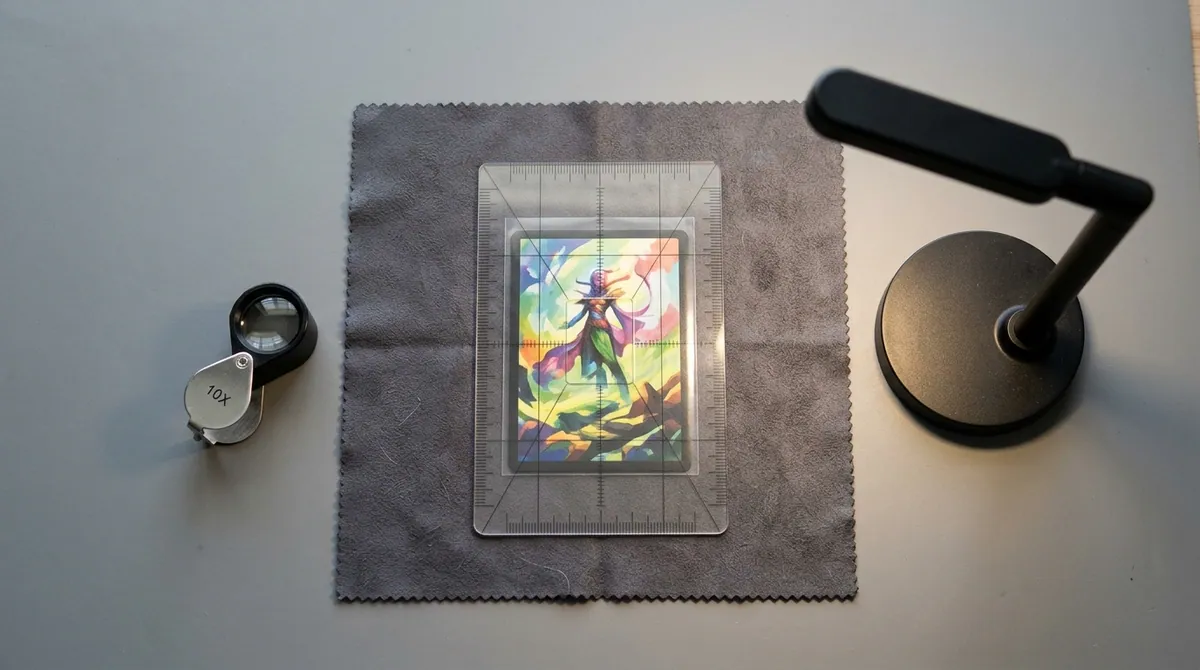
- Wash and dry your hands, then work on a clean microfiber cloth. Fingerprints and dust on your work surface create problems you’ll then try to diagnose.
- Measure front centering. Measure the left and right borders in millimeters. Divide the larger by the sum of both. For example, 2.2 mm and 1.8 mm gives 2.2 / 4.0 = 55%, so 55/45. Repeat top to bottom. Use the worse of the two axes.
- Measure back centering the same way. Backs are often worse than fronts, especially on Pokémon cards.
- Check all four corners with the loupe, front and back. Look for white fibers, rounding, or flattening at the tip. One fleck on one back corner is enough to drop out of top-tier contention.
- Run the edges. Tilt the card under the lamp and scan each edge slowly on the back. Dark borders show chipping and whitening best.
- Raking light for the surface. Set the lamp almost level with the card, around 10 to 20 degrees, and rotate the card through 360 degrees. Scratches, print lines, dimples, and indentations appear as bright or dark lines that vanish under straight-on light.
- Look for factory issues. Print lines, ink spots, and miscuts count even though you didn’t cause them.
- Check for alterations if the card is pre-owned. Uneven edges or unusual dimensions can signal trimming. See how to tell if a card is trimmed.
- Write down your honest estimate, then compare it to recent sold prices for that grade in a TAG slab and a PSA slab.
- Sleeve and protect it immediately in a penny sleeve and semi-rigid holder, following TAG’s current packing instructions.
If you fail on steps 2 through 6, that’s your signal to keep the card raw, sell it raw, or send only if you want the report for your own records.
How to pre-grade before a TAG submission with Card Grading AI
The checklist works, but it’s slow when you’re sorting a stack of 50 cards to find the three worth submitting. That’s where we built Card Grading AI to help. You photograph the front and back, and our AI card grading analyzes centering, corners, edges, and surface to give you a pre-grade estimate and flag the areas that are likely to cost points.
A practical workflow:
- Scan everything first, then hand-inspect only the cards that come back as strong candidates.
- Use the centering readout to quickly rule out cards that won’t make a top-tier grade at any company. Our card centering tool shows the left/right and top/bottom ratios.
- Track the cards you submit and their estimated values so you know whether the fee paid off. See the full list of tools on our features page.
Be clear about what this is: Card Grading AI gives you an estimate, not an official grade, appraisal, or guarantee. It doesn’t replace TAG, PSA, BGS, CGC, or any grading company, and an actual grade can differ from our pre-grade. What it does well is help you avoid paying to grade cards that were never going to come back where you hoped.
If you’re weighing TAG for your next submission, run your candidates through Card Grading AI first, check TAG’s current standards and pricing on its official site, and only send the cards that hold up under both.
FAQ
What does TAG stand for in card grading?
TAG stands for Technical Authentication & Grading. It's a third-party grading company that leans heavily on high-resolution imaging and computer vision to detect and measure defects, with human graders involved in the process, and it returns a detailed digital report alongside the slab.
Is a TAG 10 worth as much as a PSA 10?
Usually not today, at least for most mainstream cards. PSA slabs generally have the deepest resale market, so the same card often sells for more in a PSA 10 holder. TAG can still make sense for modern cards, for collectors who value the defect report, or for cards that might hit TAG's top Pristine tier. Check recent sold listings for your specific card and grade before deciding.
What is the difference between TAG Pristine 10 and Gem Mint 10?
TAG splits the top of its scale into two 10 tiers based on its 1000-point TAG Score. Pristine 10 sits at the very top of the score range and Gem Mint 10 sits just below it. TAG publishes the score ranges for each tier, and those cutoffs can change, so confirm the current numbers on TAG's official site before you submit.
Can I cross over a PSA or BGS card to TAG?
Crossover and reholder policies differ between companies and change over time, and some companies require you to crack the card out of its old slab first. Check TAG's current submission options and terms on its official site before sending a slabbed card.
Can Card Grading AI tell me what TAG will grade my card?
No app can tell you that. Card Grading AI gives you an AI pre-grade estimate based on centering, corners, edges, and surface from your photos. It's useful for deciding which cards are worth the fee, but it's not an official grade and not a substitute for TAG or any other grading company.
Keep reading
Related guides
Ready to inspect your next card?
Scan your cards instantly with Card Grading AI
Capture a clear front-and-back photo, review an AI-assisted condition estimate, and keep standout cards organized in your collection.