Collector guide
PSA 10 vs PSA 9 Explained: What Separates the Grades
PSA 10 vs PSA 9 explained: the exact centering, corner, edge, and surface differences that decide a Gem Mint grade, plus how to pre-screen cards before you submit.
By Matteo G.
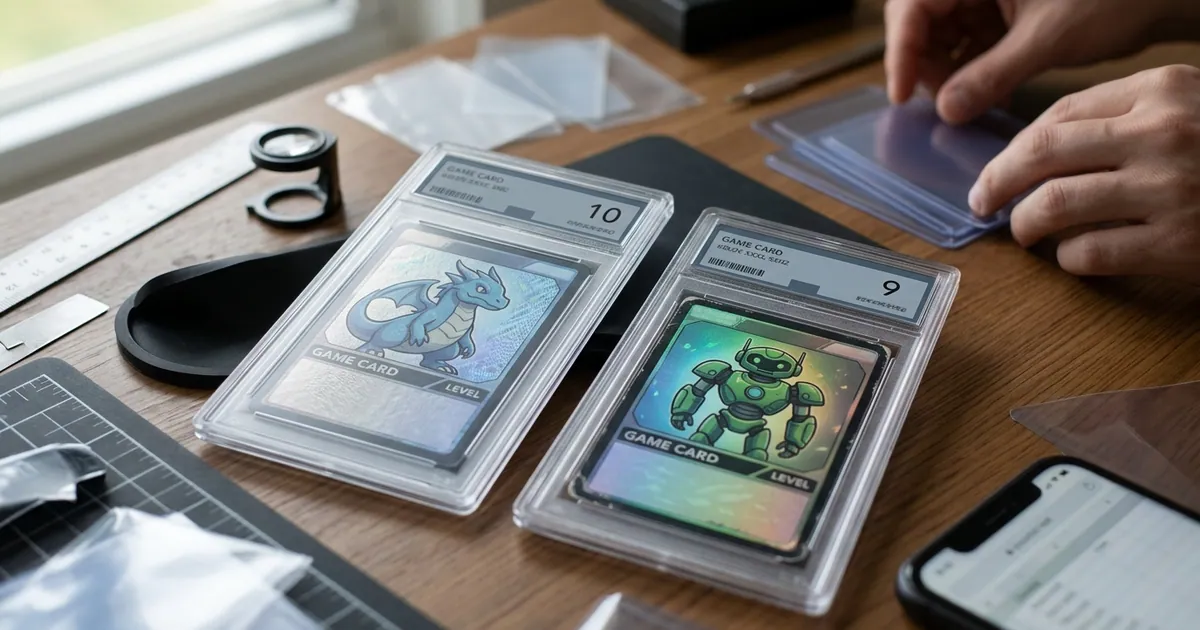
Two identical-looking cards, same set, same player, same year. One slab says PSA 10 and sells for hundreds. The other says PSA 9 and sells for a fraction of that. To a new collector, the two cards can look completely indistinguishable through the plastic — and that is exactly why understanding the line between Gem Mint and Mint is one of the most valuable skills in the hobby.
This guide breaks down what PSA actually looks for, where the 10 and the 9 diverge, why the price gap exists, and how to screen your own cards before you spend money on submission fees.
The Official Definitions, in Plain English
PSA grades on a 1–10 scale. The top two grades are the ones most modern collectors care about:
- PSA 10 (Gem Mint): A virtually perfect card. Four sharp corners, clean edges, a clear surface with no visible print defects or scratches, and strong centering — approximately 55/45 or better on the front and 75/25 or better on the back. PSA does allow an extremely subtle print imperfection that does not detract from the card’s appearance.
- PSA 9 (Mint): A superb card with one minor flaw. That flaw might be a small printing imperfection, slightly off-white borders, or centering up to roughly 60/40 on the front and 90/10 on the back.
The key word in the PSA 9 definition is one. A card with two minor issues typically drops to an 8. A card with zero visible issues and strong centering is a 10 candidate. Everything between those poles is where grading gets subjective.
The Four Subgrade Categories That Decide Everything
PSA doesn’t print subgrades on standard labels, but graders still evaluate the same four pillars. Understanding each one tells you where your card is likely to lose points.
1. Centering
Centering is the most measurable and most commonly misjudged factor. It’s expressed as a ratio of border width on opposing sides. A 55/45 left-to-right means one border is slightly wider than the other — still within Gem Mint tolerance. Push to 60/40 and you’re squarely in PSA 9 territory.
Centering is also the one factor you can measure at home with near-perfect accuracy. Our card centering guide walks through how to measure borders correctly, including the trap of measuring to the artwork instead of the printed border line.
2. Corners
Graders look at all four corners under magnification and angled light. A PSA 10 corner is sharp to a point with no whitening, fuzzing, or softness. A PSA 9 might have one corner with the faintest touch of wear — often invisible until you tilt the card against a light source.
Modern cards with dark or black borders punish corner wear brutally, because any white paper fiber shows immediately.
3. Edges
Edge chipping, nicks, and rough cuts are common on factory-fresh cards straight out of a pack. Foil and holo cards often have edge whitening from the cutting process itself. A single visible chip along a long edge is usually enough to cap a card at 9.
4. Surface
Surface is the sneakiest category. Print lines, roller marks, dimples, scratches, holo scuffs, and even a fingerprint smudge from your own handling can knock a card off Gem Mint. Holographic and chrome cards are especially vulnerable — the reflective layer shows hairline scratches that matte cardstock hides.
PSA 10 vs PSA 9: Side-by-Side
| Factor | PSA 10 (Gem Mint) | PSA 9 (Mint) |
|---|---|---|
| Front centering | ~55/45 or better | Up to ~60/40 |
| Back centering | ~75/25 or better | Up to ~90/10 |
| Corners | All four sharp, no whitening | One corner may show the slightest softness |
| Edges | Clean, no visible chipping | One minor nick or slight chipping allowed |
| Surface | No visible scratches or print defects | One minor print imperfection allowed |
| Total allowed flaws | Essentially zero | One minor flaw |
| Typical value impact | Premium tier | Often a large step down |
Why the Price Gap Is So Large
The difference between a 9 and a 10 is one small flaw. The difference in price can be 3x, 10x, or more. Three forces drive that:
Population scarcity. For most releases, PSA 9s outnumber PSA 10s significantly. When supply of the top grade is thin and demand is not, prices separate fast.
Registry and set collecting. Collectors building PSA Set Registry entries need the highest grade available. That creates a dedicated buyer pool that will only bid on 10s.
Perceived finality. A PSA 10 is the ceiling. There’s no ambiguity about whether a better copy exists in a higher grade, which makes it psychologically easier to pay a premium.
One important caveat: the gap is not universal. On high-population modern commons where tens of thousands of 10s exist, the difference between a 9 and a 10 might be a few dollars — sometimes less than the grading fee itself. Always check recent sold comps for both grades before submitting anything.
How to Pre-Screen a Card Before You Submit
Submission fees, shipping, insurance, and turnaround time add up. Screening at home is where you actually protect your money.
- Work under strong, angled light. Direct overhead light hides scratches. Tilt the card slowly against a light source and watch for surface lines and holo scuffs.
- Use a loupe or magnifier on corners. Whitening that’s invisible at arm’s length is obvious at 10x.
- Measure centering on both sides. Backs fail more often than people expect, especially on Pokémon cards.
- Check the card cold. Don’t evaluate a card you just pulled and are excited about. Emotion inflates your own grading.
- Photograph it. A high-resolution front and back scan reveals defects your eyes skip over.
Where Card Grading AI Fits In
This is the step most collectors skip. Card Grading AI lets you photograph a card and get an AI-assisted pre-grade estimate — a condition read across centering, corners, edges, and surface, with specific flags for what’s holding the card back.
It is not an official grade, an appraisal, or a guarantee. PSA, BGS, CGC, and TAG are the only entities that assign real grades. What the app does is help you triage: which cards are genuine Gem Mint candidates worth full submission cost, which are likely 9s where the economics may not work, and which should stay in the binder.
See how the analysis works on our AI card grading page, or browse the full feature list for scanning, collection tracking, and value monitoring. Pokémon collectors dealing with holo scuffs and back-centering issues should also read our Pokémon card grading guide, and sports collectors can start with the sports card grading guide.
Practical Takeaways
- The 10/9 line usually comes down to a single flaw — most often centering or a corner.
- Measure centering yourself. It’s the only factor with hard, objective numbers.
- Inspect surfaces under angled light, not overhead light.
- Check sold comps for both grades. If the spread is small, grading may not pay.
- Pre-screen before you ship. A five-minute scan is cheaper than a $25 disappointment.
Gem Mint isn’t luck. It’s pack luck plus careful handling plus honest self-assessment. Get the third part right and your submission returns will improve immediately.
Ready to check your cards? Scan your next submission candidate with Card Grading AI and see what the grader is likely to see before you pay a single fee.
FAQ
What is the actual difference between a PSA 10 and a PSA 9?
A PSA 10 (Gem Mint) card must look virtually flawless: sharp corners, clean edges, a clear surface, and centering that is roughly 55/45 or better on the front and 75/25 or better on the back. A PSA 9 (Mint) allows one minor flaw, such as slightly off centering (around 60/40 front), a small print spot, or one corner that is very slightly less than perfect. In practice, the gap is often a single defect visible only under angled light or magnification.
Why is a PSA 10 worth so much more than a PSA 9?
Scarcity and demand. For most modern sets, far more submissions land at 9 than at 10, so the Gem Mint population is smaller while registry collectors and investors compete for the top grade. On vintage cards the gap can be extreme because Gem Mint survivors are rare. On high-population modern commons, the difference may be only a few dollars, which is why checking recent sold comps for both grades matters before you submit.
Can Card Grading AI tell me if my card will get a PSA 10?
No. Card Grading AI gives you an AI-assisted pre-grade estimate and flags issues like centering, corner wear, edge chipping, and surface marks so you can decide what is worth submitting. Only PSA can assign an official grade. Treat the app as a screening tool that helps you avoid paying grading fees on cards likely to come back a 9 or lower.
Should I resubmit a PSA 9 hoping for a 10?
Only if the value gap clearly exceeds the cost of crossing over, and only if you believe the original grade was driven by a borderline call rather than a hard defect. If the card has measurable off centering or a visible surface scratch, a resubmission will almost certainly return the same grade. Re-photograph the card and re-examine it under angled light before spending more money.
Keep reading
Related guides
Ready to inspect your next card?
Scan your cards instantly with Card Grading AI
Capture a clear front-and-back photo, review an AI-assisted condition estimate, and keep standout cards organized in your collection.