Collector guide
Should I Grade My Pokemon Cards? A Practical 2026 Guide
Not every Pokemon card is worth grading. Learn the value thresholds, real costs, condition red flags, and a simple checklist to decide before you submit.
By Matteo G.
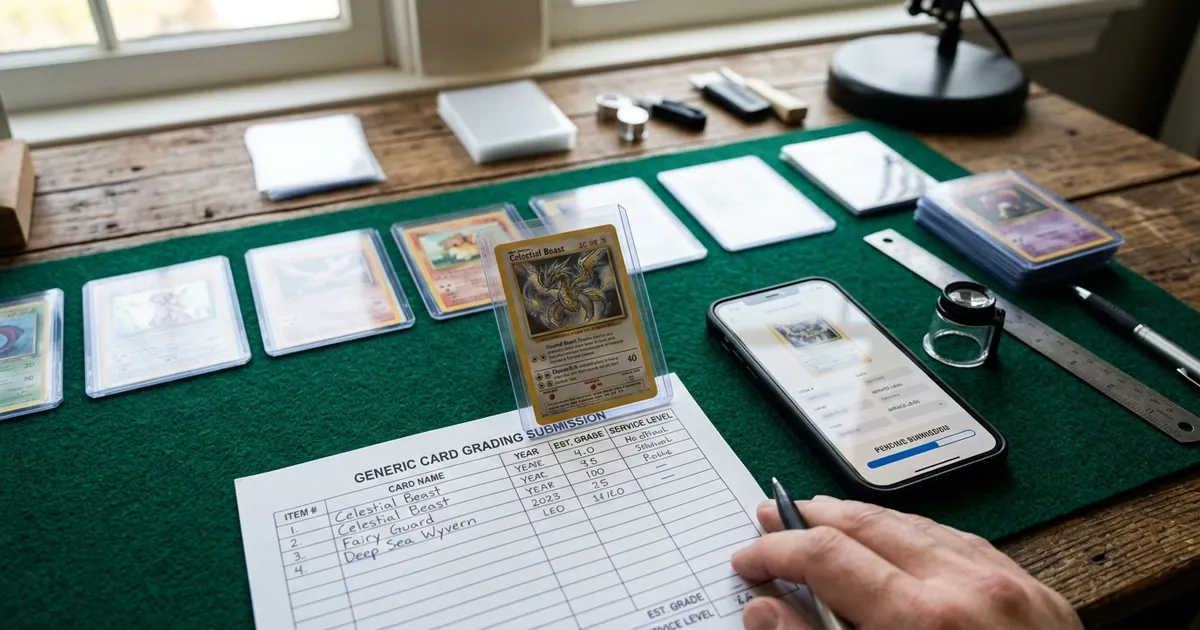
You pulled a Charizard. Or you found a shoebox from 1999 in your parents’ basement. The first question almost every collector asks is the same: should I grade my Pokemon cards, or just leave them raw?
The honest answer is that most Pokemon cards should never be graded. Grading fees, shipping, insurance, and months of wait time only make sense on a narrow slice of cards. But when it does make sense, the value difference can be dramatic. This guide walks through the actual math, the condition red flags that sink submissions, and a repeatable process you can use before you ever fill out a submission form.
The short answer: grade when the math works
Grading adds value in three situations:
- The card is valuable raw and a high grade multiplies that value.
- The card is a key vintage piece where authentication matters to buyers.
- You want long-term protection for something you have no intention of selling.
Outside of those, a slab is usually just an expensive plastic case. A common from a modern set that sells for $3 raw does not become a $100 card because it is in a holder. Even a perfect 10 on a low-demand card often sells for less than the total cost of getting it graded.
Step 1: Find the raw value before anything else
You cannot decide whether to grade until you know what the card is worth right now, in hand, ungraded. Check recent completed sales, not asking prices. Look at eBay sold listings, marketplace sales history, and price-tracking tools. Then look up what the same card sells for in a PSA 9 and a PSA 10.
That spread is your whole business case. Write down three numbers:
- Raw value
- Graded 9 value
- Graded 10 value
If the jump from raw to a 9 is small, you are betting everything on a 10, and that is a coin flip at best on most modern cards. Our guide on checking a card’s value can help you match your card to the right set and variant, which matters enormously — a shadowless or 1st Edition stamp can change the value by an order of magnitude.
Step 2: Add up the real cost
Collectors routinely underestimate this. The submission fee is only part of it.
- Grading fee — entry tiers at the major companies typically start in the mid-teens to mid-twenties per card, with declared-value tiers climbing from there. Always check current rates on the grader’s own site, since they change.
- Shipping to the grader — with tracking and insurance, not a plain envelope.
- Return shipping and insurance — often billed per submission.
- Supplies — card savers, penny sleeves, team bags, a sturdy box.
- Your time — filling out forms, packing, and waiting weeks or months.
Realistically, a single card submitted alone often costs $25-$40 all in. Bulk submissions of 20+ cards bring the per-card cost down significantly, which is why most experienced collectors save up a batch instead of sending one-offs.
Step 3: Judge the condition honestly
Graders evaluate four things. Be your own harshest critic on each.
Centering. Compare left/right and top/bottom borders on the front, then the back. Modern Pokemon printing is inconsistent, and off-center borders are the single most common reason a beautiful card comes back a 9 instead of a 10. If you’re not sure what “acceptable” looks like, read our breakdown of card centering.
Corners. Use a loupe or your phone’s macro mode. Any whitening, fuzz, or softness on a single corner is enough to cap the grade.
Edges. Holos and full-arts chip easily. Tilt the card and look along each edge for silvering or nicks.
Surface. Angle the card under a single light source and rotate it. Print lines, scratches, dimples, and holo scuffs all show up this way and are invisible under flat overhead light.
Which Pokemon cards are usually worth grading
| Card type | Typical verdict | Why |
|---|---|---|
| Base Set Charizard, Blastoise, Venusaur | Almost always grade | High raw value, huge grade multiplier, authentication matters |
| 1st Edition / shadowless vintage holos | Usually grade | Buyers pay a premium for verified condition and authenticity |
| Modern chase cards (alt arts, special illustration rares) | Grade only if near-mint or better | Value gap between 9 and 10 is large, but so is the failure rate |
| Vintage commons and non-holos | Rarely | Raw value too low to clear fees |
| Played childhood cards | Rarely | Likely 6-8 range where fees exceed the value bump |
| Sentimental favorites | Your call | Preservation and display, not profit |
| Bulk modern holos | No | Better sold or traded raw |
When you should not grade
- The raw value is under roughly $50 and you don’t have a strong 10 candidate.
- You can already see a flaw with your naked eye.
- The card is a reprint or a low-demand variant with thin sales history.
- You need the money soon — turnaround times can stretch for months.
- You are grading only because the card “feels” rare. Feelings are not sales data.
Also remember: a low grade does not damage the card, but it does publish a verdict. A raw near-mint card lets buyers dream. A slabbed 7 does not.
Reasons to grade even when the math is marginal
Profit isn’t the only motive, and that’s fine. Some collectors grade to:
- Protect a card they’ll own for decades
- Display a set in a uniform, sealed presentation
- Authenticate a vintage card before selling to a cautious buyer
- Complete a registry set with a specific grading company
Just be clear with yourself which goal you’re chasing so you don’t feel burned by a 9 on a card you were never going to sell anyway.
Pre-screen your submission before you pay
The most expensive grading mistake is sending cards that were never going to grade well. That’s exactly the gap Card Grading AI is built to close.
Snap photos of the front and back with your phone and the app analyzes centering, corners, edges, and surface to produce an AI pre-grade estimate — a realistic range, not a promise. You can scan a whole stack in a sitting, keep the strong candidates, and pull the obvious 8s out of your submission before they cost you money.
A few things to be clear about: these are estimates, not official grades. Card Grading AI is not affiliated with PSA, BGS, CGC, or TAG, and nothing in the app replaces their evaluation. What it does is help you triage, so your submission money goes toward cards that actually have a shot.
Start with Pokemon card grading for set-specific guidance, see how AI card grading works to understand what the analysis actually measures, and check pricing to find the plan that fits how many cards you’re screening.
Your five-question checklist
Before you submit any Pokemon card, answer these:
- What does this card sell for raw, based on completed sales?
- What does it sell for in a 9? In a 10?
- Is the raw-to-graded spread bigger than my all-in cost per card?
- Have I inspected centering, corners, edges, and surface under angled light?
- Does my pre-grade estimate support the grade I’m counting on?
If you can answer all five with confidence and the numbers still work, submit. If you’re guessing on any of them, wait, gather more cards for a bulk submission, and screen them properly first. Patience costs nothing. Grading the wrong cards costs real money.
FAQ
Is it worth grading a Pokemon card worth $20 raw?
Usually not. With entry-tier grading fees plus shipping and insurance often landing in the $20-$35 range per card, a $20 raw card needs a very strong shot at a top grade to break even. Most collectors set a raw-value floor of roughly $50-$75 before submitting, unless the card has sentimental value or is part of a set they want slabbed.
How can I tell if my Pokemon card will get a PSA 10?
You can't know for certain, but you can screen for the four things graders weigh most: centering, corners, edges, and surface. Look at the card under angled light for print lines and scratches, check border symmetry front and back, and inspect corners with magnification. Card Grading AI gives you an AI-based pre-grade estimate from photos so you can spot obvious knockouts before paying submission fees. It is an estimate only, never an official grade.
Should I grade sealed-pack pulls or old childhood cards?
Fresh pack pulls from modern sets are the best candidates because they haven't been handled, but modern print quality still fails on centering and edge chipping. Childhood cards are usually played-with and land in the 6-8 range, where fees rarely pay off unless the card is a high-value vintage holo like Base Set Charizard.
Does grading hurt a card's value if it comes back low?
A low grade doesn't damage the card, but it does lock in a public opinion that can cap the price. A raw card lets buyers imagine a 9 or 10; a slabbed PSA 7 removes that upside. That's why pre-screening matters most for borderline cards where the gap between grades is large.
Keep reading
Related guides
Ready to inspect your next card?
Scan your cards instantly with Card Grading AI
Capture a clear front-and-back photo, review an AI-assisted condition estimate, and keep standout cards organized in your collection.