Collector guide
TAG vs PSA Grading: Which Should Get Your Card?
TAG vs PSA grading compared: scoring, Pristine vs Gem Mint 10s, resale value, reports, and a checklist to decide where your card should go.
By Matteo G.
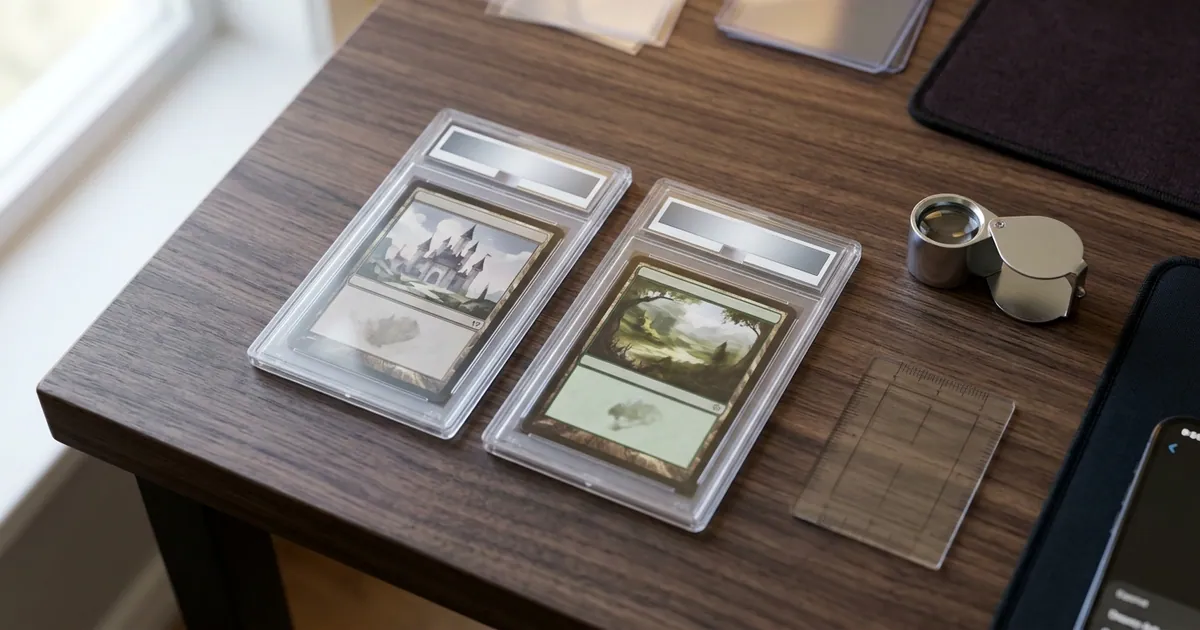
If you want the most recognized, most liquid slab for reselling a card in the US, PSA is still the default choice. If you want to know exactly why your card got its grade, TAG gives you much more information per submission: measured centering, a defect map, and a numeric score behind the grade. Which one is right depends on the card, its condition, and whether you plan to sell it or keep it.
Key takeaways
- PSA wins on market recognition. Its sales history, population data, and buyer familiarity are the deepest in the hobby, which usually means easier resale.
- TAG wins on transparency. You get an imaging-based report showing where defects are and how centering measured, instead of just a number.
- The top grades aren’t equivalent. TAG splits its top grade into Pristine 10 and Gem Mint 10. PSA has a single Gem Mint 10, and PSA grades can carry qualifiers like OC.
- Check sold comps for your exact card in both slabs before choosing. Price premiums vary by card and category, and thin sales data is a real liquidity risk.
- Pre-grade before you pay either company. Most disappointing grades trace back to centering or surface flaws you can catch at home.
TAG vs PSA at a glance
| PSA | TAG | |
|---|---|---|
| Track record | Grading since 1991 | Launched in the early 2020s |
| Grading approach | Human graders working from published standards | Imaging-driven defect detection and measurement, with human oversight |
| What the grade is based on | Grader assessment on a 1-10 scale, including half grades | A 1,000-point TAG Score converted to a 1-10 grade |
| Top grade | Gem Mint 10 | Pristine 10, then Gem Mint 10 |
| Explanation of the grade | None beyond the number and any qualifier | Digital report with flagged defects and centering measurements |
| Resale recognition | Strongest in the US market | Growing; varies a lot by category and card |
| Population data | Very large, long history | Smaller and newer |
Policies, tiers, and scale details at both companies change from time to time. Confirm specifics on each company’s official site before you submit.
How each company actually grades
PSA uses trained human graders who judge corners, edges, surface, and centering against standards published on its website. Centering is the one area with hard numbers. PSA’s published Gem Mint 10 standard calls for roughly 55/45 to 60/40 or better on the front and about 75/25 or better on the back. A PSA 9 allows roughly 60/40 to 65/35 on the front and 90/10 on the back. PSA has revised this wording before, so check the current grading standards page. Our breakdown of PSA 10 centering requirements covers how to measure against those ratios.
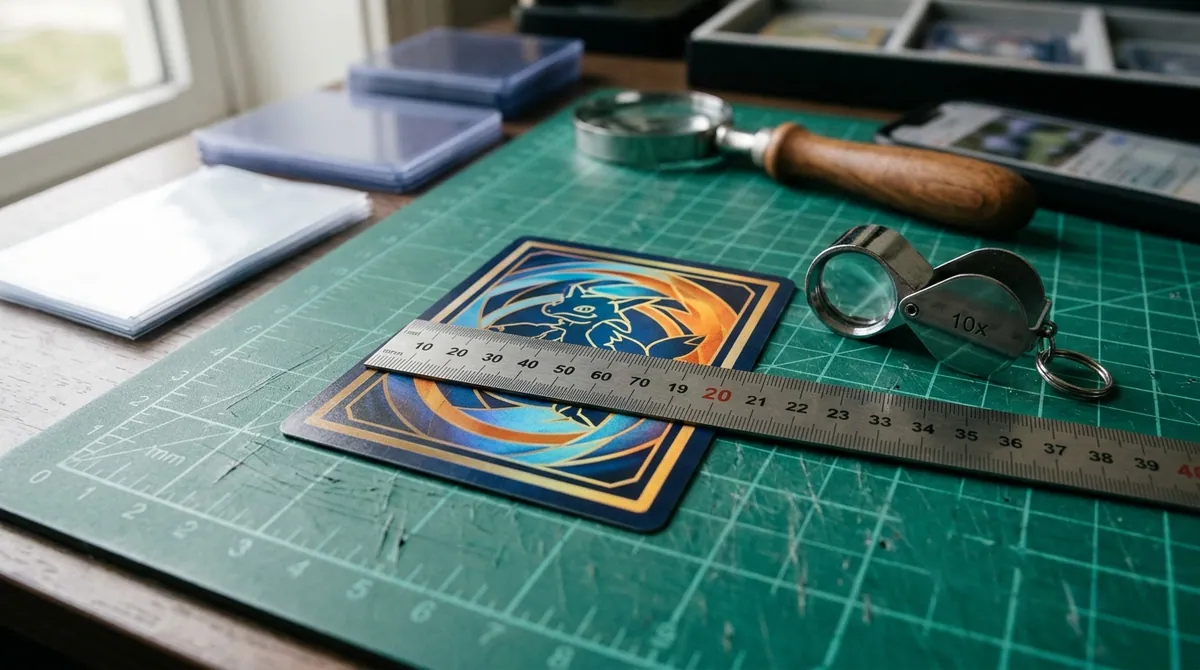
What you get back is a single number. If you expected a 10 and got a 9, PSA won’t tell you whether it was a corner, a print line, or a back-border measurement. You have to work that out yourself.
TAG builds its process around imaging. Its system captures the card, detects and scores defects, and measures centering. That produces a TAG Score out of 1,000, which converts to a familiar 1-10 grade. The report shows the flagged defects with images, so you can see the corner ding or surface scratch that cost you points. If you want more background on how TAG works on its own, read our TAG card grading guide.
In practice, PSA’s process relies on expert judgment, and a borderline card can land a half grade either way depending on how it’s viewed. TAG’s process is built to be repeatable and to show its work. Neither approach makes your card’s flaws disappear. They just report them differently.
Not every 10 is the same 10
This is where many TAG vs PSA comparisons get sloppy.
- PSA 10 (Gem Mint) is a single top tier. It’s the benchmark most US buyers know, and it’s the grade most price guides track.
- TAG Pristine 10 sits above TAG Gem Mint 10. Both are labeled 10, but they are different grades with different scores behind them and often different prices. Check TAG’s site for the current score thresholds.
- PSA qualifiers can change the value of an otherwise high grade. Examples include OC (off-center), ST (staining), PD (print defect), OF (out of focus), MK (marks), and MC (miscut). A PSA 9 OC typically sells well below a clean PSA 9.
When you compare prices, line up equivalent grades. A TAG Gem Mint 10 isn’t a TAG Pristine 10, and neither one is a PSA 10 in a buyer’s eyes.
Resale value and liquidity
For most cards, the PSA slab is the easiest to sell. Buyers know it, comps exist for almost everything, and auction houses and marketplaces treat PSA 10s as the reference price. That depth is PSA’s biggest advantage. It has little to do with grading accuracy.
TAG’s resale picture is uneven. It has gained traction with modern Pokemon and some sports collectors, and Pristine 10s can draw strong prices. For other cards, though, there may be only a handful of TAG sales, or none. A thin market means wider price swings and slower sales.
Here’s how to check comps for your card:
- Search sold listings, not active ones, for the exact card, set, and parallel.
- Pull recent sales for PSA 9, PSA 10, TAG Gem Mint 10, and TAG Pristine 10.
- Count the sales. Three sales spread over a year are not a reliable price.
- Check the grade one step below the one you’re hoping for. That’s the realistic downside.
Some collectors crack TAG slabs and resubmit to PSA, or the other way around. That costs a second fee, risks damaging the card when you open the case, and the new grade can come back lower. Plan your first submission so you don’t need a second one.
Cost, turnaround, and what you get back
Both companies price service tiers by the card’s declared value and turnaround speed, and both change fees and turnaround times often. We’re not quoting numbers here because they go stale quickly. Check current pricing on each official site and add:
- Shipping both ways, plus insurance
- Upcharges if the graded card’s value exceeds your declared tier
- Your time, since slower tiers can tie up a card for weeks or longer
With PSA, you get the slab and a cert number you can verify online. With TAG, you get the slab plus the digital report. If you’re still learning what graders penalize, that report is worth something in itself, because it shows you what to look for on your next batch.
Which should you choose?
Choose PSA if:
- You plan to sell the card and want the broadest buyer pool.
- The card’s value depends on a PSA 10 premium that’s well established in sales data.
- It’s a vintage or high-end card where PSA’s long population history matters to buyers.
Choose TAG if:
- You want measured, documented feedback on why the card graded the way it did.
- You think the card could reach Pristine, and you’ve confirmed Pristine sales exist for it.
- You’re keeping the card and care more about documentation than resale.
Consider either if your comps show similar prices for both slabs at the grade you realistically expect. Then turnaround and cost can decide it.
For category-specific tips, see our guides to Pokemon card grading and sports card grading.
Pre-submission checklist: card in hand
Work through this checklist before you pay either company. You’ll need a 10x loupe, a millimeter ruler or a centering tool, a small LED flashlight, and a microfiber cloth.
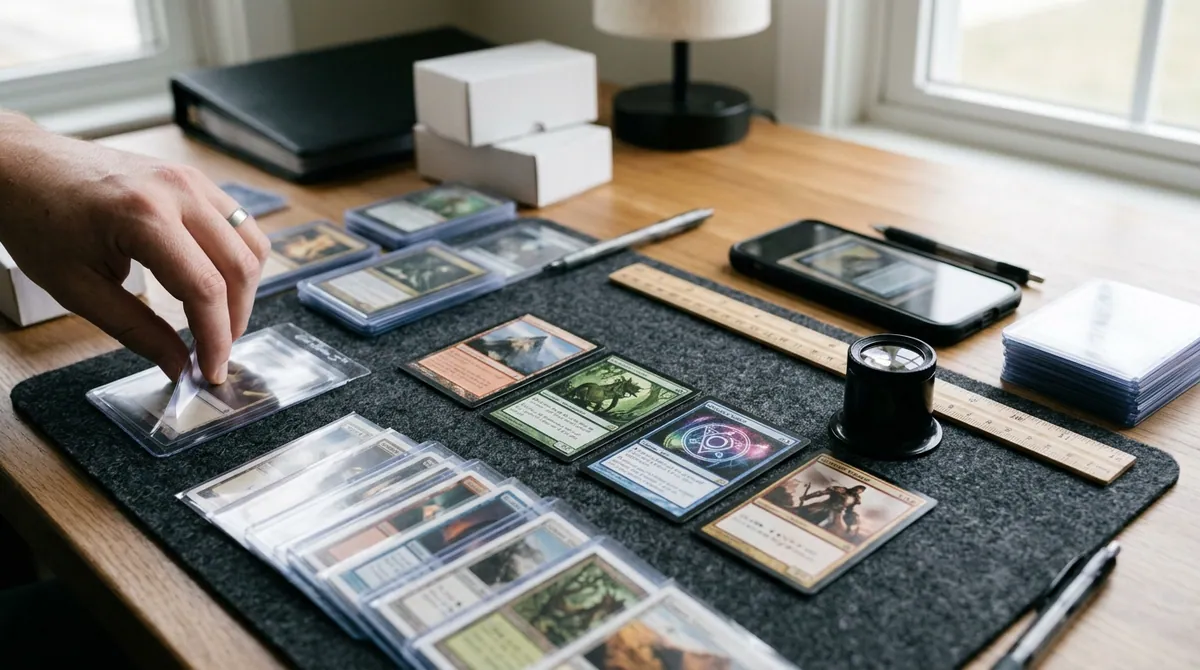
- Prep your hands and workspace. Wash and dry your hands, and work on a clean, soft surface. Handle the card by its edges.
- Measure front centering. Measure the left and right borders in millimeters and convert them to a ratio. For example, 2.2 mm and 1.8 mm gives 55/45. Do the same for top and bottom. If either axis is worse than about 60/40, a PSA 10 is unlikely. Use the card centering tool if you’d rather not do the math.
- Measure back centering. PSA’s back tolerance is looser (about 75/25 for a 10), but a badly shifted back still costs points at both companies.
- Inspect all four corners under the loupe. Look for white specks, soft or rounded tips, and fraying. One soft corner usually rules out a 10.
- Check edges, especially on the back. Dark borders show whitening and chipping fast. Run the loupe along all four edges.
- Rake the surface with light. In a dim room, hold the LED almost flat to the card and slowly tilt the card. Hairline scratches, print lines, dimples, and indents show up as shadows or bright lines. Repeat on the back.
- Check under soft, even light. Diffuse daylight helps you spot staining, gloss loss, and print defects that raking light can miss.
- Pull comps at your realistic grade. Price the grade one step below your hope in both PSA and TAG slabs.
- Run the math. Compare fees plus shipping plus insurance to the value at the realistic grade, not the dream grade.
- Package according to current instructions. Use a penny sleeve and whatever holder the company currently requests. PSA has long preferred semi-rigid card savers, but confirm before you ship.
When not to grade with either
Sometimes neither company is the right answer.
- The math doesn’t work. If the realistic graded value doesn’t clearly beat the raw value plus all fees, skip it unless the card matters to you personally.
- There’s a visible crease, dent, or surface scuff. Both companies will catch it, and the grade will reflect it.
- Centering is clearly outside the 10 window on a modern card where only 10s carry a real premium. A 9 often sells for little more than the raw card.
- You’re chasing a grade through repeated resubmissions. Each attempt adds a fee, and the card’s condition won’t improve.
- You need a fast sale in a category with thin TAG comps. Choose PSA, or sell raw.
- You want to learn from the result. In that case PSA’s bare number won’t help much, and TAG’s report is the better tool.
Where Card Grading AI fits
TAG and PSA both charge you to find out what condition your card is in. Card Grading AI helps you estimate that before you pay. Scan the front and back with your phone. We measure centering and flag likely corner, edge, and surface issues, then give you a pre-grade estimate you can compare to PSA’s published centering standards and your own comps.
To be clear, our results are estimates, not official grades or appraisals, and they don’t replace PSA, TAG, or any other grading company. They help you decide which cards are worth a submission fee, which tier to choose, and which cards to leave raw. You can see plan options on our pricing page. Run your next batch through Card Grading AI before you fill out a submission form.
FAQ
Is TAG grading better than PSA?
Neither is better for every card. PSA has the longest track record, the largest population data, and the most recognized slab in the US resale market. TAG gives you a detailed report with measured centering and flagged defects, plus a split top grade (Pristine 10 and Gem Mint 10). If resale liquidity matters most, PSA is usually the safer default. If you want transparency and detailed feedback, TAG offers more information per card. Compare recent sold prices for your exact card in both slabs before deciding.
Is a TAG 10 worth the same as a PSA 10?
Not automatically. Prices depend on the specific card, the category, and how many recent sales exist for each slab. For many cards, PSA 10s have deeper and more consistent sales history. TAG Pristine 10s are positioned above TAG Gem Mint 10s, and some sell well, but you should check recent sold listings for your card in both grades. Don't rely on a general rule.
Can I send a TAG-graded card to PSA?
Collectors do crack TAG slabs and resubmit raw cards to PSA, but you pay a second fee and risk damaging the card when you open the case. PSA has offered crossover review for cards in other companies' holders, but availability and rules change. Confirm the current crossover policy on PSA's official site before you plan around it.
Does PSA tell you why a card got its grade?
No. PSA assigns a single grade, sometimes with a qualifier such as OC for off-center. It doesn't provide a defect-by-defect breakdown. TAG's main selling point is the report that shows where defects were found and how centering measured.
Can Card Grading AI tell me whether my card will get a PSA 10 or TAG Pristine?
No tool can guarantee an official grade. Card Grading AI gives you an AI pre-grade estimate from your photos. It measures centering and flags likely corner, edge, and surface issues so you can decide whether a card is worth submitting and which tier makes sense. The official grade always comes from the grading company.
Keep reading
Related guides
Ready to inspect your next card?
Scan your cards instantly with Card Grading AI
Capture a clear front-and-back photo, review an AI-assisted condition estimate, and keep standout cards organized in your collection.