Collector guide
CGC Grading Prices: Tiers, Fees, and When It Pays
CGC grading prices explained: how tiers, declared value caps, and hidden fees add up, plus a checklist to decide if a card is worth the cost to grade.
By Matteo G.
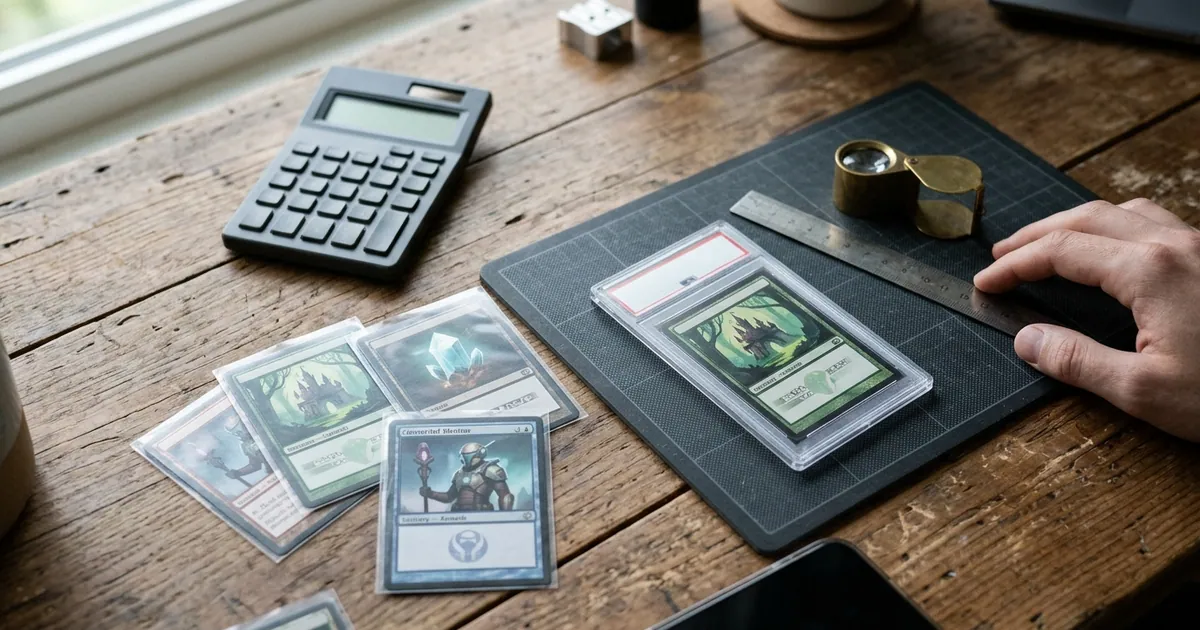
CGC grading prices are set by service tier. Each tier has a per-card fee, an estimated turnaround, and a cap on how much each card can be worth. The cheapest tiers are built for lower-value bulk cards, and faster or higher-value tiers can cost many times more. Shipping, insurance, and handling come on top. The real question isn’t what CGC charges. It’s whether the grade your card is likely to get covers your total cost.
Key takeaways
- CGC prices card grading per card by tier, and tiers are defined by turnaround time and maximum declared value. Fees change, so confirm current numbers on the official CGC Cards site before you submit.
- Your real cost is the grading fee plus shipping both ways, insured return shipping, any handling or membership costs, and possible upcharges if the card is worth more than your tier’s cap.
- Do the break-even math using the grade you’ll most likely get, not the grade you hope for. A card that only profits at a 10 is a gamble.
- Don’t grade cards whose likely-grade value barely beats raw value plus fees, unless you want the slab for your own collection.
- An AI pre-grade from Card Grading AI can flag centering and surface problems before you spend money. It is an estimate, not an official grade.
How CGC prices card grading
CGC Cards grades Pokemon, Magic, Yu-Gi-Oh!, sports cards, and other TCGs. Its sports grading absorbed the former CSG brand, so most collectors now see one CGC fee schedule. Like PSA and Beckett, CGC sorts submissions into tiers. Every tier has three variables:
- Price per card. The headline number.
- Maximum declared value per card. The highest value a card in that tier can be worth after grading. Cheap tiers have low caps.
- Estimated turnaround. Faster tiers cost more. Posted turnarounds are estimates and can slip during busy periods.
Some lower-cost tiers have had minimum card counts, and some discounts or tiers have required a paid collector membership. These rules have changed over time, so check the current submission page rather than trusting a forum post from last year.
As a rough orientation only: CGC’s lowest-cost bulk-style tiers have historically run from the low-to-mid teens up to around $20 per card. Standard and express tiers have run from tens of dollars up to a few hundred for fast, high-value service. Treat these as ballpark history, not a quote. The live fee table on CGC’s site is the only number that counts.
What actually goes into your total cost
The headline fee is often 60 to 80 percent of what you actually spend per card on a small submission. Here’s what to add up:

| Cost component | What drives it | How to keep it down |
|---|---|---|
| Grading fee | Tier chosen | Pick the cheapest tier whose value cap fits your card |
| Shipping to CGC | Box weight, carrier, insurance on the way in | Batch cards into one submission |
| Return shipping and insurance | Total declared value of the order | Declare honestly, since over-declaring raises insurance |
| Handling or per-order fees | CGC’s current policy | Fewer, larger submissions spread this out |
| Membership (if required) | Tier access or discounts | Only worth it if you submit regularly |
| Upcharge | Graded value exceeds tier cap | Estimate declared value from real sold comps |
| Supplies | Sleeves, semi-rigid holders, box | Minor, but count them |
The upcharge is the one people forget. If you put a card in a low-cap tier and it comes back as a 10 worth more than that cap, expect to be billed the difference to the correct tier. That’s a good problem to have, but budget for it on cards with a big 9-to-10 jump.
For a side-by-side look at how PSA structures the same costs, see our PSA grading cost and tiers guide.
Picking the right CGC tier
Choose your tier by value cap first, turnaround second.
- Use the cheapest tier whose cap covers the card’s realistic graded value. If a CGC 10 of your card sells for $120 and the bulk tier cap is lower than that, you’re in a higher tier. Ignoring this just means a surprise upcharge.
- Only pay for speed if timing matters. Examples: a card spiking after a tournament result, a rookie during a hot streak, or a sealed-product release window. For most PC cards, the slow tier is the right tier.
- Group cards by value. Don’t push a $25 card into an expensive tier because one $400 card in the same box needs it. Split them into separate tiers or separate submissions.
- Decide on subgrades deliberately. CGC has offered subgrades as an option on some services. They can help sell high-end cards to buyers who care about the breakdown, but they add cost. Check whether they’re currently available and priced for your tier.
The break-even math before you submit
This is where most grading decisions go wrong. People price the card at a 10 and send it in. Do this instead.
Step 1: Pull sold comps, not asking prices. For your exact card, set, and variant, find recent sold prices (last 30 to 90 days) for raw near-mint copies, CGC 9, CGC 10, and Pristine 10 if any exist.
Step 2: Total your cost per card. Grading fee + your share of shipping, insurance, and handling + selling fees if you plan to sell. Marketplace fees often take 10 to 15 percent, so include them.
Step 3: Run the numbers at each likely grade. Here’s an illustrative example with round, made-up numbers:
- Raw value: $40
- CGC 10 sold comps: $150
- CGC 9 sold comps: $55
- CGC 8 sold comps: $35
- All-in grading cost per card: $26
At a 10, you net about $84 over selling raw before selling fees. At a 9, you lose about $11. At an 8, you lose about $31. Unless you’re genuinely confident in a 10, that card is a coin flip that costs you $26 to play.
Step 4: Weight by honest odds. Suppose you think the card is 30 percent likely to get a 10, 50 percent a 9, and 20 percent an 8. The expected graded value is roughly $80. Subtract the $40 raw value and $26 cost and you have a thin margin. Marketplace fees would mostly erase it.
The rule of thumb: if the card loses money at the grade you’re most likely to get, don’t submit it for profit. If you’re not sure whether a card is a candidate at all, start with should I grade my Pokemon cards.
Pre-submission checklist with the card in hand
Work through this before you fill out the submission form. You need a sleeve, a small ruler or phone, a 10x loupe, and a single bright LED light.

- Sleeve it and handle by the edges. Fingerprints on holo surfaces show up under grading lights.
- Measure centering, front and back. Measure the left vs. right border and the top vs. bottom border, then express each as a ratio, such as 55/45. PSA publicly lists 55/45 front and 75/25 back for a 10, and that’s a useful benchmark. CGC publishes its own scale with centering expectations by grade, and Pristine 10 demands essentially perfect centering. Check CGC’s grading scale page for current tolerances. Our card centering tool does the ratio math from a photo.
- Inspect the surface under raking light. Hold the LED low, nearly parallel to the card, and tilt the card slowly. Look for hairline scratches, print lines, indentations, and roller marks. Foils and holos show scratches worst, so check them at several angles.
- Check all four corners with the loupe. Look for white fraying, rounding, or soft spots. One fuzzy corner usually takes a card out of 10 range.
- Check edges, especially the back. Dark-bordered backs show whitening and chipping clearly. Run your eye along all four edges under the light.
- Look for factory flaws. Miscuts, crimps on pack-fresh cards, and ink spots count against the grade even though you didn’t cause them.
- Write down an honest grade range, such as 8 to 9 or 9 to 10. If you can’t rule out an 8, price it as an 8.
- Pick the tier whose value cap covers the top of that range, then confirm the live price on CGC’s site.
- Run the break-even math from the section above with your real numbers.
When CGC grading is not worth the fee
Be willing to skip grading. Don’t submit when:
- The card’s raw value is close to the fee. A $15 card in a $20 tier only makes sense if you want it slabbed for your binder.
- The 9 and 10 prices are both near raw. Many modern cards have large populations of graded copies, and the slab premium is small.
- You found a defect in the checklist. Visible whitening, a soft corner, or an off-center back won’t get better in a slab.
- Buyers of that card pay more for another slab brand. Premiums vary by category and change over time. For some cards, the same grade sells higher in one company’s slab. Compare sold comps across brands before choosing. Our PSA vs BGS vs CGC comparison covers the broader differences.
- You need the money back fast. Turnaround estimates can stretch. Don’t tie up cash you’ll need before the cards return.
There are good reasons to grade below break-even: authentication on a card you plan to keep, long-term protection, or a personal-collection slab you just want. Make that choice deliberately rather than by accident.
Using Card Grading AI before you pay CGC
The cheapest grading fee is the one you don’t pay on a card that was never going to make it. That’s what we built Card Grading AI for. Photograph the front and back, and the app estimates centering ratios and flags likely corner, edge, and surface issues. You get a pre-grade range to plug into the break-even math above. It works on web, iOS, and Android, and our Pokemon card grading page shows how it handles holos and full-art cards.
To be clear about what it is: Card Grading AI provides estimates, not official grades, appraisals, or guarantees. CGC’s graders decide the grade on your label. Use the app to sort your stack into likely candidates and cards to leave raw, then confirm the borderline ones with your own loupe. You can see plan options on our pricing page. Pre-screening a box before submission usually costs less than one wasted grading fee.
FAQ
How much does CGC charge to grade a card?
It depends on the service tier. Tiers are priced per card and set by turnaround speed and a maximum declared value per card. Cheaper bulk-style tiers have historically cost in the teens to around $20 per card, and fast or high-value tiers can reach hundreds of dollars. Shipping, insurance, and handling are extra. CGC changes its prices, so check the current fee schedule on the official CGC Cards site before you submit.
What is the declared value on a CGC submission?
Declared value is your estimate of what the card will be worth after grading. It determines which tiers you can use and how much return insurance costs. If the graded card is worth more than your tier's cap, expect to be upcharged to the correct tier. Base it on recent sold prices for that card at the grade you realistically expect.
Is CGC cheaper than PSA?
Sometimes, at certain tiers and times, but the per-card fee is only half the question. Graded cards of the same card and grade can sell for different prices depending on the slab brand, so compare recent sold prices for CGC and PSA copies of your specific card. Then compare total cost, including shipping and insurance, not just the headline fee.
What is a CGC Pristine 10?
Pristine 10 is CGC's top grade, above Gem Mint 10. CGC describes it as essentially flawless, including under magnification, with near-perfect centering. Very few cards reach it, so don't use Pristine prices to justify a submission unless the card looks flawless under a loupe and measures close to 50/50.
Can Card Grading AI tell me what CGC will grade my card?
No. Card Grading AI gives an AI pre-grade, an estimate based on photos of centering, corners, edges, and surface. It can help you decide whether a card is worth paying a CGC fee for, but it is not an official grade, appraisal, or guarantee, and CGC's graders make the final call.
Keep reading
Related guides
Ready to inspect your next card?
Scan your cards instantly with Card Grading AI
Capture a clear front-and-back photo, review an AI-assisted condition estimate, and keep standout cards organized in your collection.