Collector guide
How to Tell If a Card Is Trimmed: A Collector's Checklist
How to tell if a card is trimmed: measure against set-mates, read edge texture, check corners and centering, and know when grading isn't worth the fee.
By Matteo G.
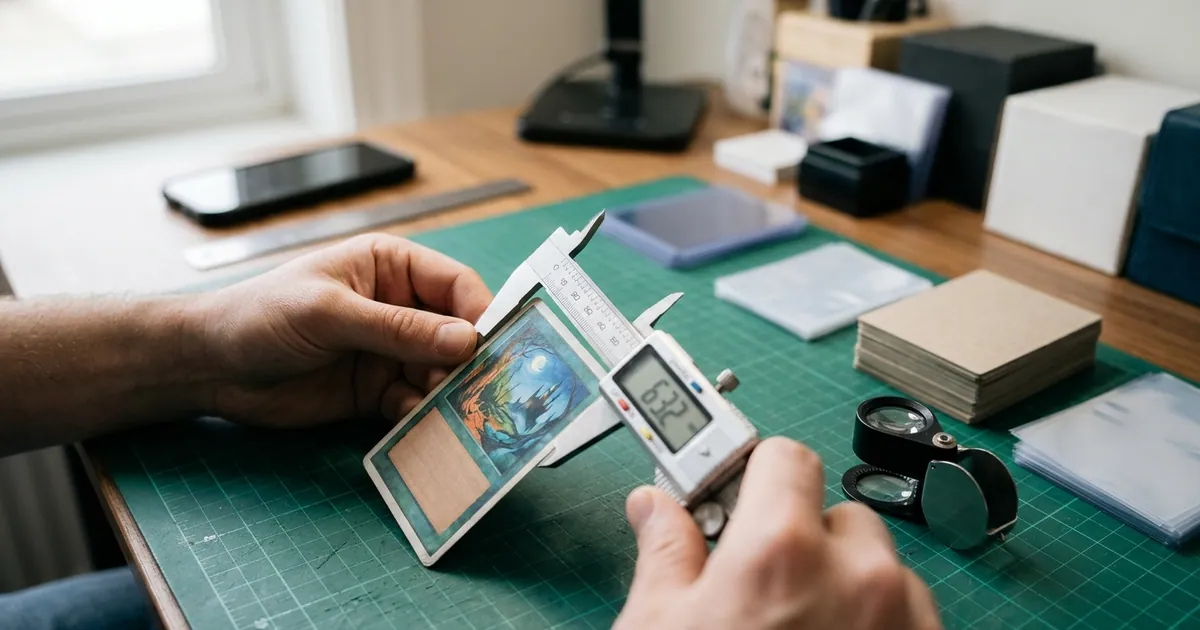
A trimmed card is one that had an edge or corner shaved after it left the factory, usually to sharpen corners, remove whitening, or fake better centering. To spot one, check three things. First, does it measure smaller or out of square compared with known-good copies from the same set? Second, do its edges show a different cut texture than the factory edges? Third, do the corners and centering look too perfect for the rest of the card’s condition? No single check proves trimming, but two or three red flags together mean you should pass, or get a professional opinion before paying a premium.
Key takeaways
- Measure first. Digital calipers and two or three verified set-mates beat any eyeball test, because factory sizes vary by set and era.
- Factory edges have a consistent texture. Trimmed edges are often smoother, slightly angled, wavy, or brighter than the surrounding stock. This is especially visible on vintage cards.
- Mismatch is the biggest tell. Watch for razor-sharp corners on a card with a worn surface, or flawless centering on a card that measures short.
- Major graders treat trimming as an alteration. PSA, BGS, SGC, and CGC generally won’t give a trimmed card a numeric grade. Fees and label wording vary, so confirm on each company’s site.
- Photos can flag, but can’t confirm. An AI pre-grade or a photo can point out suspicious edges and borders. Only calipers and a professional grader can settle the question.
What trimming is, and why it’s so common
Trimming means removing a sliver of a card’s stock with a blade, paper cutter, or precision trimmer. The sliver can be a fraction of a millimeter. People do it for three reasons:
- To remove edge chipping or whitening.
- To re-sharpen soft corners.
- To shave a wide border so an off-center card looks closer to 50/50.
All three push a card toward a higher grade. That’s why trimming shows up most where one grade point is worth real money: key vintage rookies, high-end modern parallels, and chase Pokémon cards.
It’s also why trimmed cards circulate raw. A seller who knows a card was trimmed has every reason to keep it away from a grading company. If you buy raw cards with real money behind them, learning these checks is far cheaper than learning the hard way.
Start with size: measure against the right reference
Every trimmed card is smaller than it was. The catch is that factory cards aren’t all identical either. Cutting tolerances, era, and manufacturer all create small variation. So the useful question isn’t whether the card is exactly 2.5 by 3.5 inches. It’s whether the card is smaller than verified copies from the same set.
| Card type | Typical nominal size | Notes |
|---|---|---|
| Modern sports cards (most base products) | 2.5 x 3.5 in (63.5 x 88.9 mm) | Thick patch and relic cards keep the same face size but add depth |
| Pokémon and Magic: The Gathering | 63 x 88 mm | Rounded corners, so check corner radius as well as size |
| Yu-Gi-Oh! | 59 x 86 mm | Smaller than Pokémon; never compare across games |
| Topps 1952–1956 | About 2-5/8 x 3-3/4 in | Larger vintage format; Topps switched to 2.5 x 3.5 in 1957 |
| Other vintage and oddball issues | Varies widely | Use a set-specific reference or graded set-mates |
Treat these as starting points, not pass/fail limits. Grading companies don’t publish one universal size tolerance, and factory miscuts can run long or short.
How to measure:
- Take the card out of its sleeve.
- Zero the calipers.
- Close the jaws gently. Squeezing compresses the stock and skews the reading.
- Measure each dimension at three points.
Rule of thumb (my own, not an official standard): if a card is short on one axis by about half a millimeter or more compared with every set-mate, while the set-mates closely match each other, treat it as a red flag rather than noise.
Check whether the edges are parallel. Compare the width at the top of the card with the width at the bottom. Factory cuts almost always produce parallel edges, even on a miscut card. A diamond-cut card has tilted printing inside square edges, and that’s a factory flaw. Edges that aren’t parallel to each other point to a hand trim.
Edge texture: factory cuts vs. blade cuts
Factory cuts are made by large dies or guillotine blades at production speed. Under a 10x loupe, they usually show a uniform texture along the whole edge. Vintage stock often looks slightly fuzzy or fibrous. Modern chromium-style cards often show a fine, rough cut. The key word is uniform: all four edges of a factory card typically look like siblings.
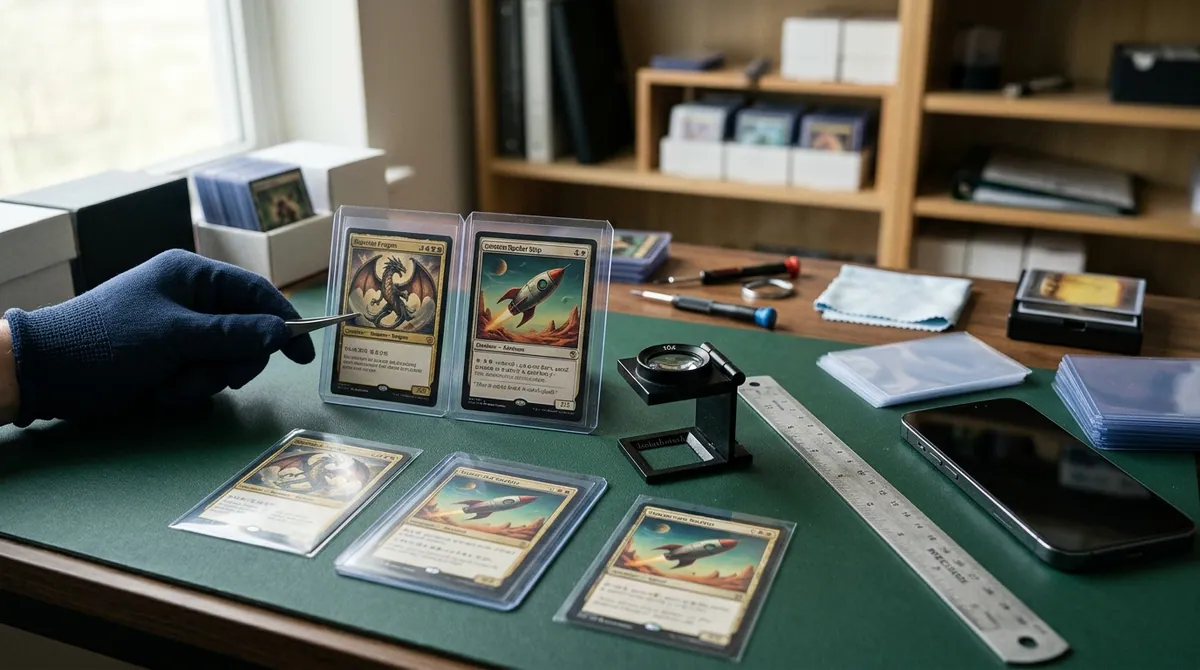
Trimmed edges often break that pattern in one of these ways:
- Too clean. One or two edges look glassy, compressed, or burnished, while the others show normal factory texture.
- Angled. A hand-held blade rarely cuts perfectly perpendicular to the card’s face. Look at the edge head-on for a slight bevel.
- Wavy or stepped. The blade may wobble along its path, or leave a tiny step near a corner where the cut started or stopped.
- Brighter stock. On vintage cards, original edges tone with age. A fresh cut exposes lighter, cleaner fibers. A bright white edge on a cream-toned 1960s card is a classic warning sign.
- Missing wear where wear should be. The surface shows handling and the corners are soft, yet one edge looks pristine.
Lighting matters. Use a daylight-balanced LED and hold it low, nearly parallel to the edge, so the texture casts tiny shadows. This is called raking light. Rotate the card so every edge gets the same light. Inconsistent lighting is how collectors talk themselves into false positives.
If you’re unsure what normal edge wear looks like, our card edge whitening guide covers what graders expect from untouched edges.
Corners and squareness
Corners give trimmers away more often than edges, because recutting an edge forces them to deal with the corners too.
- Square-cornered cards (most sports cards). Lay the card on a grid cutting mat or against a small machinist’s square. A trimmed edge often leaves one or two corners slightly off 90 degrees.
- Rounded-corner cards (Pokémon, MTG, many modern products). From the factory, all four corners share the same radius. After recutting an edge, a trimmer has to re-round the corners with a corner punch. That often leaves a slightly different radius, or a tiny flat spot where the arc meets the edge. Overlay the suspect card on a known-good set-mate and compare each corner under a loupe.
- Sharpness mismatch. Corners are usually the first part of a card to wear. Needle-sharp corners on a card with surface scratches, light creasing, or dull gloss deserve suspicion.
Centering that looks too good
One common reason to trim is to fix centering, so read the borders and the size together.
Say a card measures short on one axis and has near-perfect left/right centering, but its set is known for poor centering. The likely story is that someone shaved the wide border.
The opposite can happen too. A design frame or border line that sits closer to one edge than it does on set-mates could mean the card was trimmed too far, or it could simply be off-center. The caliper readings tell you which.
For measuring border ratios, see our card centering tool and guide and the walkthrough on how to measure card centering.
Step-by-step checklist: checking a card in hand
What you need:
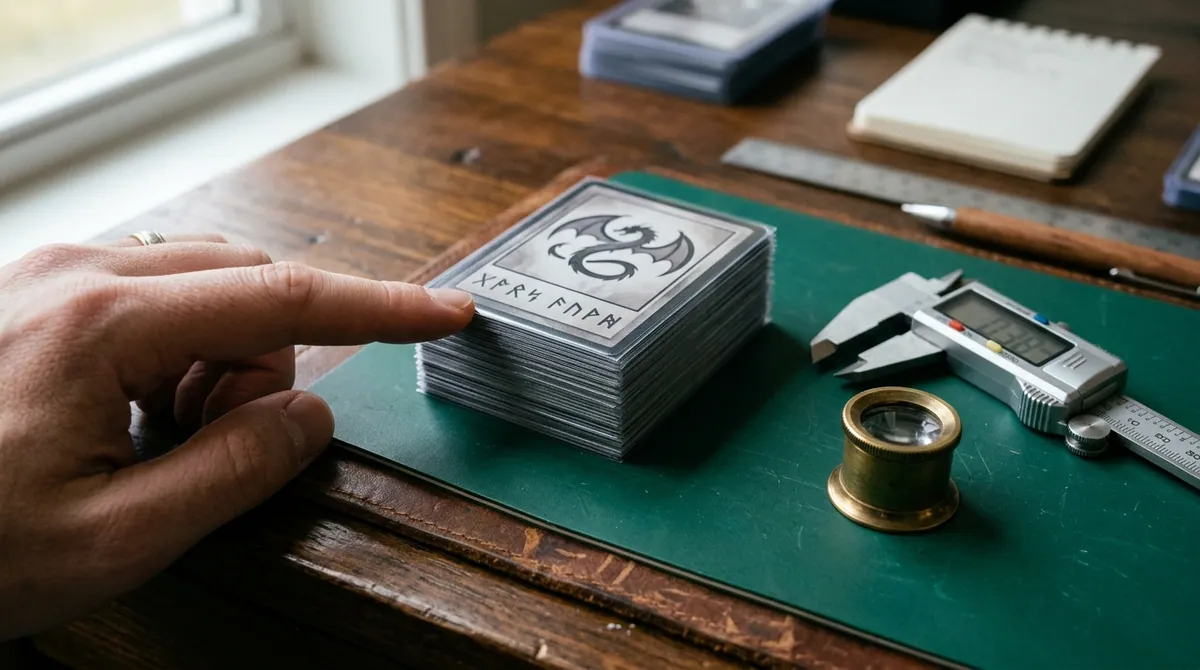
- Digital calipers with 0.01 mm resolution
- A 10x to 30x loupe
- A daylight-balanced LED lamp
- A grid mat or small square
- Two or three verified set-mates (graded or pack-fresh)
- Your phone camera
The checklist:
- Identify the exact set, year, and parallel. Look up its nominal size. Don’t compare across sets or card types.
- Prepare the card and tools. Remove the card from its sleeve or top loader, and zero the calipers.
- Measure the suspect card six times. Take the width at the top, middle, and bottom, then the length at the left, center, and right. Write all six numbers down.
- Measure the set-mates the same way. Compare averages. Also check whether the suspect card’s own readings vary more than theirs do, which signals non-parallel edges.
- Do the stack test. Square the suspect card inside a stack of set-mates and tap the stack on the table. Run a fingertip along each side. A trimmed edge sits back, and you can often feel the lip.
- Check squareness against the grid or square.
- Inspect every edge under the loupe with raking light. Compare the texture side to side, and against the set-mates.
- Compare edge color to the card stock. This matters most on vintage cards.
- Compare corner shape and radius by overlaying a set-mate.
- Measure border centering and ask whether it makes sense alongside the size readings.
- Photograph the edges and the caliper readings. They’re useful in a return dispute and for comparing later.
Reading the results: one mild flag on its own is usually noise. Two flags together, such as short plus non-parallel, or short plus one odd edge texture, mean you should treat the card as altered until a professional grader says otherwise.
What grading companies do with trimmed cards
PSA, Beckett (BGS), SGC, and CGC all treat trimming as an alteration. In general, a trimmed card won’t receive a numeric grade.
PSA, for example, publicly lists evidence of trimming among the reasons a card may not get a numeric grade. It also enforces a minimum size requirement. That second point matters: a card that came out of the factory short can be rejected even if nobody ever touched it.
Several details differ by company and can change over time:
- The exact codes and labels used, such as an Authentic Altered style designation versus a no-grade return
- Whether you still pay the grading fee for a rejected card
- How undersized-but-unaltered cards are handled
Check each grader’s official FAQ and submission terms before you send anything.
One more caution: a slab isn’t absolute proof. Graders are good but not infallible. For expensive cards, especially in older holders, running the size and edge checks yourself is still worth the ten minutes.
When not to grade (or buy)
- Don’t submit a card you strongly suspect is trimmed, hoping it slips through. You’ll likely pay the fee and get it back with no grade. Knowingly selling an altered card as unaltered is fraud.
- Don’t grade a cheap card just to settle the question. If the raw card is worth less than the grading fee plus shipping, the answer doesn’t change anything financially. Enjoy it as a binder copy.
- Don’t buy high-dollar raw cards without measurements. Ask the seller for caliper readings and raking-light photos of all four edges. Buy with a return policy, or buy the card already graded.
- Do consider grading when the card has real value, your checks come back clean or ambiguous, and you want an independent opinion before you sell. Our guide on how to prepare cards for grading covers the next steps.
- Do disclose it. If you own a card you now believe is trimmed, say so when you sell. An altered card still has value as a filler or binder copy, just not slab-level value.
Where Card Grading AI fits
Card Grading AI is a pre-grading tool. Upload clear front and back photos, and it returns an estimated condition read on centering, corners, edges, and surface. That helps you spot things worth a closer look, like border ratios that don’t fit the set or an edge that reads differently from the other three.
What it isn’t:
- It isn’t a measuring instrument, and it can’t confirm trimming from a photo.
- Its results are estimates, not official grades, appraisals, or a replacement for PSA, BGS, SGC, CGC, or TAG.
The practical workflow:
- Use the checklist above, with calipers and set-mates, to check size.
- Run the card through Card Grading AI for a centering and condition pre-grade.
- Decide whether the card is worth a grading fee at all.
If you have questions about how our estimates work or what they can’t tell you, the FAQ covers it. Start your next raw card with a scan, then reach for the calipers when something looks off.
FAQ
Can a trimmed card be graded by PSA, BGS, SGC, or CGC?
Generally it will not receive a numeric grade. Major graders treat trimming as an alteration, so the card is typically returned as altered or with a no-grade outcome. The exact label, code, and whether you still pay the grading fee vary by company and can change over time, so confirm on the official site before you submit.
Is a slightly undersized card always trimmed?
No. Factory cutting varies by set and era, and miscuts can come out of the pack short. Compare the card against two or three verified copies from the same set. A card that is short and also has non-parallel edges or a different edge texture is much more suspicious than one that is only short. Keep in mind that graders can still reject a card that is factory-short if it falls below their minimum size requirement.
Can AI detect a trimmed card from a photo?
Not reliably on its own. A photo-based tool can flag things worth a closer look, like border ratios that don't fit the set or an edge that looks different from the others. It cannot measure a card's physical size precisely. Card Grading AI gives estimated pre-grades, not official grades or alteration verdicts. Use calipers and set-mates to check size, and use a professional grader for a final opinion.
What tools do I need to check a card for trimming?
You need digital calipers that read to 0.01 mm, a 10x to 30x loupe, a daylight-balanced LED lamp you can angle low across the edge, a grid cutting mat or small square, and ideally two or three graded or pack-fresh copies of the same card or set for comparison.
How much does trimming hurt a card's value?
A lot, though there is no fixed percentage. A trimmed card can't compete with unaltered graded copies. It usually sells as a filler or binder copy at a steep discount, and it should always be disclosed as altered when sold.
Keep reading
Related guides
Ready to inspect your next card?
Scan your cards instantly with Card Grading AI
Capture a clear front-and-back photo, review an AI-assisted condition estimate, and keep standout cards organized in your collection.