Collector guide
Card Creases and Dents Grading: A Collector's Guide
Learn how creases, dents, and bends affect card grades, how to spot them with light, and how to pre-screen cards before you pay PSA, BGS, or CGC.
By Matteo G.
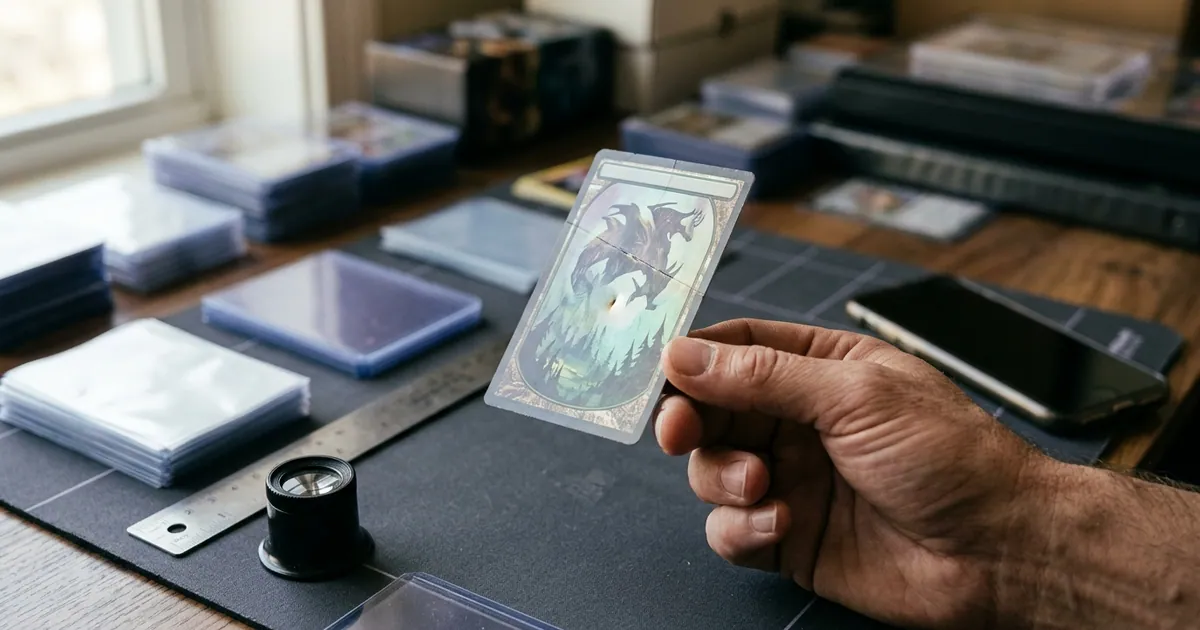
Creases and dents are the defects that end grading dreams fastest. Centering can be argued, edge whitening can be subtle, and a faint surface scratch might slip past on a lucky day — but a crease is structural damage, and every major grading company treats it that way. If you are planning a submission, learning to find creases and dents before you pay shipping and grading fees is one of the highest-value skills in the hobby.
This guide covers what separates a bend from a dent from a true crease, how graders weigh each one, the lighting technique that exposes them, and how to pre-screen a stack of cards efficiently.
Bend vs. Dent vs. Crease: Know What You Are Looking At
These three words get used interchangeably at card shows, but they describe different levels of damage and carry very different grade penalties.
A bend is a curve or warp in the card stock with no broken fibers. Hold the card edge-on and it looks like a gentle arc. Bends often come from tight top loaders, a stack stored under weight, or humidity. Many bends relax if the card sits flat in a sleeve and semi-rigid holder for a few weeks. A bend that relaxes fully may cost nothing at grading.
A dent is a localized impression — a fingernail press, a pressure point from a stacked corner, or a spot where something sat on the card. The surface is deformed but the fibers may still be intact. Dents are sneaky because they often disappear under flat overhead light and only appear when light rakes across the card at a low angle.
A crease is a fold line where the card’s paper fibers have actually broken. The print layer typically cracks along the line, showing as a pale or dull streak. Run a fingertip gently across it and you can often feel the ridge. Creases do not go away. Pressing a creased card only flattens the profile; the broken fibers remain visible under light and under a grader’s loupe.
The practical rule: if light passes through differently along the line, or if you see white showing through the print, you are looking at a crease.
How Graders Weigh Creases and Dents
Grading companies build their scales around four pillars — centering, corners, edges, and surface — and creases land squarely in surface, though a corner crease damages two categories at once. What matters is that creases are treated as major defects, not incremental deductions.
Here is a general sense of how these defects map to grade ceilings. Treat this as orientation, not a promise; every grader applies judgment.
| Defect | Typical visibility | Realistic grade ceiling |
|---|---|---|
| Fully relaxed bend, no fiber break | Edge-on only | Can still reach the top of the scale |
| Light surface dent, no break | Raking light only | Mid to upper-mid grades |
| Light crease, back only | Raking light, short line | Low-to-mid grades |
| Defined crease through the image | Visible in normal light | Poor to Good range |
| Corner crease or fold | Visible from any angle | Poor to Good range |
The nuance most collectors miss: length and location matter as much as depth. A one-eighth-inch dent in a dark border area reads very differently than a two-inch crease running diagonally through a player’s face. Graders look at eye appeal alongside technical condition, and a crease that cuts the focal point of the card is punished hardest.
The Lighting Technique That Finds Everything
Flat, even light is what you want for scanning card art. It is exactly wrong for finding creases. To expose them, you need raking light — a single light source hitting the card at a low, glancing angle.
Here is the routine:
- Work under one directional light source — a desk lamp, a window, or a phone flashlight propped up — and turn off competing overhead lights.
- Hold the card so the light strikes the surface at roughly 15 to 30 degrees, nearly parallel to the card face.
- Slowly rotate the card a full 360 degrees while watching the surface. Creases and dents reveal themselves as the angle changes because they catch and scatter light differently than the flat gloss.
- Repeat for the back. Back creases are easy to miss and they absolutely affect grades.
- Tilt the card edge-on at eye level to check for bends and warping along both axes.
Do this out of the sleeve when it is safe to do so, on a clean soft surface. Sleeve plastic adds its own reflections and can hide shallow dents.
For vintage cards, add a second check: hold the card up to a light source from behind. Fiber breaks often show as brighter lines where the stock has thinned. This is especially effective on 1950s–1980s cardboard stock, which is far more porous than modern coated stock.
Why Pressing Is Not a Fix
You will see plenty of advice about pressing cards to remove creases. Understand what pressing actually does: it flattens the physical profile of the card. It does not knit broken fibers back together, and it does not restore cracked print layer.
More importantly, aggressive pressing can be interpreted as alteration. Grading companies are explicit that altered cards may be rejected or labeled, and that outcome is worse than an honest low grade. Gently relaxing a bend by storing a card flat under even, light weight in a penny sleeve and semi-rigid holder is different from heat-pressing a crease out — the first is sane storage, the second risks your card and your submission. When in doubt, submit as-is.
Pre-Screening a Stack Efficiently
If you have a box of candidates, you do not need to agonize over each card. Build a fast triage pass:
- Pass 1 — edge-on: Fan through the stack checking profiles. Pull anything with visible bend or warp.
- Pass 2 — raking light, front: Thirty seconds per card, rotating under angled light. Pull anything showing a line.
- Pass 3 — raking light, back: Same drill. Backs hide more creases than fronts.
- Pass 4 — photograph the survivors and evaluate them properly alongside centering, corners, and edges.
For step four, a pre-grading tool saves real time. Card Grading AI analyzes your uploaded front and back images and returns an estimated grade with flags on the specific defects it detects, including likely creases, dents, and surface disruption. You can see the analysis pipeline on how it works and the full toolset on the features page. It is a screening aid, not an official grade — the value is in deciding which twenty cards out of two hundred deserve a submission slot.
One caveat worth repeating: any photo-based analysis is only as good as your photos. If you shoot under flat overhead light, a crease may simply not be present in the image data, and no tool can flag what the camera did not capture. Shoot each card twice — once flat-lit for the full image, once under raking light to expose surface topography — and upload both if the tool allows it.
Vintage vs. Modern: Different Failure Modes
Vintage cardboard creases easily but also hides light bends well because the stock is matte. A 1971 Topps card with a soft corner bend may photograph cleanly and still receive a reasonable grade. Modern glossy stock behaves oppositely: it resists bending more, but when it does crease, the coating cracks and the defect becomes dramatically visible under any light.
This matters for sports collectors handling mixed-era boxes. If you are working through vintage and modern in the same session, adjust your expectations rather than your standards — the same defect reads differently across eras. Our sports card grading guide covers era-specific condition expectations in more depth.
It is also worth checking creases and centering together rather than sequentially. A card with a marginal crease and off-center framing is almost never worth a submission fee, while a clean-centered card with a tiny back dent might still be. Running centering analysis in the same pass keeps the decision honest.
The Bottom Line
Creases and dents are the defects with the least forgiveness and the clearest test: use raking light, inspect both sides, and be honest about what you see. A crease found on your desk costs nothing. The same crease found by a grader costs the submission fee, the shipping, the insurance, and weeks of waiting.
Build the light check into your routine, photograph the survivors properly, and run them through Card Grading AI for an estimated pre-grade before you commit. Then send only the cards that earned it.
Card Grading AI provides estimated pre-grades for planning purposes only. Results are not official grades, appraisals, or guarantees, and do not replace evaluation by PSA, BGS, CGC, TAG, or any other grading service.
FAQ
Can a card with a crease still get a PSA 10?
No. A true crease breaks or displaces the card's fibers, and every major grader treats that as a major defect. Even a light crease visible only under angled light typically caps a card in the Poor to Very Good range, and creases through the image or across a corner usually land lower. If the mark is a soft bend with no fiber break, the ceiling is higher but still rarely above the mid grades.
What is the difference between a bend, a dent, and a crease?
A bend is a curve in the stock with no fiber damage; it can sometimes relax over time under even, gentle pressure in a sleeve and holder. A dent is a localized impression, often from a fingernail, a press, or a stacked card corner, that deforms the surface but may not break the fibers. A crease is a folded line where the fibers and often the print layer have actually broken, usually showing a white or dull line under raking light.
Does a crease on the back of a card hurt the grade less than one on the front?
Somewhat, but not as much as collectors hope. Back creases are weighted a little more forgivingly by some graders because the front carries the eye appeal, yet a defined crease anywhere is still a structural flaw. Expect a back crease to keep a card out of high grades regardless of how clean the front looks.
Should I submit a creased card for grading at all?
Usually only if the card is scarce or valuable enough that an authenticated low-grade slab still carries real market value, such as vintage rookies or key vintage Pokemon. For modern commons and mid-value cards, grading fees and shipping often exceed what a low-grade slab returns. Compare the realistic graded value to the total submission cost before you send.
Can Card Grading AI detect creases from a photo?
Card Grading AI analyzes the images you upload and flags visible condition issues, including likely creases, dents, and bends, as part of an estimated pre-grade. Detection quality depends heavily on your lighting and angles, so shoot with angled light as described in this guide. Results are estimates to help you decide what to submit, never official grades or a replacement for PSA, BGS, CGC, or TAG.
Keep reading
Related guides
Ready to inspect your next card?
Scan your cards instantly with Card Grading AI
Capture a clear front-and-back photo, review an AI-assisted condition estimate, and keep standout cards organized in your collection.