Collector guide
Card Saver vs Top Loader: Which to Use and When
Card saver vs top loader explained: which holder graders prefer for submissions, which is better for storage and shipping, and how to load each safely.
By Matteo G.
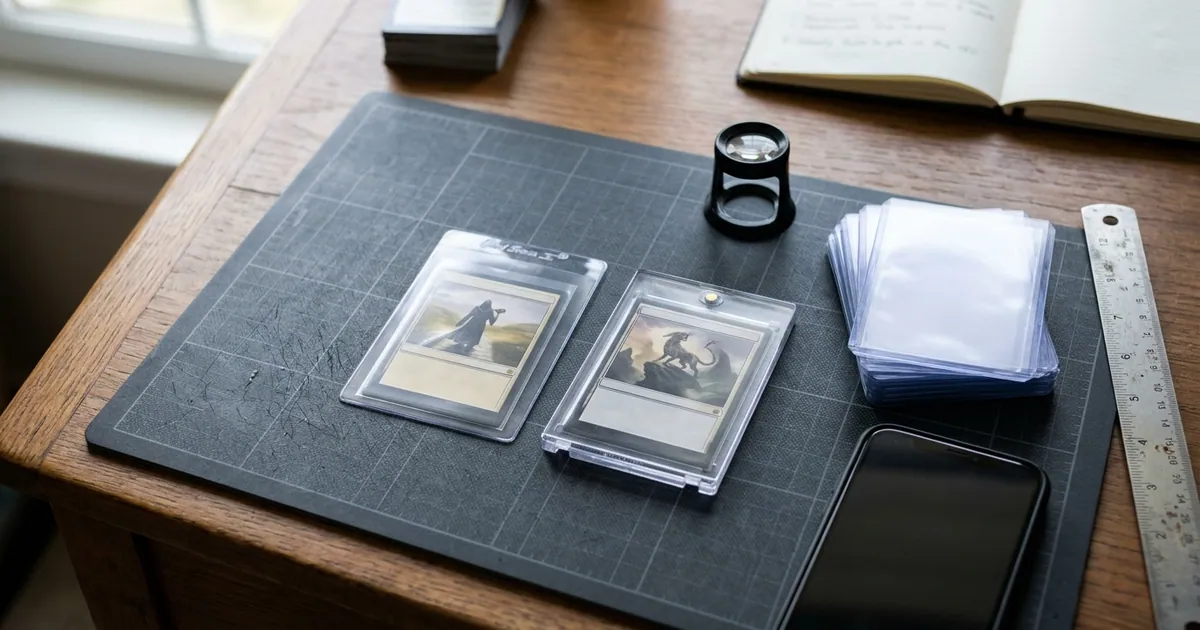
If you’re sending cards to a grading company, use a semi-rigid card saver (the Card Saver I is the standard). That’s what PSA has long asked for, and it’s what most graders handle fastest and most safely. For everything else, including storage, display, shows, and shipping raw cards you’ve sold, a rigid top loader is usually the better tool. Most serious collectors keep both on hand and switch between them depending on where the card is going.
Key takeaways
- Card savers are for submissions. Their flex lets graders squeeze them open and remove the card without catching a corner on a rigid lip.
- Top loaders are for storage, display, and shipping raw cards. Rigid walls resist bending in boxes, binders of loose cards, and mailers.
- Always use a penny sleeve first. A bare card should never go into either holder.
- Match the holder to the card’s thickness. A 35pt top loader fits most standard base cards. Thick patch and relic cards need higher-rated holders.
- Submission rules vary by company and change over time. Confirm the current packing instructions on the official PSA, BGS, CGC, SGC, or TAG site before you pack.
What’s actually different between a card saver and a top loader
Both are clear plastic sleeves that sit over a penny-sleeved card. They behave very differently, though.
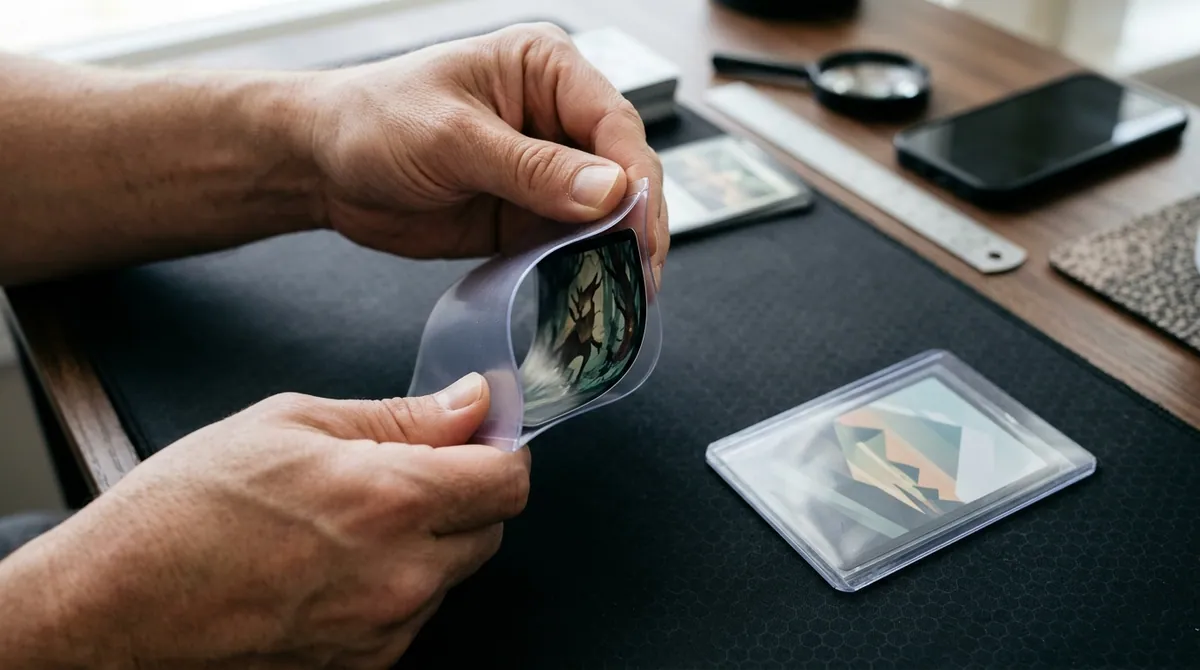
A top loader is a rigid, clear holder, usually 3“ x 4“ for standard cards, open on one short end. It’s sold by thickness rating in points (pt): 35pt for standard base cards, then 55pt, 75pt, 100pt, 130pt, 180pt and up for thicker relic, patch, and premium stock cards. It doesn’t bend, which is the whole point.
A card saver (semi-rigid holder) is thinner and flexible. The opening is wider, and when you squeeze the long sides, the holder bows open so the card slides out easily. The Card Saver I is sized for standard-thickness cards. Larger and thicker variants exist, so check the manufacturer’s sizing before you buy for thick cards.
| Card saver (semi-rigid) | Top loader (rigid) | |
|---|---|---|
| Stiffness | Flexible, bends under pressure | Rigid, resists bending |
| Card removal | Squeeze to open, card slides out easily | Card must be slid or tipped out through a fixed opening |
| Best for | Grading submissions | Storage, display, shipping sold raw cards |
| Grader preference | Commonly requested (PSA, others vary) | Often discouraged for submissions |
| Thickness options | Limited, a few sizes | Wide range of pt ratings |
| Bulk and weight | Thinner and lighter when stacked | Bulkier and heavier |
| Weak point | Bends if a mailer gets crushed | Rigid lip can ding corners on careless insertion |
Why grading companies prefer semi-rigid holders
Picture a grading-company intake desk processing thousands of cards. Every card has to come out of its holder, get handled, and go into a slab. With a top loader, the card has to be slid or shaken out through a rigid opening, and a rushed pull can drag a corner along the edge of the plastic. With a card saver, a quick squeeze opens the holder and the card slides out with almost no contact. Faster and safer for everyone.
That’s why PSA’s published submission instructions have for years asked for cards in penny sleeves inside semi-rigid holders like the Card Saver I, and have discouraged top loaders, screw-down holders, and magnetic one-touch cases. Other graders publish their own packing rules, and those rules can differ or change. Some are more tolerant of top loaders. Don’t rely on forum posts or old videos. Open the official submission guide for the company and service level you’re using and follow it to the letter. Packing your cards the way the grader asks is the easiest way to avoid delays or damage.
A few rules show up across most graders’ guidance and are worth following regardless:
- Don’t tape the holders shut. Tape slows down removal and can damage cards when it’s cut or peeled.
- Don’t use screw-downs or magnetic holders for submission unless the grader explicitly allows it.
- One card per holder. Never double up.
When a top loader is the better choice
Once a card is home, rigid usually wins.
- Long-term storage of raw cards you care about. A top loader in a storage box keeps the card flat and protected from bends. Card savers stored loosely can flex over time if the box isn’t packed snugly. For the bigger picture on boxes, humidity, and light, see our guide on how to store trading cards safely.
- Shipping a raw card you sold. The standard approach is penny sleeve, top loader, then a team bag or a strip of painter’s tape across the opening, sandwiched between cardboard in a bubble mailer or small box. A flexible card saver in a soft mailer is an invitation for a bent card.
- Card shows and trades. Top loaders survive being pulled in and out of binders and display cases all day.
- Thick cards. The wide range of pt ratings means you can find a top loader that fits a 130pt patch card properly, which isn’t always true of semi-rigids.
A quick rule on thickness: the card should slide in without resistance and sit flat without bowing. If you have to push, the holder is too thin. If the card rattles around freely in a much thicker holder, it can shift and rub during shipping. Size up or down accordingly.
When not to use either one (and what to do instead)
Holders are cheap, but they’re not free, and they’re not always the right move.
- Don’t top-load every bulk common. Bulk cards live fine in row boxes. Save holders for cards with real value or sentimental weight.
- Don’t force a thick card into a Card Saver I. If it bows, it can pick up an edge dent or a bend you didn’t have before. Check the grader’s guidance for thick cards and use a holder sized for them.
- Don’t use soft vinyl or unknown-material binder pages for long-term storage of valuable cards. Stick with products sold specifically for card storage.
- Don’t pay a grading fee just because a card is already in a card saver. The holder doesn’t improve the grade. If a modern card has visible whitening, a soft corner, or obvious off-centering, the likely grade may not justify the fee plus shipping. Keep it raw in a top loader. Our guide on how to prepare cards for grading covers the full decision.
How to load a card saver for submission: step-by-step checklist
Do this at a clean desk with a card in hand.
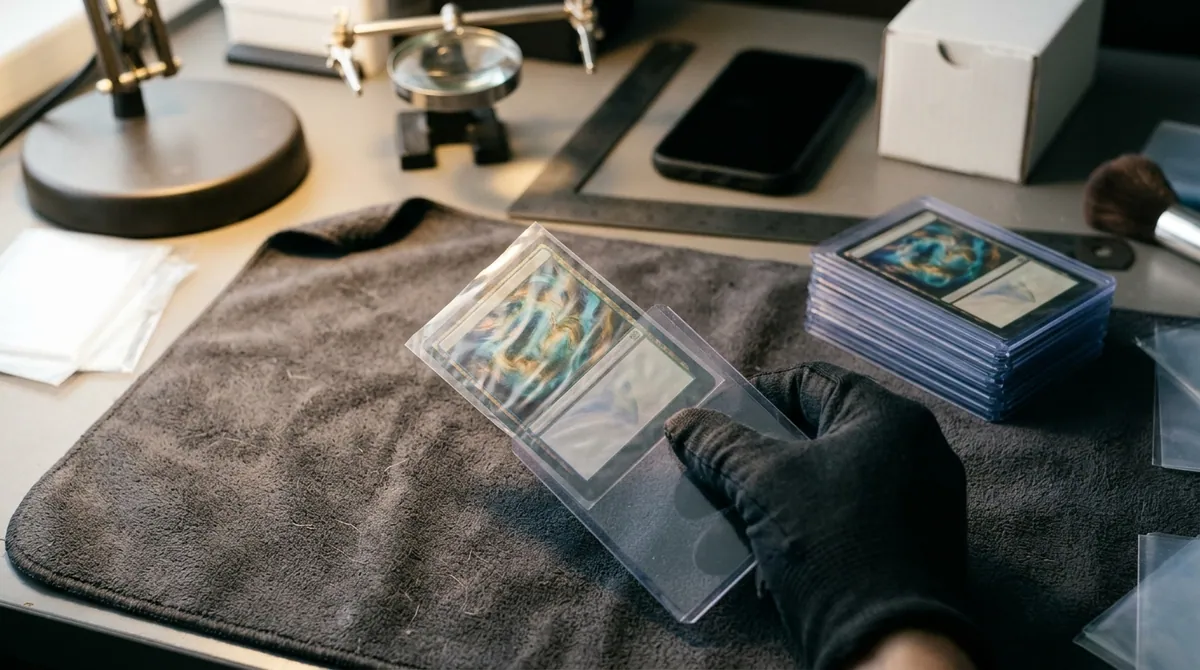
- Inspect the card first. Look at the surface under a lamp held at a low angle (raking light) to catch scratches, print lines, and dents. Then check the edges and corners for whitening. Measure centering front and back. Our card centering tool can help. If the card has an obvious flaw, decide now whether it’s worth submitting.
- Wash and fully dry your hands. Handle the card by its edges only.
- Use a fresh standard penny sleeve. Avoid tight perfect-fit inner sleeves for submissions unless the grader allows them, because they’re harder to remove. Slide the card in bottom-first, slowly, without letting the corners catch on the sleeve’s seam.
- Squeeze the card saver’s long sides so the opening bows wide.
- Slide the sleeved card in until it seats. Don’t push hard against the bottom; you don’t want to compress a corner.
- Check the fit. The card should sit flat, fully visible, with no bowing and no debris trapped inside. If it looks tight, the card may be too thick for a Card Saver I.
- Leave the opening untaped. Don’t add stickers or labels unless the grader’s instructions specifically allow them.
- Arrange cards in the same order as your submission form. This makes intake easier and helps you verify the return.
- Photograph the front and back of each card before you pack. Keep the photos as your condition record.
- Pack for crush resistance. Stack the card savers, place them in a resealable bag, sandwich the stack between two pieces of stiff cardboard, and ship in a box with padding so nothing slides. Avoid tight rubber bands directly on the holders, since they can dent edges.
How to load a top loader without dinging corners
Most top loader damage happens during insertion and removal, not storage.
- Sleeve the card first. The sleeve gives the corners a buffer against the rigid lip.
- Pick the right thickness. 35pt for standard base cards. Measure or check the manufacturer’s spec for anything thicker.
- Insert at a slight angle, leading with the bottom edge of the sleeve, and let it slide down. If it catches, back it out and try again. Don’t shove.
- To remove, tip the top loader so the card slides toward the opening, then pull gently by the sleeve, not the card.
- For shipping, close the opening with a team bag or painter’s tape (it peels cleanly) and protect the top loader between cardboard.
Where Card Grading AI fits in your prep
The holder protects the card. It doesn’t tell you whether the card is worth submitting. That’s the question Card Grading AI is built to help with. Snap clear photos of the front and back, and the app gives you an AI pre-grade estimate covering centering, corners, edges, and surface, so you can sort your stack before you buy supplies or pay fees. You can see the process on how it works and read more about the approach on our AI card grading page.
To be clear, a Card Grading AI result is an estimate, not an official grade, an appraisal, or a guarantee of what PSA, BGS, CGC, SGC, or TAG will assign. Use it as a filter. Cards that look strong go into card savers for submission. Cards that don’t stay raw in top loaders. Common questions about accuracy and limits are answered on our FAQ.
The short version: keep a pack of card savers ready for submission day and a box of top loaders for everything else. Check the grader’s current packing rules every time you submit. Run a quick pre-grade with Card Grading AI before you seal the box, and you’ll spend your grading budget on the cards that have the best shot.
FAQ
Does PSA accept cards in top loaders?
PSA's submission instructions have long asked for cards in penny sleeves inside semi-rigid holders such as Card Saver I, and they have discouraged rigid top loaders, screw-downs, and magnetic holders. Policies can change, so check PSA's current submission guide before you pack. If they say semi-rigid, follow it exactly.
Can I store my cards long term in card savers?
You can, but top loaders are usually better for long-term storage and display because they are rigid and resist bending. Card savers flex, so they work best when they are packed snugly in a box. Many collectors keep cards in top loaders and move them into card savers only when a submission is coming up.
What top loader thickness do I need?
Top loaders are rated in points (pt). 35pt fits most standard base cards, including typical Pokemon, MTG, and sports base cards. Thicker cards such as patch, relic, and some chrome or premium stock cards need higher ratings like 55pt, 75pt, 100pt, or above. Check the thickness listed by the manufacturer or measure with calipers, and pick a holder that fits without bowing the card.
Should I tape the top of a card saver before sending it to a grader?
No. Graders generally ask you not to tape card savers shut because tape slows down removal and can damage cards when it is cut or peeled. Tape the outside of the shipping box, not the holders. For raw cards you sell and ship, painter's tape or a team bag over a top loader is the common approach.
Will Card Grading AI tell me which cards are worth putting in a card saver for submission?
Card Grading AI gives you an AI pre-grade estimate from photos of the front and back, highlighting centering, corners, edges, and surface. It is not an official grade or a guarantee, but it helps you decide which cards look strong enough to justify a grading fee before you spend money on supplies and submission costs.
Keep reading
Related guides
Ready to inspect your next card?
Scan your cards instantly with Card Grading AI
Capture a clear front-and-back photo, review an AI-assisted condition estimate, and keep standout cards organized in your collection.