Collector guide
How Much Is This Card Worth? A Collector's Method
Find out how much your card is really worth: identify the exact version, judge condition honestly, read sold comps, and decide if grading pays off.
By Matteo G.
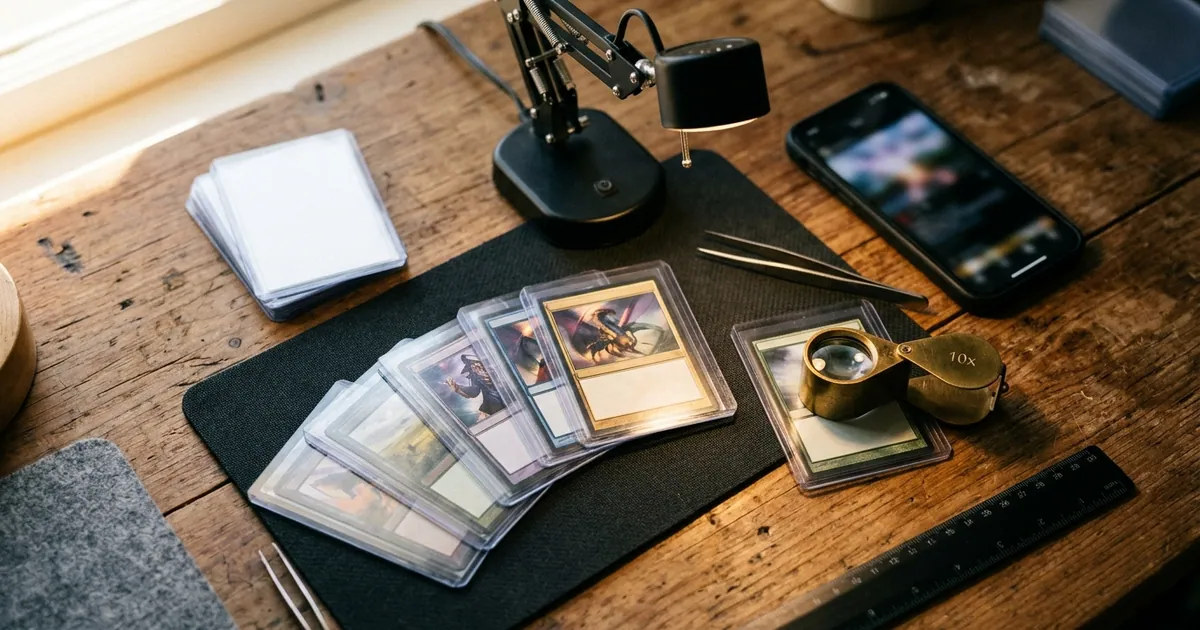
Your card is worth roughly what the exact same card, in the same condition, has sold for recently, minus what it costs you to sell it. That isn’t the highest asking price on eBay, a price guide number from two years ago, or what a PSA 10 went for if yours is sitting raw in a binder. Get three things right (the exact version, an honest condition read, and real sold comps) and you can reach a realistic price range in about 15 minutes.
This guide is the decision framework. For a walkthrough of specific lookup tools, our guide on how to check a card’s value covers them in depth.
Key takeaways
- Only sold prices count. Asking prices tell you what sellers hope for. They don’t tell you what buyers pay.
- Identify the exact version first. An edition stamp, parallel, or serial number can multiply a card’s value many times over. If you compare against the wrong version, every later step is wasted.
- Condition is the biggest swing factor for the same card. On modern cards, the gap between a PSA 9 and a PSA 10 is often a multiple, not a small percentage.
- Grading only makes sense when the math works. Your expected graded value minus all-in grading costs has to clearly beat the raw price.
- Any estimate is only a starting range. That includes an AI pre-grade. It is not an appraisal.
Step 1: Identify the exact card, not just the name
Charizard or a Wembanyama rookie isn’t specific enough to price. Dozens of versions can share a name and a photo, and they sell for wildly different amounts. Before you look up a single price, write down these details:
- Set and year. Check the copyright line and set symbol on Pokémon and MTG cards. On sports cards, check the brand and product line on the back, such as Topps Chrome vs. base Topps vs. Bowman.
- Card number. Pokémon prints it as a fraction like 4/102 in a bottom corner. Sports cards usually print it on the back. A number above the set total, such as 105/102, usually means a secret rare.
- Edition and print markers. Look for First Edition stamps, shadowless vs. unlimited Base Set Pokémon, reverse holo vs. regular holo, and early vs. later print runs.
- Parallel or variant. Check for refractors, Prizm colors, foil treatments, alternate art, and promo stamps. Tilt the card under light, because many parallels only show up at an angle.
- Serial number. Stamped numbering like 23/99 means a limited print run and usually a premium. Low numbers, the 1/1, and numbers matching a player’s jersey often sell higher.
- Autograph or memorabilia. On-card autos typically sell for more than sticker autos. For relic cards, patch quality matters.
- Language. Japanese, English, and other-language Pokémon cards are separate markets with separate prices.
If you can’t confirm a detail, search the set name and card number together. That pairing is the most reliable way to find exact matches in sold listings.
Step 2: Judge condition honestly
The same card can sell for a few dollars or a few hundred depending on condition. This is where most people get their number wrong, usually by being optimistic. Raw cards are sold by condition tiers. TCGplayer, for example, uses Near Mint, Lightly Played, Moderately Played, Heavily Played, and Damaged. Graded cards are priced by the grader’s number.
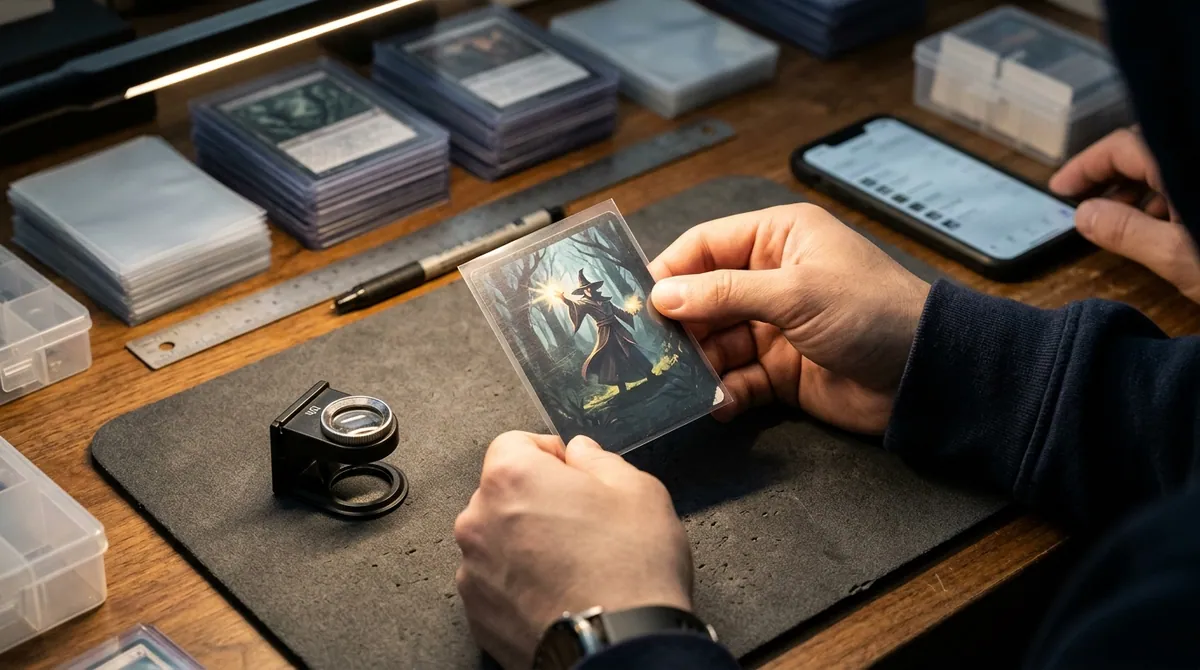
Check the four things every major grader evaluates:
- Centering. Compare border widths left vs. right and top vs. bottom, on both the front and back. PSA’s published standards call for roughly 55/45 or better on the front and 75/25 or better on the back for a PSA 10. For a PSA 9, they call for about 60/40 front and 90/10 back. Other graders use different tolerances, and standards can change, so confirm on the official site before relying on them. A centering tool is more accurate than eyeballing it.
- Corners. Use a 10x loupe or your phone’s zoom. Any fuzziness, rounding, or white showing at a corner tip rules out gem mint.
- Edges. Flip the card over. Whitening and chipping show up far more on the back, especially on dark-bordered cards.
- Surface. Hold the card under one bright light at a low angle and slowly tilt it. This raking light reveals scratches, print lines, dents, and fingerprints that overhead room lighting hides. A crease anywhere is a major value hit, even a light one you can only see at an angle.
Be blunt with yourself. If you found a flaw in two minutes, a professional grader will find it too. A buyer studying your photos probably will as well.
Step 3: Find sold prices, not asking prices
Each price source answers a slightly different question:

| Source | What it tells you | Watch out for |
|---|---|---|
| eBay sold listings (Sold Items filter) | Real transactions for raw and graded copies | Best-offer sales show the original list price crossed out, not the accepted amount |
| 130point | eBay sold data, including accepted best-offer prices for many listings | Coverage isn’t complete for every sale |
| TCGplayer Market Price | Sales-based prices for raw TCG cards | Confirm you’re looking at the right printing and condition |
| PSA Auction Prices Realized | Historical sale prices for PSA-graded copies by grade | Covers only PSA slabs, not raw cards or other graders |
| PriceCharting and similar aggregators | Quick averages and trend lines | Averages can blur condition, variants, and outliers |
Follow these rules when you read comps:
- Use the last 30 to 90 days. Card prices move with player performance, set hype, and reprints. A sale from last year is history, not a comp.
- Find at least three to five sales. One sale is an anecdote. If the card rarely trades, widen the window and accept a wider range.
- Match both condition and grader. A PSA 10, a BGS 9.5, and a CGC 10 don’t trade at the same price. Never price a raw card off slab sales.
- Throw out outliers. Lots, misidentified listings, damaged cards sold as near mint, and one-off bidding wars all distort averages. Use the middle of the cluster.
- Compare auctions and Buy It Now separately when their prices differ a lot. Auctions that end at odd hours sometimes sell low. Fixed-price sales can include patient sellers who waited for the right buyer.
Step 4: Adjust for what you’d actually take home
Market value and the money that lands in your pocket are different numbers.
Selling on eBay means paying a final value fee, plus shipping supplies and postage. At the time of writing, the fee is roughly 13% on most trading card sales plus a small per-order fee. Rates vary by category, price, and seller status, so check eBay’s current fee page.
Selling to a local card shop or a dealer at a show is faster. Dealers need margin to resell, though, so their offers commonly come in well below market. How far below depends on the shop and how quickly the card moves. Trades usually get you more in credit than you’d get in cash.
So a card’s practical value depends on how you plan to sell it.
Raw vs. graded: when grading changes the answer
Grading can raise a card’s value a lot, but only when the card is strong enough and the raw-to-graded gap covers the cost. Here is the math with illustrative numbers, not real prices for any specific card:
- Raw near mint copies sell for $40.
- PSA 9 copies sell for $60.
- PSA 10 copies sell for $250.
- Your all-in cost to grade (fee, shipping both ways, and insurance) is $35.
If the card lands a 9, you net $60 minus $35, or $25, from a card worth $40 raw. You lost money. Only a 10 makes this submission pay, so the real question is how confident you are that the card is a 10. If the honest answer is maybe, you’re placing a bet, and you should know the odds first.
PSA’s public population report helps with those odds. It shows how many copies have received each grade, which tells you both how hard a 10 is and how scarce one is.
Skip grading when:
- The raw value is below or close to your all-in grading cost, and there’s no realistic path to a 10.
- The card has a visible crease, several whitened corners, or centering clearly worse than 60/40. It will likely grade in a range where the slab adds little or nothing.
- It’s a high-population modern card where 9s sell near raw prices.
- You need the money soon. Turnaround times vary by tier and backlog and can stretch for weeks or months.
Grading fees and service tiers change often, so check the grader’s official pricing page for current numbers. For a deeper look at this decision, see raw vs graded cards.
The 15-minute card value checklist
Grab the card, a bright lamp, and your phone.
- Sleeve the card first. Handle it by the edges so you don’t add fingerprints or edge wear while you inspect it.
- Write the full ID. Include year, set, card number, name, parallel or variant, serial number, edition, and language.
- Check centering on the front and back, and note the approximate ratio.
- Inspect corners and edges with a loupe or phone zoom. Start with the back.
- Tilt the surface under raking light. Note any scratches, dents, print lines, or creases.
- Assign an honest condition tier. If you’re considering grading, assign an estimated grade range instead.
- Search sold listings by set name plus card number, filtered to sold, from the last 30 to 90 days.
- Collect three to five matching comps in the same condition or grade, and discard outliers.
- Note the low, middle, and high prices of that cluster. That spread is your value range.
- Subtract selling costs for the sales channel you would actually use.
- If you’re considering grading, compare the raw value to graded comps for your realistic grade, minus all-in fees.
Common reasons people overestimate card value
- Pricing off asking prices. A listing that has sat for months is evidence the price is too high.
- Using PSA 10 comps for a raw card. Most raw cards don’t grade 10, even pack-fresh ones.
- Missing the variant. The photo matches, but the parallel, edition, or print run doesn’t.
- Anchoring on one viral sale. A record sale gets the headlines, but the quiet sales afterward set the market.
- Trusting old price guides. Static guides lag the market, sometimes badly in either direction.
Where Card Grading AI fits
The hardest part of pricing a card is Step 2: knowing which condition tier you’re actually in. That’s what Card Grading AI is built for.
Scan your card with your phone or upload photos on the web. You get an AI pre-grade that evaluates centering, corners, edges, and surface. That tells you whether to pull comps for near mint raw copies, PSA 9s, or 10s, and whether a grading submission is worth considering.
The result is an estimate to guide your decision. It is not an official grade, an appraisal, or a guarantee of what PSA, BGS, CGC, TAG, or any other grader will assign.
You can use the catalog to keep track of the cards you’ve checked, so you don’t redo the research every time you wonder what one is worth. Browse the full list of features, then scan the card on your desk to see which comps actually apply to it.
FAQ
Is the price on an eBay listing what my card is worth?
No. Active listings show what sellers are asking, and many sit unsold for months because the price is too high. Use sold listings from the last 30 to 90 days for the exact same version in the same condition or grade. That gives you a much more realistic value range.
How do I value a card that has no recent sales?
Widen your search window to six to twelve months, check auction archives such as PSA Auction Prices Realized for graded copies, and look at closely comparable cards like other parallels of the same player or card from the same set. Expect a wider, less certain range. Thinly traded cards sell for whatever a motivated buyer will pay, so patience matters more than precision.
Does grading always increase a card's value?
No. Grading adds value mainly when a card lands in a high grade and the gap between raw and graded prices is bigger than your all-in grading cost. Many modern cards that grade a 9 or lower sell for close to raw prices, so the fee can wipe out any gain. Run the math with realistic grade expectations before you submit.
Can an app tell me exactly what my card is worth?
No app can give you an exact, guaranteed value. Card Grading AI gives you an AI pre-grade estimate of centering, corners, edges, and surface so you know which condition tier's sold comps to use. It is not an official grade or an appraisal. Always confirm with recent sold prices.
Are printed price guides accurate?
Static and printed guides usually lag the market, sometimes badly in either direction, because card prices react quickly to player performance, reprints, and collector demand. Treat them as rough context only. Base your number on recent sold comps for your exact card and condition.
Keep reading
Related guides
Ready to inspect your next card?
Scan your cards instantly with Card Grading AI
Capture a clear front-and-back photo, review an AI-assisted condition estimate, and keep standout cards organized in your collection.