Collector guide
Baseball Card Values: What Makes a Card Worth Money
Learn what drives baseball card values: rookies, era, scarcity, and condition. Find real sold prices and decide whether grading is worth the fee.
By Matteo G.
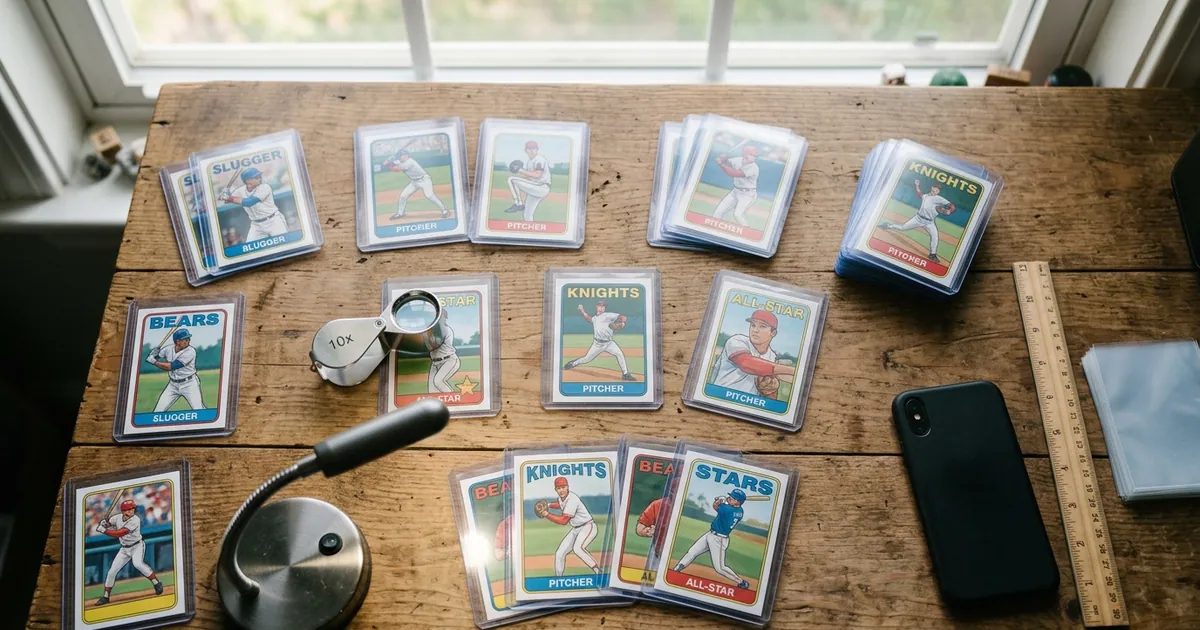
Baseball card values come down to five things: the player, whether it’s a true rookie card, how scarce that specific version is, the era it came from, and its condition. Price guides and asking prices are mostly noise. The number that matters is what the exact same card, in the same condition or grade, actually sold for recently. This guide shows you how to tell which factors apply to the card in your hand and how to turn that into a realistic price.
Key takeaways
- Recent sold prices are the only reliable value. Match the exact card, parallel, and grade. Asking prices and printed guides trail the market.
- Rookie cards drive the market. First-year cards of Hall of Famers and current stars hold most of the money. Most base cards of common players from 1986 to 1993 are worth very little.
- Modern scarcity comes from versions of the same card. Parallels, serial numbering, short prints, and autographs can make one player’s card worth cents in one version and hundreds or more in another.
- Condition multiplies value, especially at the top. On modern cards, the gap between a 9 and a 10 can be dramatic.
- Grade only when the numbers work. Realistic graded value minus fees and shipping has to beat the raw price.
The five factors behind baseball card values
1. The player
Demand follows the name on the front. Hall of Famers, all-time greats, and today’s biggest stars hold value. Most players’ cards are worth little no matter how old they are.
Active players’ prices move with performance, injuries, and headlines. Prospect cards swing the hardest because buyers are betting on a career that hasn’t happened yet. If you’re holding prospect cards, remember that a price you see today can look very different after one bad season.
2. Rookie card status
A player’s officially licensed rookie card is usually their most important card. Since 2006, MLB-licensed rookie cards have carried a printed RC logo, which makes modern rookies easy to spot.
For older cards, you have to know the set history. Some famous examples are widely documented, like the 1989 Upper Deck Ken Griffey Jr. In the 1980s, players also had “XRC” cards from traded or update sets that came out before their first regular-issue rookie.
Modern prospects add another layer. Bowman cards marked as a player’s first Bowman card often come out years before the official RC. They form their own market, and the Chrome and autographed versions draw the most interest.
3. Scarcity: parallels, serial numbers, short prints, and autographs
Modern products print the same card in many versions. These are the ones that matter most:
- Parallels. These are the same photo and design with a different finish or border color, such as refractors in Topps Chrome. Rarer colors sell for more.
- Serial numbering. A stamped number like 12/99 tells you exactly how many exist. Lower print runs usually mean higher prices, and a 1/1 sits at the top.
- Short prints and image variations. These are scarcer versions that sometimes differ only by photo. Confirm them against the set checklist from the manufacturer or a trusted database before you assume yours is one.
- Autographs. On-card autographs generally sell for more than sticker autographs of the same player.
Licensing matters too. Topps has held the exclusive MLB license since 2010, so Panini baseball cards show players without official team logos. Unlicensed cards typically sell for less than comparable Topps or Bowman cards.
4. Era
| Era | What drives value | Typical condition | Common pitfall |
|---|---|---|---|
| Pre-war (before ~1942) | Player, rarity, authenticity | Wear is expected; high grades are rare | Reprints and alterations |
| Vintage (~1948-1979) | Stars and rookies; condition premiums are huge | Off-center printing and rough card stock are common | Assuming age alone means value |
| Junk wax (~1986-1993) | Only key rookies in top condition | Mass-produced; gem copies are the point | Overpaying for common “errors” |
| Modern (1994-present) | Rookies, parallels, serial numbers, autographs | Gem condition is expected for top prices | Ignoring which parallel you have |
The junk wax era deserves a warning. Sets from that stretch were printed in such huge quantities that most cards are worth little even in great shape. Treat “rare error” listings from those years with suspicion, because many advertised errors were printed in large numbers.
Condition: where the biggest swings happen
Condition is where the same card can be worth very different amounts. Graders look at four areas: centering, corners, edges, and surface.
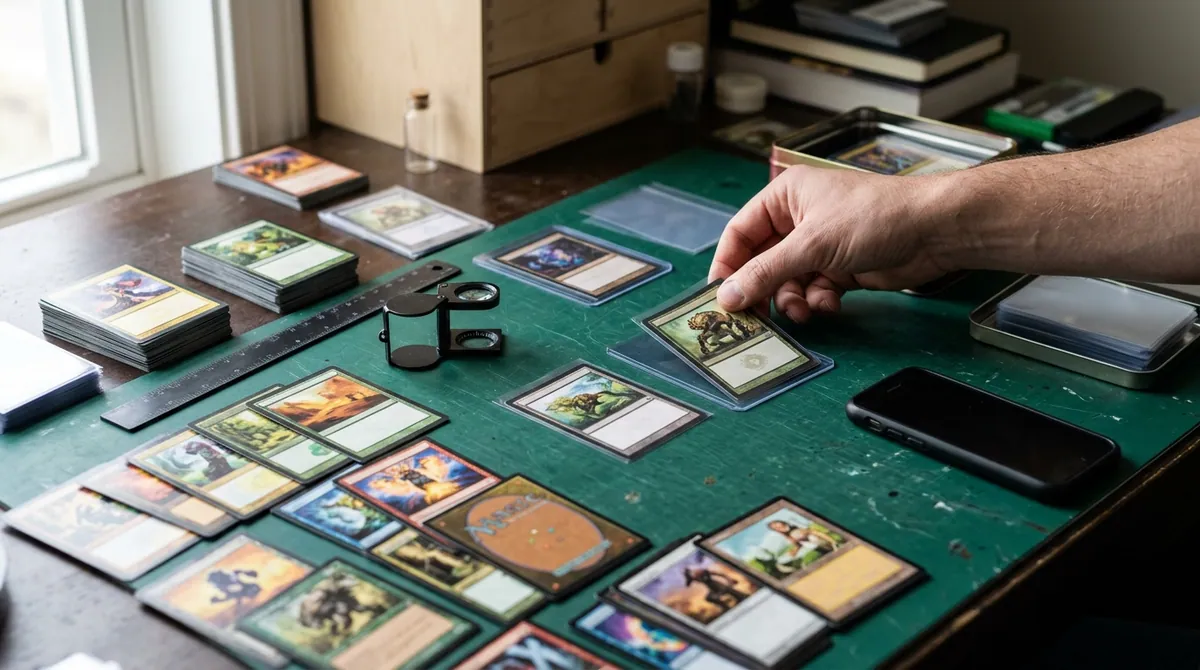
Centering. PSA’s published standards call for roughly 55/45 or better on the front and 75/25 on the back for a Gem Mint 10. A Mint 9 allows about 60/40 on the front and 90/10 on the back. A NM-MT 8 allows about 65/35 on the front and 90/10 on the back. Other graders use different tolerances, and standards can be updated, so confirm on each company’s official site. You can measure centering with a ruler or with our card centering tool.
Corners. Use a 10x loupe. Look for softness, rounding, or fraying. Any visible white at a corner tip rules out a top grade on most modern cards.
Edges. Check every edge for chipping and whitening. This matters most on cards with dark or colored borders.
Surface. Hold one bright light at a low angle and slowly tilt the card. This raking light shows scratches, print lines, dimples, and indentations that overhead room light hides. Chrome and refractor finishes show scratches easily, so check them closely.
Vintage condition works differently. Cards from the 1950s through the 1970s were often cut off-center and printed on rough stock. Buyers expect some flaws, which is exactly why sharp, well-centered vintage copies sell for large premiums.
Where to find real baseball card values
Use sold data, not asking prices. These are the most useful sources:
- eBay sold listings. Filter for sold items and match the year, set, card number, parallel, and grade exactly. When a listing sells through Best Offer, eBay shows a struck-through price instead of the real one. Third-party tools like 130point can often show the accepted offer.
- PSA Auction Prices Realized. This tracks sales of PSA-graded cards by grade.
- Major auction house archives. These are useful for high-end vintage cards and key rookies.
- Printed or online price guides. They’re good for identifying cards. They often lag the market, so don’t treat them as the value.
Follow a few comp rules:
- Use at least three to five recent sales.
- Throw out obvious outliers.
- Note the sale dates.
- Compare like with like. A PSA 10, a BGS 9.5, and an SGC 10 of the same card often sell at different prices.
- Price raw cards against raw sales, not slabbed ones.
Step-by-step: value a baseball card in your hand
Work through this checklist with the card sleeved and a notebook nearby:
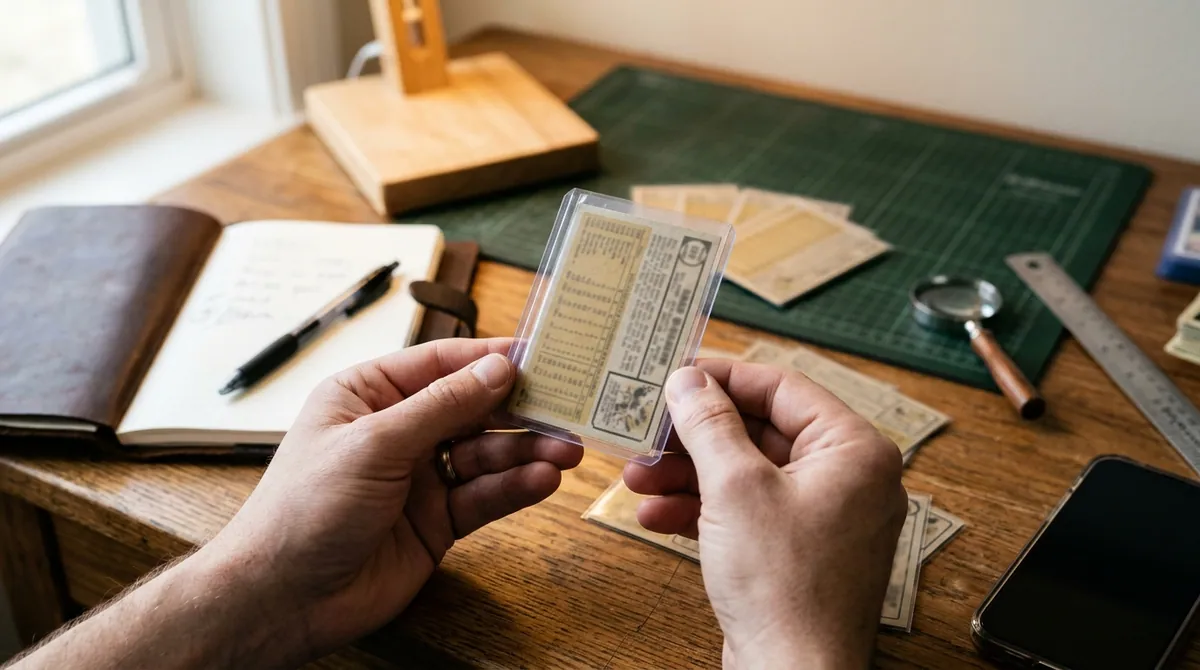
- Read the back. Write down the year, manufacturer, set name, and card number.
- Check rookie status. Look for the RC logo on cards from 2006 onward. For older cards, check the set checklist to see whether this is the player’s rookie, XRC, or first Bowman card.
- Identify the version. Compare the finish and border to the base card. Check for a serial number stamp, usually on the back. Look up the set checklist for short prints or variations.
- Note any autograph or relic. Record whether the autograph is on-card or a sticker.
- Check centering. Measure the borders left to right and top to bottom on both front and back. Compare the results against the grader standards above.
- Inspect corners and edges. Use a loupe under bright, even light.
- Inspect the surface. Use a single low-angle light and tilt the card slowly through several angles.
- Decide on a realistic grade range. Be honest here. Most raw cards from packs are not 10s.
- Pull sold comps. Get raw sales, plus graded sales at the high and low end of your expected range.
- Write down three numbers. Record the raw value, the likely graded value, and the cost to grade. You’ll use them in the next section.
When grading raises value, and when it doesn’t
Grading adds value in three ways:
- It confirms authenticity.
- It locks in a condition buyers trust.
- It makes high-grade copies easy to sell.
That value isn’t free, though. Before you submit anything, run this check:
Expected graded price − grading fee − shipping and insurance > raw price
Here’s a hypothetical example. Suppose a raw card sells for $40, a PSA 10 sells for $200, a PSA 9 for $60, and a PSA 8 for $35. If your honest inspection says this is a 9, grading probably loses money once fees and shipping come out. If it looks like a strong 10 candidate, the math may work. Fees vary by service level and change over time, so check the grader’s site. Our PSA grading cost guide covers how the tiers compare.
Skip grading when:
- The card is a common base card, especially from the junk wax era.
- There’s a visible crease, a stain, or heavy corner wear on a modern card.
- The centering is clearly outside the tolerance for the grade you’d need.
- It’s a hyped prospect whose price could fall while the card sits in a grading queue.
Consider grading when:
- It’s a key rookie or a vintage star.
- It’s a low-numbered parallel or an autograph, where authentication protects resale.
- It’s a card that looks clean under a loupe and raking light.
For a deeper look at sports-specific grading, see our sports card grading page.
How Card Grading AI fits in
The hardest part of valuing a raw card is guessing its grade. That guess decides which comps you should trust.
Card Grading AI analyzes photos of your card for centering, corners, edges, and surface, then returns an estimated pre-grade. It’s an estimate, not an official grade, an appraisal, or a guarantee. It does not replace PSA, BGS, SGC, CGC, or TAG.
What a pre-grade does is help you sort cards in two ways:
- It separates likely 10 candidates from cards that should stay raw.
- It points you to the right sold comps instead of the most flattering ones.
You can also track your collection and purchase prices in one place. See everything on our features page, and read how to value sports cards with AI for a walkthrough of combining pre-grades with price data.
Pull out the card you’re most curious about and run the checklist above. Then scan it with Card Grading AI to check your condition read before you spend money on a grading submission.
FAQ
How do I find out what my baseball card is worth?
Identify the exact card first: year, set, card number, and any parallel or serial number. Then look up recent sold prices for that exact card in matching condition or grade. eBay sold listings, PSA's Auction Prices Realized, and major auction house archives are good sources. Use several recent sales rather than one, and ignore asking prices.
Are baseball cards from the late 1980s and early 1990s worth anything?
Most base cards from roughly 1986 to 1993 are worth very little because they were printed in enormous quantities. The exceptions are key rookie cards of star players, especially in true gem-mint condition, and some genuinely scarce inserts. Be skeptical of listings advertising rare errors from this era. Many were mass-produced.
Does grading always increase a baseball card's value?
No. Grading pays off when the card is valuable and likely to land a high grade, or when authentication matters, as with vintage stars or autographs. For common cards or cards with visible flaws, the grading fee and shipping often exceed any price gain. Run the numbers using sold prices at the grade you realistically expect.
Is a Card Grading AI pre-grade the same as a PSA grade?
No. Card Grading AI gives an estimate based on photos of centering, corners, edges, and surface. It helps you decide which cards to submit and which sold comps to compare against. Only a grading company like PSA, BGS, SGC, CGC, or TAG can assign an official grade.
Keep reading
Related guides
Ready to inspect your next card?
Scan your cards instantly with Card Grading AI
Capture a clear front-and-back photo, review an AI-assisted condition estimate, and keep standout cards organized in your collection.