Collector guide
Raw vs Graded Cards: Which Is Worth More in 2026?
Raw vs graded cards explained: costs, liquidity, resale value, risk, and how to decide which cards to slab and which to sell ungraded.
By Matteo G.
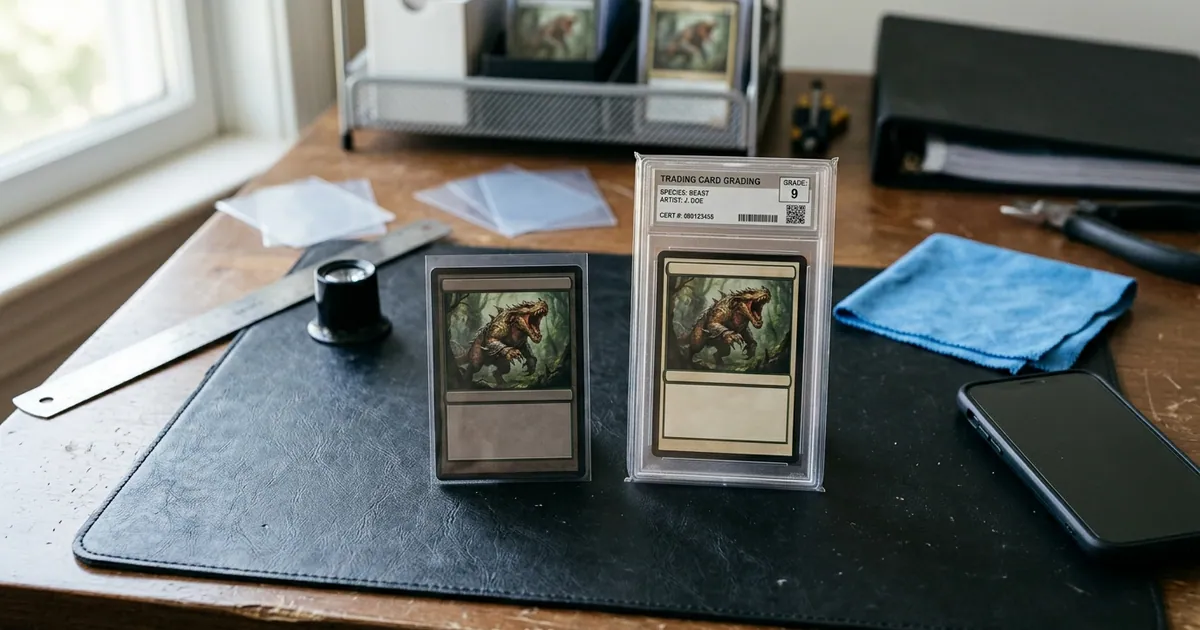
Every collector eventually hits the same fork in the road: leave a card raw, or send it off to be graded and slabbed? The answer changes card by card, and getting it wrong costs real money — either in grading fees you never recover, or in resale value you leave on the table. This guide breaks down what raw and graded really mean, how each one behaves in the US market, and how to build a repeatable decision process instead of guessing.
What “raw” and “graded” actually mean
A raw card is any card that has not been evaluated and encapsulated by a third-party grading company. It might be mint out of the pack, it might be a 1999 card that has lived in a binder for two decades. Raw is a packaging status, not a condition status — which is exactly why raw sales carry so much ambiguity.
A graded card has been submitted to a company like PSA, BGS, CGC, or TAG, examined for centering, corners, edges, and surface, assigned a numeric grade, and sealed in a tamper-evident holder with a label and certification number. The slab does three things at once: it authenticates the card, it standardizes condition into one number a buyer can trust, and it protects the card from future damage.
That third-party number is the whole ballgame. When two collectors argue over whether a card is “near mint” or “excellent,” they are arguing about opinions. A graded card replaces the argument with a shared reference point.
Raw vs graded at a glance
| Factor | Raw cards | Graded cards |
|---|---|---|
| Upfront cost | None beyond sleeves and toploaders | Grading fee, shipping both ways, insurance |
| Time to sell-ready | Immediate | Weeks to months depending on service level |
| Buyer confidence | Depends on your photos and description | High — condition and authenticity are certified |
| Price ceiling | Capped by condition uncertainty | Highest for top grades |
| Downside risk | Buyer disputes, returns, low offers | A low grade can permanently cap the value |
| Best for | Lower-value cards, cards you plan to trade or keep | High-value, high-condition, or vintage cards |
| Storage | Compact, flexible | Bulky, but far more protective |
The economics: when grading pays for itself
Grading is a spread business. You are betting that the difference between the raw price and the graded price at your expected grade is larger than your total cost to get there.
A workable formula:
Expected gain = (likely graded price × your confidence in that grade) − raw price − grading fee − shipping and insurance − supplies
Three things trip people up here.
First, people anchor on the PSA 10 price. If a card is $400 in a 10 and $45 in a 9, the 10 price is irrelevant unless your card genuinely has a shot at a 10. Modern cards get graded in enormous volume, and the gap between a 9 and a 10 is often razor-thin on a print line or a soft corner you can barely see.
Second, fees are not just the fee. Add outbound shipping with tracking and insurance, return shipping, card savers, team bags, and a rigid mailer. On a bulk submission that overhead spreads out nicely. On a single card, it can double your effective cost.
Third, liquidity has value. A graded card sells faster, to a wider audience, with far fewer condition complaints. If you are actively moving inventory, that alone can justify grading cards you would otherwise leave raw.
As a rough US market heuristic: if a card is worth under about $25 raw and does not have a dramatic graded premium, it usually belongs in a binder, not a slab.
Where raw cards genuinely win
Raw is not the consolation prize. There are clear situations where staying raw is the smarter play.
- Player and set collectors. If you are building a master set in a binder, slabs are a storage nightmare and add cost without adding enjoyment.
- Modern bulk. Base rookies, common holos, and reprints rarely clear the grading break-even line.
- Cards with obvious flaws. A visible surface scratch or a whitened corner will not improve in a slab. Grading confirms the problem and prints it on a label.
- Trade fodder. Raw cards are easy to bundle, ship cheaply, and trade at local shops or shows.
- Cards you might upgrade later. Keeping a copy raw preserves the option to sell it quickly and buy a better copy.
The key to selling raw well is documentation. Shoot both sides under even, diffuse light. Add tight shots of all four corners and the edges. Describe flaws in words, not just photos. Buyers forgive imperfections they were told about; they do not forgive surprises.
Where graded cards genuinely win
- Vintage and high-dollar cards, where authenticity and trimming concerns are real and a slab is functionally required for serious buyers.
- Cards with steep grade curves, where a 10 is worth multiples of a 9 and your copy looks clean under magnification.
- Long-term holds, where encapsulation protects against handling, humidity, and accidental damage.
- Anything you plan to consign or auction, since major auction houses and high-end buyers expect certification.
Building a decision process you can repeat
Here is the workflow most experienced US collectors converge on.
1. Sort by value first, not by feelings. Pull out every card with a raw value above your grading threshold. Everything below it goes to a binder. Cataloging your collection in one place makes this dramatically faster — you can browse identified cards and market context in the /catalog.
2. Inspect condition honestly. Use a bright light, a loupe or your phone’s macro mode, and check centering front and back, all eight corners, edge whitening, and surface under angled light. Rotate the card slowly; surface scratches only appear at certain angles.
3. Run a pre-grade estimate before you pay for anything. This is the step that saves the most money. Card Grading AI scans your card and returns AI-assisted subgrade estimates for centering, corners, edges, and surface, plus an overall pre-grade range. It is not an official grade and it never replaces PSA, BGS, CGC, or TAG — it is a triage tool that helps you separate the likely 9.5s from the obvious 8s before you commit to a submission. See /how-it-works for the scan flow and /pricing for plan details.
4. Compare raw and graded comps at the realistic grade. Look at recent sold prices, not asking prices, and weight the grade your inspection actually supports.
5. Submit selectively. Group your keepers into one submission to spread shipping costs. Everything that fails the math stays raw and gets listed or stored.
Common mistakes to avoid
- Grading sentimental cards. A slab does not make a card mean more to you. It just makes it cost more.
- Ignoring centering. Centering is the most common ceiling on an otherwise clean card, and it is the easiest thing to measure before submitting.
- Assuming pack-fresh equals gem. Factory cutting, print lines, and roller marks happen inside the wrapper.
- Cracking slabs to resubmit without a reason. If the original grade was fair, you are paying twice for the same answer.
- Forgetting the calendar. Turnaround times are real. A card locked in a submission cannot be sold during a market spike.
The practical takeaway
Raw versus graded is not a philosophy debate — it is a per-card cost-benefit calculation. Grade the cards where certification unlocks a materially higher price or protects a materially valuable asset. Keep everything else raw, documented, and stored well.
The fastest way to stop guessing is to screen your collection before you spend a dollar on fees. Scan your best candidates with Card Grading AI, review the estimated subgrades, and submit only the cards where the numbers make sense. Remember that every result is an estimate meant to inform your decision, not an official grade or an appraisal — the grading company always has the final word.
FAQ
Are graded cards always worth more than raw cards?
No. Graded cards usually sell for more only when the grade is high and the card has enough underlying value to justify the fee. A common card that grades a 9 can easily be worth less than the cost of grading it, and a mid-grade slab on a low-value card often sells for about the same as the raw copy.
Should I buy raw or graded cards as an investor?
Graded cards remove condition guesswork, which is why they trade with tighter spreads and fewer disputes. Raw cards can offer better upside if you are confident in your condition assessment, but you are taking on the risk that the market disagrees with you. Many collectors buy graded for expensive vintage and raw for modern cards they plan to grade themselves.
How do I know if a raw card is worth grading?
Compare the raw market price to the graded price at the most likely grade, then subtract grading fees, shipping, insurance, and supplies. If the spread does not clearly cover those costs with room for error, keep it raw. Running a pre-grade estimate first with Card Grading AI helps you screen out obvious 8s before you pay for a submission.
Does Card Grading AI give me an official grade?
No. Card Grading AI produces AI-assisted pre-grade estimates for centering, corners, edges, and surface so you can triage your collection. Only PSA, BGS, CGC, TAG, and other grading companies can issue an official grade, and their final call may differ from any estimate.
Is it safe to sell raw cards online?
Yes, if you document condition carefully. Photograph the front and back under even light, show corners and edges close up, note any flaws in the description, and ship in a semi-rigid holder inside a rigid mailer. Clear condition disclosure is the single best way to avoid returns and not-as-described claims.
Keep reading
Related guides
Ready to inspect your next card?
Scan your cards instantly with Card Grading AI
Capture a clear front-and-back photo, review an AI-assisted condition estimate, and keep standout cards organized in your collection.