Collector guide
How to Check a Card's Value: A Collector's Guide
Learn how to check a card's value step by step using sold comps, population data, condition, and grade multipliers—plus how AI pre-grading helps you price smarter.
By Matteo G.
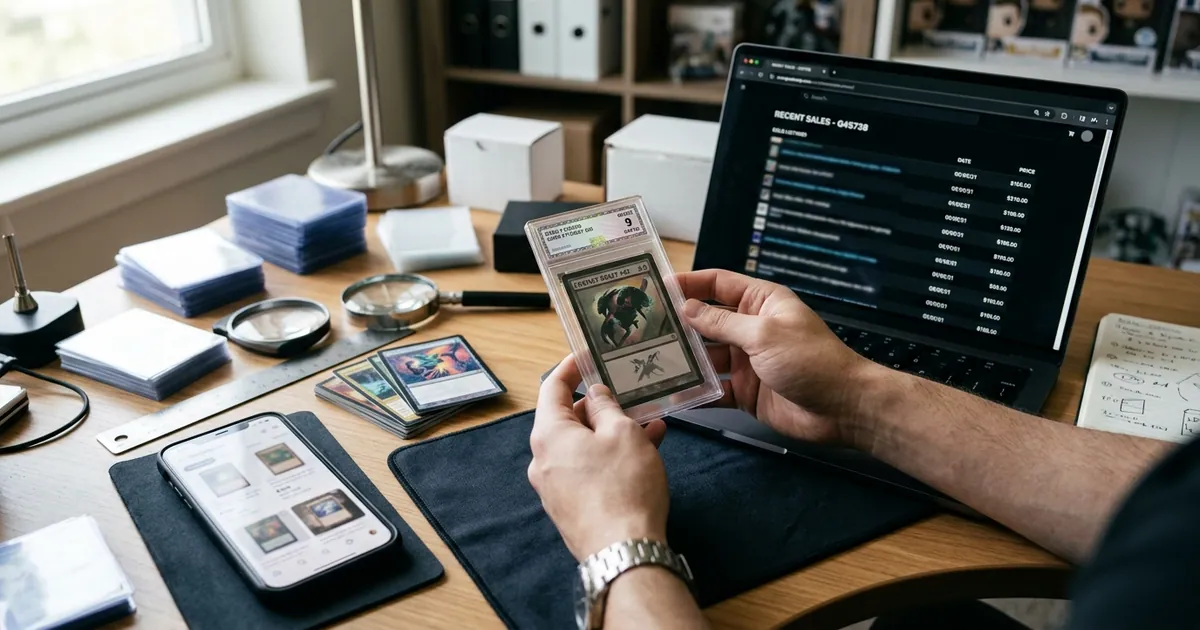
Every collector eventually asks the same question: what is this card actually worth? The honest answer is that a card is worth what a real buyer recently paid for the same card in the same condition. Everything else—price guides, app estimates, forum opinions, the number your friend swears he saw once—is context, not truth. The good news is that checking a card’s value is a repeatable process, and once you learn it you can price a single card in about three minutes and a whole box in an afternoon.
This guide walks through exactly how to check a card’s value as a US collector: how to identify the card correctly, where to find reliable sold comps, how condition and grade change the number, and how to avoid the mistakes that cost people real money.
Step 1: Identify the exact card, not just the player or character
Most bad valuations start here. Two cards can show the same player, the same year, and the same photo, yet be worth $4 and $400. What separates them is set, parallel, print run, and numbering.
Before you look up a price, write down:
- Year and set (for example, 2023 Topps Chrome, not just “Topps”)
- Card number, usually printed small on the front or back
- Parallel or insert name: refractor, prizm, holo, reverse holo, silver, gold, negative, etc.
- Serial number if it is numbered, such as /99 or /25
- Rookie card indicators (RC logos, first-year status)
- Language and region for Pokémon and other TCG cards—Japanese, English, and Korean prints trade in separate markets
If you are not sure what you are holding, scanning it is faster than squinting at the copyright line. Card Grading AI can identify cards and file them into your organized collection, so you can build a clean list before you start pricing. Browse the supported sets in the catalog to see how granular the identification gets.
Step 2: Pull recent sold comps, not active listings
Active listings tell you what sellers hope to get. Sold listings tell you what the market actually paid. Always use the latter.
When you search sold prices, filter or manually screen for:
- The same grade. A PSA 10 comp is meaningless if your card is raw.
- The same parallel. Base and refractor sales get mixed together constantly.
- A recent window. Prefer the last 30 days; extend to 90 days only if sales are thin.
- Single cards, not lots. A four-card lot at $60 is not a $60 comp.
- Real transactions. Skip suspiciously round numbers on brand-new seller accounts and any listing where the photo does not match the title.
With five to ten clean comps, throw out the highest and lowest, then take the middle of what remains. That midpoint is your working value. If you only find one or two sales, treat the number as a rough range rather than a price.
Step 3: Grade the condition honestly
Condition is the single biggest value multiplier for most cards. The same 1999 holo can be a $30 card with soft corners and a four-figure card in a high grade. That is why checking value without assessing condition is guesswork.
Look at the four things graders look at:
- Centering — front and back border ratios. Off-center cards cap out fast. Our centering guide explains how the measurement actually works.
- Corners — sharp, or slightly rounded and fuzzy under light?
- Edges — whitening, chipping, or rough cuts along the border
- Surface — print lines, scratches, dimples, and gloss loss under angled light
This is where an AI pre-grade helps. Card Grading AI scans your card and returns an estimated condition assessment with sub-scores, so you have a defensible starting point instead of a gut feeling. It is an estimate, not an official grade—only PSA, BGS, CGC, or TAG can issue those—but it tells you which comp tier to shop against. See how the scanning workflow fits together on the features page.
Step 4: Apply grade tiers to your comp research
Once you have a condition estimate, look up comps at that tier and one tier above and below. That gives you a realistic range plus a sense of your upside if a submission goes well.
| What you have | Which comps to check | What usually drives the price |
|---|---|---|
| Raw card, visible wear | Raw / ungraded sold listings | Photos, honesty of description, seller feedback |
| Raw card, looks clean | Raw comps plus PSA 8–9 comps | Perceived grading upside, centering |
| Raw card, looks near-flawless | PSA 9 and PSA 10 comps, minus fees | Whether a 10 is realistic; surface under light |
| Graded 8–9 | Same grade, same company | Population count, eye appeal within grade |
| Graded 10 / Black Label | Same grade, same company | Scarcity at the top grade, current demand |
A practical rule: if a raw card is worth $25 and a graded 9 is worth $45, grading probably is not worth it after fees and shipping. If raw is $60 and a 10 is $600, the math changes completely. Sports collectors can dig deeper into that decision in our sports card grading breakdown.
Step 5: Adjust for demand signals the comps miss
Comps are backward-looking. A few forward-looking factors are worth a mental adjustment:
- Player or character momentum. A rookie’s cards can move 30% in a week during a hot streak, and fall just as fast after an injury.
- Population growth. As more copies get graded, high-grade scarcity often erodes and prices drift down.
- Reprints and re-releases. New printings of a popular character usually soften older equivalents.
- Seasonality. Sports cards typically get more attention during their season and playoffs.
- Sale channel. Auctions with strong exposure can beat fixed-price listings on desirable cards, while common cards usually sell faster at a set price.
Step 6: Record the value and re-check it
A one-time lookup goes stale within weeks. Keep a running record of each card’s identification, your condition estimate, the comp range you found, and the date you checked. That log is what makes insurance conversations, trade negotiations, and tax records simple instead of stressful.
Card Grading AI stores your scans, pre-grade estimates, and collection organization in one place, so re-checking values later means updating comps rather than rebuilding your whole inventory from scratch. Compare plan options on the pricing page.
Common mistakes that lead to bad valuations
- Using asking prices. The most-listed price is not the market price.
- Ignoring the grading company. A PSA 9 and a CGC 9 do not always trade at the same level.
- Comparing across languages. Japanese and English TCG markets price differently.
- Assuming your raw card is a 10. Most are not. Surface flaws hide until you tilt the card under a light.
- Forgetting total costs. Grading fees, shipping both ways, insurance, and selling fees all come out of your gross.
- Trusting a single sale. One high outlier is a story, not a comp.
Putting it all together
Checking a card’s value comes down to a short loop: identify exactly what you have, estimate its condition honestly, find clean sold comps at that condition tier, adjust for current demand, then write the number down with the date. Do it in that order and you will price cards more accurately than most people at a card show.
If you want to skip the tedious parts—identification, condition notes, and keeping your inventory organized—start by scanning your top 20 cards with Card Grading AI. You will get an AI pre-grade estimate for each one and a structured collection you can actually search, which makes every future comp check faster. Just remember what the estimate is and is not: a helpful screening tool for deciding what to sell, hold, or submit, never an official grade or appraisal.
FAQ
What is the most accurate way to check a card's value?
Recent sold prices for the exact same card, same set, same parallel, and same grade are the most accurate source. Asking prices and price-guide averages are useful context, but only completed sales show what buyers actually paid. Look at the last 30 to 90 days of sales and ignore obvious outliers such as lots, reprints, or listings with the wrong card pictured.
Does a card have to be graded to have value?
No. Plenty of raw cards sell well, especially modern parallels, vintage stars, and popular Pokémon cards. Grading mainly matters when the card is valuable enough that condition confirmation and protection add more money than the grading fee and shipping cost. For lower-value cards, the fees often eat the entire upside.
Can Card Grading AI tell me exactly what my card is worth?
Card Grading AI helps you identify the card, organize it in your collection, and see an AI pre-grade estimate of condition so you can compare against the right sold comps. It does not issue official grades or appraisals, and no app can guarantee a sale price. Final value always depends on the live market and, if you submit, the grading company's official assessment.
How often do card values change?
Constantly. Modern sports cards can swing within a single week based on player performance, injuries, or playoff runs. Pokémon and vintage cards move more slowly but still react to reprints, set rotations, and grading population changes. Re-check comps before any sale, and re-check insured values on your top cards at least once or twice a year.
Keep reading
Related guides
Ready to inspect your next card?
Scan your cards instantly with Card Grading AI
Capture a clear front-and-back photo, review an AI-assisted condition estimate, and keep standout cards organized in your collection.