Collector guide
Beckett Card Grading: The BGS Scale and Subgrades
How Beckett card grading works: the BGS 1-10 scale, the four subgrades, how the overall grade is set, label colors, and a pre-check checklist.
By Matteo G.
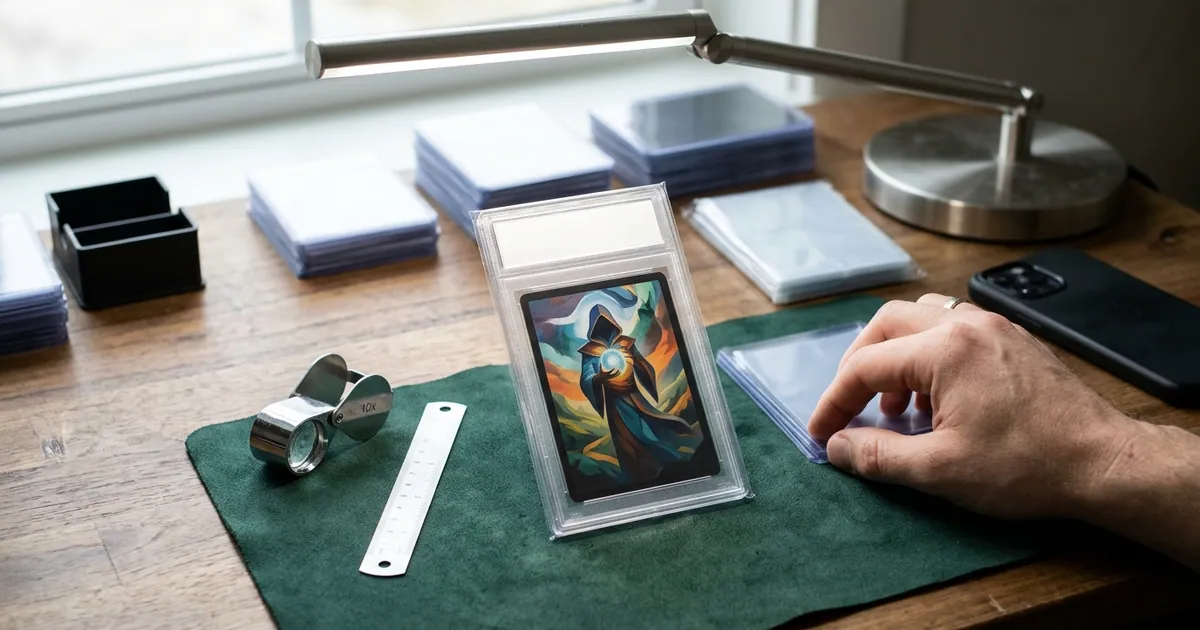
Beckett card grading (BGS) rates cards on a 1-to-10 scale in half-point steps. Each card also gets four subgrades, for centering, corners, edges, and surface. The overall grade is driven mostly by the weakest subgrade, not an average of all four. That is why a card with three perfect categories can still come back a 9.
If you understand how those subgrades work, you can predict your BGS result much more accurately. You can also tell when Beckett is the right company for a card and when it isn’t.
Key takeaways
- BGS uses a 1-10 scale in half-point increments, plus four subgrades: centering, corners, edges, surface.
- The overall grade is not an average. It generally can’t exceed your lowest subgrade by more than one point, and the lowest subgrade matters most.
- A BGS 9.5 Gem Mint typically needs three 9.5 subgrades and none below 9. A Black Label requires 10 in all four.
- Subgrades cut both ways. They reward a near-perfect card, but they also publish its weak spot to every buyer.
- Pre-check centering and surface before you pay the fee. Those two categories surprise people most.
How the BGS grading scale works
Beckett grades from 1 (Poor) to 10 (Pristine), with half-point steps at most levels. The tiers that drive the most money are near the top:
- 10 Pristine: flawless to the eye and essentially flawless under magnification
- 9.5 Gem Mint: the grade most collectors think of as “the gem” at Beckett
- 9 Mint: excellent, with minor flaws visible under close inspection
- 8.5 NM-MT+ and 8 NM-MT: clean cards with noticeable but minor issues
The big difference from PSA is the top. PSA’s 10 is its gem grade. At Beckett, 9.5 does that job, and 10 Pristine is a rarer tier above it. If you are comparing companies, our PSA vs BGS vs CGC breakdown covers the market side in more detail.
The four BGS subgrades and what graders check
Each subgrade is scored on the same half-point scale. Beckett publishes descriptions for each grade level on its official grading scale page. The summary below covers what matters most at the top end.
| Subgrade | What a Pristine 10 looks like | How to check at home |
|---|---|---|
| Centering | 50/50 on the front, 60/40 or better on the back | Measure opposite borders with a ruler or a centering tool |
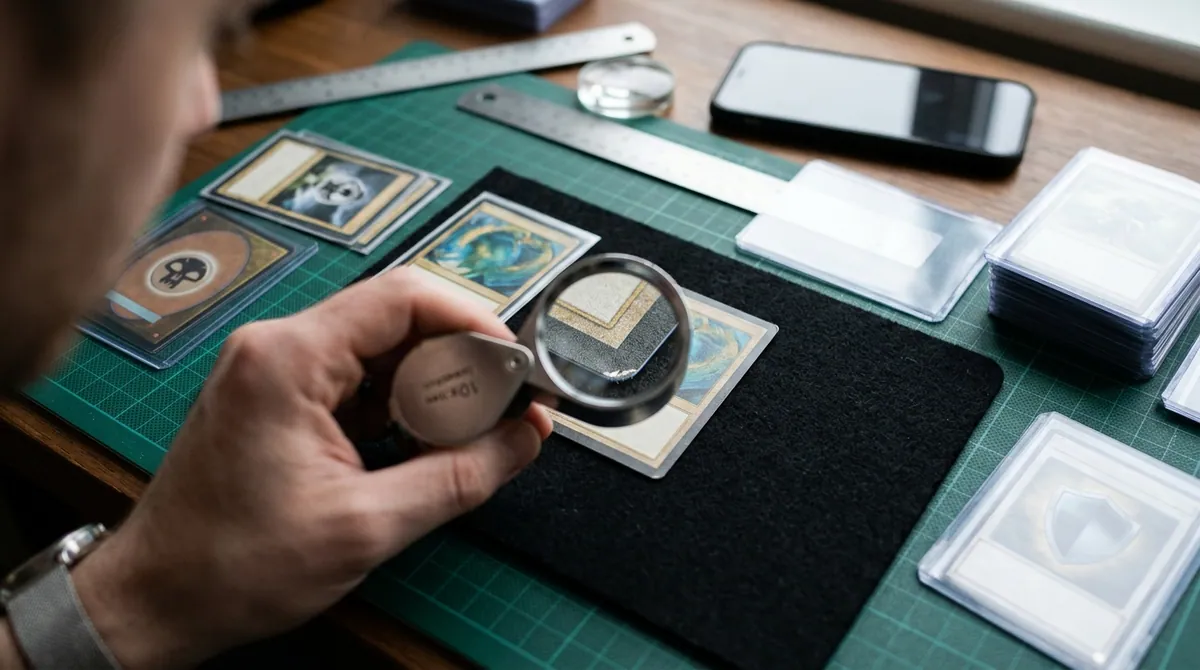
| Corners | Perfect to the naked eye, Mint under magnification | 10x loupe, each corner front and back |
| Edges | Perfect to the naked eye, virtually perfect under magnification | Raking light along all four edges, front and back |
| Surface | No print spots, flawless color and focus, full gloss, no scratches or print lines | Low-angle LED light, tilt the card slowly |
A few practical notes:
Centering is strict at the top. The published 10 standard is 50/50 on the front, so a 10 centering subgrade is genuinely rare. Tolerances loosen with each half-step down. Gem Mint 9.5 centering sits around the 55/45 range. Beckett’s grading scale page lists the exact front and back tolerances for each level, so confirm there before you rely on a number. Back centering counts too, and many people never check it.
Corners and edges are judged under magnification. “Mint to the naked eye” is not enough for a 10. Fraying you can only see with a loupe is often what separates a 9.5 from a 10.
Surface is the silent killer on modern cards. Chrome and holo stock show light scratches, print lines, and dimples that disappear under normal room light. You only see them under a raking light. For a deeper walkthrough, see how to check card surface for grading.
How Beckett turns subgrades into an overall grade
This is the part most guides get wrong. Beckett has stated publicly that the final grade is not an average. In practice, it works like this:
- The lowest subgrade sets the ceiling. The overall grade generally can’t be more than one full point above it.
- The second-lowest subgrade comes next. It determines how close to that ceiling the card lands.
- Graders keep some discretion when they weigh the overall look of the card.
The commonly cited thresholds at the top end:
- 9.5 Gem Mint: at least three 9.5 subgrades, with the fourth no lower than 9
- 10 Pristine (gold label): at least three 10 subgrades, with the fourth no lower than 9.5
- 10 Black Label: all four subgrades at 10
Some worked examples:
- Centering 9.5, Corners 9.5, Edges 9.5, Surface 8.5 → 9 overall. Beckett itself has used this example. One 8.5 is enough to block a 9.5.
- Centering 9, Corners 9.5, Edges 10, Surface 9.5 → likely 9.5. There are three subgrades at 9.5 or better and the lowest is 9.
- Centering 10, Corners 10, Edges 10, Surface 9.5 → 10 Pristine, gold label.
- Centering 8, Corners 10, Edges 10, Surface 10 → not a 9.5. The 8 centering subgrade caps the card no matter how clean everything else is.
The practical lesson: one weak category matters more than three strong ones. When you pre-check a card, look for its worst flaw first.
Black, gold, silver, and white: BGS label tiers
Beckett color-codes its labels, and the label color affects resale more than many new collectors expect.
- Black Label: Pristine 10 with four 10 subgrades. These are very rare and usually carry a large premium.
- Gold Label: 9.5 Gem Mint and non-black Pristine 10s.
- Silver Label: generally the Mint 9 / 8.5 tier.
- White Label: lower grades.
Beckett has adjusted label designs and tier boundaries over the years, so confirm the current scheme on Beckett’s site. Autographed cards also receive a separate autograph grade, which appears on the label alongside the card grade.
Buyers also read the subgrades, not just the label color. A 9.5 with a 10 in centering is generally more appealing than a 9.5 with a 9 in centering. Some collectors specifically hunt “quad 9.5s,” where all four subgrades are 9.5.
BGS vs BVG vs BCCG
Beckett runs more than one grading line, and mixing them up leads to bad comps:
- BGS: the main service for modern cards, with the subgrade system described above.
- BVG (Beckett Vintage Grading): for older cards, with standards adjusted for vintage printing and stock.
- BCCG: a lower-cost line with a simplified scale. A BCCG 10 is not equivalent to a BGS 10.
Service levels, which cards qualify for each line, and whether subgrades are included or optional have all changed over time. Check Beckett’s current submission page before you fill out a form.
Pre-check a card for Beckett in 10 steps
Use this checklist with the card in hand before you pay a grading fee:

- Clean hands, clean surface. Work on a lint-free microfiber cloth or mat. Handle the card only by its edges.
- Set up two lights. Use a neutral-white overhead light and an LED you can hold at a low angle, nearly parallel to the card.
- Measure front centering, left/right. Measure both borders with a ruler. Divide the larger by the total. For example, borders of 2.0 mm and 1.6 mm give 2.0 / 3.6 ≈ 56/44.
- Measure front centering, top/bottom. Repeat the same math. Beckett checks both axes.
- Measure back centering. Anything worse than 60/40 rules out a 10 centering subgrade.
- Loupe all eight corners. Check four on the front and four on the back. Note any white fraying, rounding, or soft tips.
- Run the edges under raking light. Look for chipping, roughness from the factory cut, and whitening. This is especially important on dark borders.
- Tilt the surface slowly under the low-angle LED. Look for scratches, print lines, dimples, print spots, and fingerprints. Check holo and chrome areas twice.
- Assign each category an honest subgrade. Don’t round up. Write the four numbers down.
- Apply the lowest-subgrade rule. If any category lands at 8.5 or lower, assume your realistic ceiling is about one point above it. Then decide whether the expected grade justifies the fee.
If step 3 or 5 is tedious, the card centering tool measures borders from a photo. Our guide on how to measure card centering explains the ratio math in more depth.
When BGS is the right choice, and when it isn’t
BGS can make sense when:
- You have a modern card you believe is genuinely near-flawless. A high gold-label 10 or a Black Label can outperform other companies’ top grades for some cards.
- Buyers in your card’s market actively look for BGS subgrades. This is common for certain modern sports rookies and autographs.
- You want the autograph graded on the same label.
Skip BGS, or skip grading entirely, when:
- The card’s raw value is close to the grading fee. A 9 won’t recover the cost and shipping on a low-value card.
- Centering is visibly off. On many cards, a low centering subgrade printed on the label hurts resale more than the same card in a slab without subgrades would.
- You are chasing the highest liquidity for Pokemon. For many Pokemon cards, PSA 10s tend to sell more readily and at higher prices than BGS 9.5s. Compare sold listings for your exact card before you choose.
- You can’t find recent sold comps for your card in BGS. If there’s no market data, you are guessing at the payoff.
The honest middle ground: subgrades reward truly exceptional cards and expose merely good ones. If your card is “pretty clean” rather than near-perfect, the transparency can work against you.
Using Card Grading AI before you submit
Card Grading AI gives you a fast second opinion before you spend money. Scan the front and back, and the app estimates condition across centering, corners, edges, and surface. It also measures centering ratios from your photo. That maps directly onto how Beckett breaks a card down, so you can spot the weak category that would cap your overall grade. You can read more about the process in how it works or on the AI card grading page. If you mostly submit sports cards, the sports card grading page covers that workflow.
To be clear: our results are AI pre-grade estimates, not official grades, appraisals, or guarantees. Beckett’s graders make the final call. Use the estimate to filter out cards that clearly won’t hit 9.5 and to double-check the ones you think might, then submit with realistic expectations. You can try a scan with Card Grading AI on your next stack of hopefuls before you fill out a submission form.
FAQ
Is the BGS overall grade an average of the four subgrades?
No. Beckett states that the overall grade is not a simple average. The lowest subgrade has the most influence, and the overall grade generally cannot be more than one point above it. The second-lowest subgrade matters next. For example, Beckett has illustrated that subgrades of 9.5, 9.5, 9.5, and 8.5 result in a 9, not a 9.5.
What is the difference between a BGS 10 gold label and a Black Label?
Both are Pristine 10s. A Black Label requires a 10 in all four subgrades: centering, corners, edges, and surface. A gold-label Pristine 10 is commonly understood to need at least three 10 subgrades, with the fourth no lower than 9.5. Black Labels are much rarer and usually sell at a significant premium over gold-label 10s.
Is a BGS 9.5 the same as a PSA 10?
Not exactly. Both mean gem mint condition, but the standards and the market differ. For many modern sports cards, a BGS 9.5 trades somewhat below a PSA 10. Strong 9.5s with high subgrades can come close, and for some Pokemon cards the gap is wider. Always compare recent sold listings for your specific card and grade.
Does Beckett always include subgrades?
Subgrades are what most collectors associate with BGS. However, Beckett has changed its service levels over time, and subgrades have at times been offered as an option rather than included automatically. Check Beckett's current submission options before you send cards if you want subgrades on the label.
Can Card Grading AI tell me what my card will get from Beckett?
No tool can promise an official grade. Card Grading AI gives you an AI pre-grade estimate and a centering measurement from your photos. You can use these to catch obvious problems and decide whether a card is worth submitting, but only Beckett can assign a BGS grade.
Keep reading
Related guides
Ready to inspect your next card?
Scan your cards instantly with Card Grading AI
Capture a clear front-and-back photo, review an AI-assisted condition estimate, and keep standout cards organized in your collection.