Collector guide
PSA 10 Centering Requirements: The Real Numbers
PSA 10 centering requirements explained: front and back ratios, how to measure them, a hands-on checklist, and when an off-center card isn't worth grading.
By Matteo G.
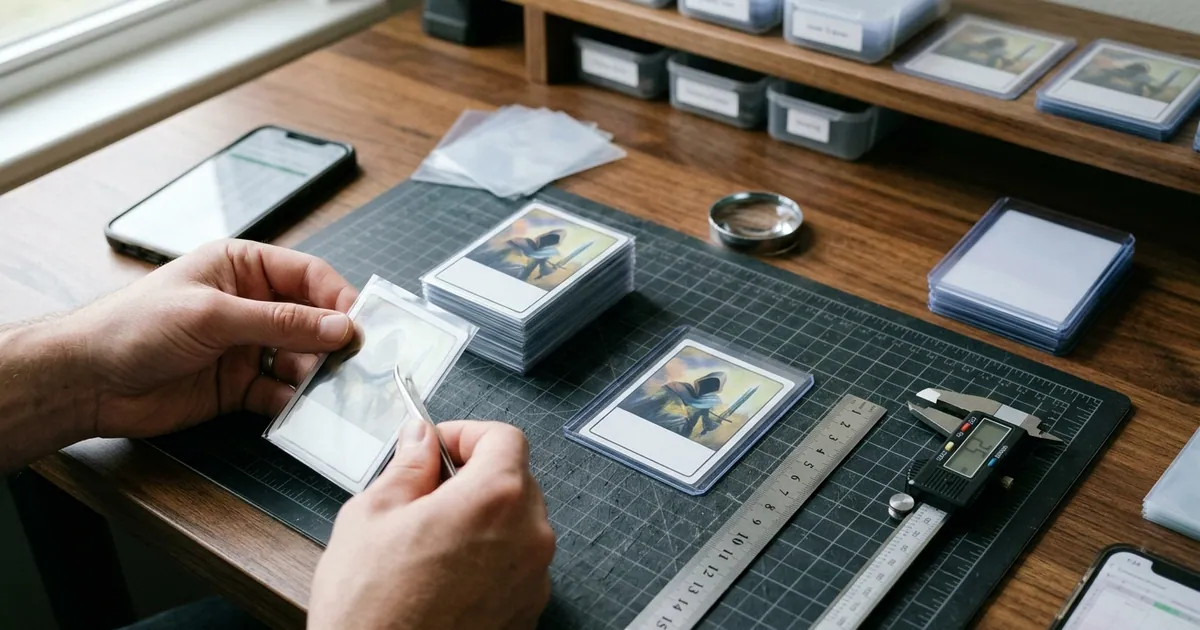
PSA’s published standard for a Gem Mint 10 calls for front centering of approximately 55/45 to 60/40 or better and back centering of 75/25 or better. That applies to both left/right and top/bottom, and the worse axis is the one that counts. PSA has tightened its front-centering language over the years, so aim for 55/45 or better and confirm the current wording on PSA’s official grading standards page before you submit.
Centering is also only the entry ticket. A perfectly centered card with one soft corner still won’t get a 10.
Key takeaways
- Front: roughly 55/45 to 60/40 or better for a PSA 10. Treat 55/45 as the safe target and 60/40 as the edge of the cliff.
- Back: 75/25 or better. That’s forgiving, but not unlimited.
- Both axes count. A card that’s 50/50 left-to-right but 63/37 top-to-bottom is not a 10 candidate.
- Measure, don’t eyeball. Most people can’t reliably tell 58/42 from 62/38 by eye, and that gap is often the difference between a 10 and a 9.
- Borderline centering changes the math. If the card’s PSA 9 value doesn’t cover the grading fee and shipping, a coin-flip on centering is a bad bet.
What PSA Actually Publishes for a 10
PSA lists its grading standards publicly. For Gem Mint 10, it describes a virtually perfect card: four sharp corners, sharp focus, full original gloss, no staining, and a slight printing imperfection allowed only if it doesn’t hurt the card’s overall appeal. Centering is written as a ratio range for the front and a separate, looser ratio for the back.
A few things about that wording matter:
- It says approximately. PSA graders are people looking at a card, not a machine applying a hard cutoff. A card measuring exactly 60/40 is not guaranteed anything.
- Eye appeal plays a role. PSA states that eye appeal is considered. A card that technically measures in range but looks visibly lopsided, often because of tilt, can lose out.
- Standards change. PSA has revised its centering language before, including a tighter front range for the top grade. Policies can also differ by card type or era. Check PSA’s site the week you submit, not a forum post from three years ago.
If you’re submitting to another company, don’t carry these numbers over. BGS, CGC, SGC, and TAG each publish their own criteria, and some are stricter for their top tier. Look up the company you’re actually using.
How Centering Ratios Work
A centering ratio compares two opposite borders. You measure the left and right borders (or top and bottom), add them together, and express each as a share of the total.
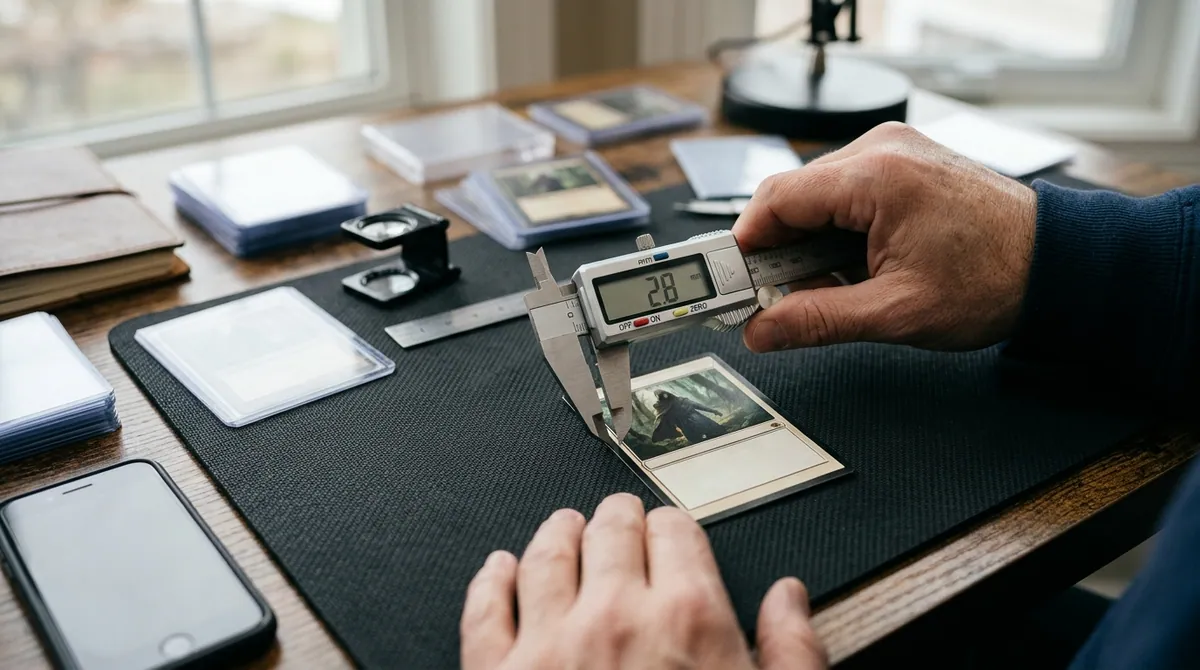
Formula: larger border / (left + right) x 100 = the bigger number in the ratio.
Two worked examples:
- Left border 2.2 mm, right border 1.8 mm. Total 4.0 mm. 2.2 / 4.0 = 55%. That’s 55/45, inside the comfortable PSA 10 zone.
- Left border 2.5 mm, right border 1.5 mm. Total 4.0 mm. 2.5 / 4.0 = 62.5%. That’s 62.5/37.5, outside the PSA 10 range and more like PSA 9 territory on centering alone.
Look at how small that difference is: 0.3 mm on each side moved the card from a safe 10 range to a likely 9. A standard card is 63.5 mm wide and its borders are often only a few millimeters, so tiny shifts produce big ratio swings. That’s why eyeballing fails and a millimeter ruler, calipers, or a scan-based tool works much better.
The back works the same way, just with a looser threshold. A back with a 3.0 mm border on one side and 1.0 mm on the other is 3.0 / 4.0 = 75%, which is exactly 75/25, right at the edge of the PSA 10 back standard.
PSA Centering Standards by Grade
Here’s how PSA’s published centering guidance has typically scaled across grades. Use it to set expectations, then confirm the current figures on PSA’s website, since the wording, especially for 10, has been revised before.
| PSA grade | Front centering (approx.) | Back centering (approx.) |
|---|---|---|
| Gem Mint 10 | 55/45 to 60/40 or better | 75/25 or better |
| Mint 9 | 60/40 to 65/35 or better | 90/10 or better |
| NM-MT 8 | 65/35 to 70/30 or better | 90/10 or better |
| NM 7 | 70/30 to 75/25 or better | 90/10 or better |
| EX-MT 6 | 80/20 or better | 90/10 or better |
The practical read: centering alone can drop a card from a 10 to a 9 with a pretty small miss on the front. The back has much more room, so it’s rarely the deciding factor on modern cards, but it’s not irrelevant.
PSA can also use an OC (off-center) qualifier on a card that would otherwise earn a higher grade. Buyers generally discount qualified slabs heavily, so an OC label on an otherwise clean card is often a worse outcome than a plain lower number.
Step-by-Step: Checking a Card for PSA 10 Centering
Do this with the card in hand, on a clean desk, before you spend a dollar on submission fees.
- Set up your light. Use bright, even, diffused light, like a daylight-balanced desk lamp or a window without direct sun. Harsh single-point light casts shadows on the border edges and throws off measurements.
- Get the card flat. Leave it in a clean, tight penny sleeve or take it out onto a microfiber cloth. Don’t measure through a scuffed toploader. Warped plastic distorts the edges.
- Identify the reference line. On bordered cards, measure from the cut edge of the card to the inner edge of the printed frame. Pick the same visual line on all four sides.
- Measure left and right near the top. Use calipers or a ruler with 0.5 mm marks. Write both numbers down.
- Measure left and right again near the bottom. If these numbers differ noticeably from step 4, the print is tilted. Use the worse pair.
- Measure top and bottom near the left and right sides the same way.
- Calculate both front ratios. Larger border divided by total. Your front score is the worse of the two axes.
- Flip the card and repeat for the back. Many backs have a printed border or frame you can measure against.
- Compare against the standard with a margin. Front 55/45 or better: strong 10 candidate on centering. Between 55/45 and 60/40: possible, but risky. Worse than 60/40: plan for a 9 at best.
- Only then check everything else. Look at corners under magnification, run a light across the surface at a low angle for scratches and print lines, and check edges for whitening. A card has to pass all of it.
If you’d rather skip the arithmetic, our card centering tool measures the borders from a photo and gives you the ratio for each axis.
Tricky Cases: Tilt, Borderless Cards, and Backs
Tilted prints. A diamond-cut or tilted card can measure 52/48 at the top and 64/36 at the bottom. Graders see the whole card, and tilt hurts eye appeal even if one end looks fine. Always measure near both corners on each axis, as in steps 4 and 5.
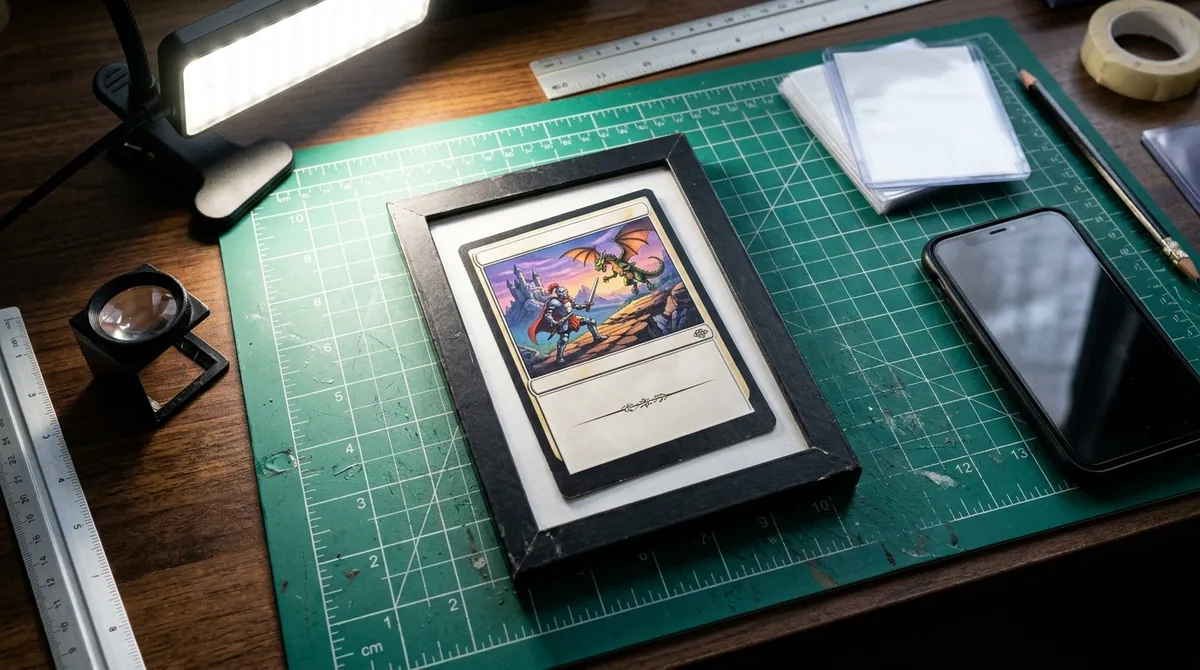
Borderless and full-art cards. No border means no obvious line to measure. Collectors usually measure against a consistent design element: a printed frame, text box, or the edge of an inner art panel. This is judgment-heavy, and you won’t find a published millimeter guide for every set. If a card’s layout is offset in a way that’s obvious at arm’s length, assume a grader will notice too.
Thin borders. Many modern cards have narrow borders, so a fraction of a millimeter swings the ratio hard. Use calipers or a high-resolution flatbed scan rather than a plastic ruler.
Backs. The 75/25 back tolerance sounds generous, and usually is. But miscut sheets sometimes produce backs that are badly shifted even when the front looks acceptable. It takes 30 seconds to check.
Same set, different results. Centering varies within a print run. Don’t assume one copy’s centering tells you anything about another copy from the same pack or box.
When Centering Kills the Case for Grading
Here’s my blunt take: a card that measures worse than 60/40 on the front should not be submitted chasing a 10. Submit it only if a PSA 9, or even an 8, is still worth more than the raw card plus fees, shipping, and insurance.
Run this quick check before submitting:
- Look up recent sold prices for raw, PSA 9, and PSA 10 copies. Use sold listings, not asking prices.
- Add up your total cost: PSA’s fee for the service level you’d need (check PSA’s current pricing, since tiers and fees change), shipping both ways, and insurance.
- Assume the lower grade. If the card is 58/42, plan around a 9 and treat a 10 as a bonus.
- Skip it if the 9 barely beats raw. For plenty of modern cards, a PSA 9 sells for close to raw value, and grading turns into a loss once fees are counted.
Other times not to grade on centering grounds:
- The card is a sentimental keeper. If you’ll never sell it, the slab is mostly protection, and a good toploader or one-touch is cheaper.
- You’re buying raw to crack a 10. If the listing photos don’t let you measure centering, assume the seller already checked and kept the well-centered copies.
- The centering is fine but the surface isn’t. A 50/50 card with a visible scratch is still not a 10.
The reverse is also true: a 50/50 card from a set where well-centered copies are rare can be worth grading even if other flaws are borderline, because centering is the one thing a grader can’t overlook.
How Card Grading AI Fits In
Card Grading AI is built for the step before you pay for grading. You photograph the front and back, and the app estimates centering ratios on both axes along with corners, edges, and surface, then returns a pre-grade estimate. You can read the details on how it works.
To be clear about what that is and isn’t: it’s an estimate, not a PSA grade, an appraisal, or a guarantee. PSA graders apply their own judgment, and only they can put a number on a slab. What a pre-grade can do is flag the cards that are obviously off-center before you spend money on them, and help you sort a stack into likely candidates and keepers.
If you’re screening a batch for submission, start with the centering checker, then run your strongest candidates through the full AI card grading pre-grade to catch corner, edge, and surface issues you might miss.
Quick Decision Guide
- Front 55/45 or better, back 75/25 or better, clean corners and surface: strong PSA 10 candidate. Worth considering for submission if the price spread justifies it.
- Front between 55/45 and 60/40: possible 10, real chance of a 9. Grade only if the 9 still makes financial sense.
- Front worse than 60/40: don’t chase a 10. Grade only for protection, authentication, or if a 9 or 8 still pays.
- Tilted, or unclear reference lines on a full-art card: measure at both ends and lean conservative.
Measure first, check the rest of the card second, run the numbers third. That order saves more money on grading fees than any other habit.
FAQ
What centering does a card need for a PSA 10?
PSA's published standard for Gem Mint 10 calls for front centering of approximately 55/45 to 60/40 or better and back centering of 75/25 or better. PSA has tightened its wording on front centering over time, so check the current grading standards page on PSA's website before submitting.
Is a 60/40 card guaranteed to get a PSA 10?
No. A card at 60/40 sits at the outer edge of the published range, and PSA graders use their own judgment, eye appeal included. Corners, edges, and surface also have to be essentially flawless. Treat 55/45 or better as the comfortable target.
Does back centering matter for a PSA 10?
Yes, but the tolerance is much looser. PSA's Gem Mint 10 standard allows roughly 75/25 on the back. Backs are rarely the reason a modern card misses a 10, but badly shifted backs do happen, so measure them anyway.
What does the OC qualifier mean on a PSA slab?
OC stands for off-center. PSA may apply it when a card would otherwise grade higher but its centering falls below that grade's standard. Collectors usually value OC-qualified cards well below unqualified cards of the same number, so a borderline card can end up worth less than you expected.
Can an app tell me if my card will get a PSA 10?
No app can promise an official grade. Card Grading AI gives you a centering measurement and an AI pre-grade estimate so you can screen cards before paying fees, but only PSA can assign a PSA grade.
Keep reading
Related guides
Ready to inspect your next card?
Scan your cards instantly with Card Grading AI
Capture a clear front-and-back photo, review an AI-assisted condition estimate, and keep standout cards organized in your collection.