Collector guide
How to Spot Fake Pokemon Cards: A Collector's Checklist
Learn how to spot fake Pokemon cards with checkable tests: text, holo texture, light, weight, loupe print patterns, plus fake slabs and resealed packs.
By Matteo G.
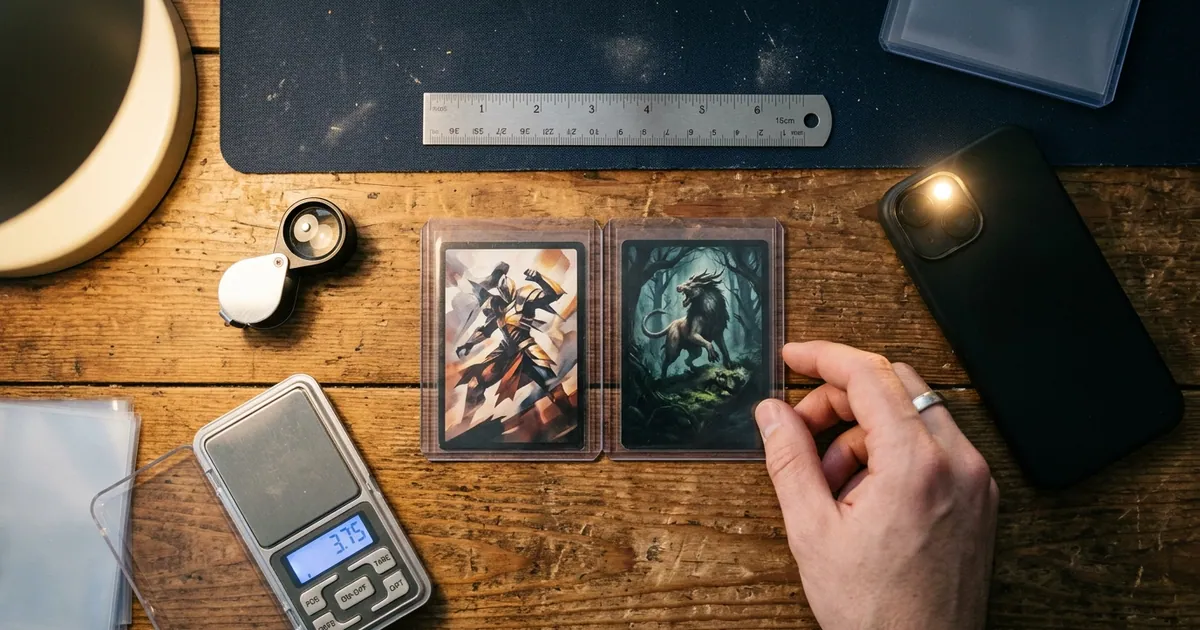
To spot fake Pokémon cards, compare the suspect card against a known genuine card from the same set and era. Check the text and font, the color of the back, the holo pattern and texture, how much light passes through the card, and the print pattern under a loupe. Most fakes fail two or more of these checks within a few minutes. No single test proves anything, so stack them. For expensive cards, let a major grading company make the final call.
Key takeaways
- Always compare against a genuine reference card from the same set, era, and language. Your eyes are far more reliable side by side than from memory.
- Text errors are the quickest giveaway. Look for typos, a missing accent in “Pokémon,” wrong energy symbols, odd fonts, and HP or damage numbers that don’t fit the era.
- Modern fakes usually fail on texture and foil. Genuine full arts and gold cards have a fine embossed texture you can see and feel. Most fakes are smooth and glossy.
- The flashlight and weight tests help but aren’t conclusive. Better counterfeits now pass them, so use them as supporting evidence.
- For high-value cards or slabs, verify officially. Look up the cert number with the grading company and confirm the card matches. For raw cards worth more than the grading fee, submit to an established grader.
Start with a known genuine reference card
Every reliable authentication check is a comparison. Before you judge a suspect card, grab a genuine card you pulled yourself from a sealed pack bought at a trusted retailer. Ideally it should come from the same set, or at least the same era.
Why this matters:
- Card stock changed over time. Wizards of the Coast-era cards (1999–2003) feel and look different from modern Scarlet & Violet cards. A vintage card can “fail” a test that a modern card passes, and vice versa.
- Language matters. Japanese cards use different stock, a different back design, and a different finish. Never compare a Japanese card against an English one and call it fake because it feels different.
- Rarity type matters. A regular holo, a reverse holo, a textured full art, and a gold secret rare each have a distinct finish. Compare like with like.
If you don’t own the exact card, pull up reference images of the same card number in our card catalog. Then check the set symbol, card number, illustrator credit, and layout against your copy.
A step-by-step checklist with the card in hand
Tools: a phone flashlight, a 30x–60x jeweler’s loupe (a phone macro lens works in a pinch), a pocket scale that reads to 0.01 g, a ruler or calipers, and your reference card.
- Read every word on the card. Check the name, attack text, weakness and resistance, and the copyright line at the bottom. Fakes often have spelling mistakes or awkward grammar. They also tend to drop the accent on the “é” in Pokémon. Watch for HP values or attack damage that don’t exist for that era, like a vintage-style card with 1,000 HP.
- Check the set symbol and card number. The symbol must match the set. The card number must make sense for the set total. Numbers above the total are normal only for secret rares. Confirm the illustrator name matches the reference.
- Measure it. Standard Pokémon cards are 2.5 x 3.5 inches (63 x 88 mm) with evenly rounded corners. A card that is noticeably small or has uneven corner radii is a red flag. Keep in mind that genuine cards can be trimmed too. If a card measures short, read our guide on how to tell if a card is trimmed.
- Compare the backs side by side. A genuine English back has a deep blue swirl with visible depth and gradients, and a saturated red Poké Ball. Fakes are often too light, purple-tinted, too dark, or blurry. Back centering varies naturally, so don’t treat a crooked back border as proof of anything.
- Tilt it under a single light. Check where the foil sits and what the pattern looks like. Then check whether textured cards actually have texture. The next section covers this in detail.
- Do the flashlight test. In a dim room, hold your phone flashlight directly against the back and look at the front. Compare the glow against your reference card.
- Feel the stock. Genuine cards have a specific snap and a semi-gloss finish. Fakes often feel flimsy, overly stiff, waxy, or slick like photo paper. Don’t bend a card you care about. A gentle flex between your fingers next to the reference card is enough.
- Weigh it. Genuine modern English cards are commonly cited at roughly 1.7–1.8 g. Weight varies by era and finish, though. Textured and holo cards can differ slightly from non-holos. The useful signal is a big gap from your same-type reference card, not a specific number.
- Check the print under a loupe. Look at the text, the energy symbols, and the colored areas.
- Inspect the edges and cut. Genuine cards have clean, consistent factory cuts. Fakes often show ragged or fuzzy edges, sloppy corner rounding, or an edge color that doesn’t match your reference.
If a card fails one check, stay skeptical. If it fails two or more clearly, treat it as fake until a professional says otherwise.
Genuine vs. fake: what each check usually shows
| Check | Genuine (typical) | Fake (typical) |
|---|---|---|
| Text | Correct spelling, accented “é,” consistent font and spacing | Typos, missing accent, mismatched fonts, odd spacing |
| Back | Deep blue swirl with depth, saturated red | Washed out, purple-tinted, blurry, or too dark |
| Holo location | Matches rarity type (art window, reverse, or full card) | Rainbow sheen everywhere or in the wrong area |
| Texture | Fine embossed ridges on full arts and gold cards | Smooth, flat, very glossy |
| Flashlight | Dim, muted glow (varies by era) | Often bright and even |
| Loupe | Tidy rosette dots, crisp solid-black text | Blurry dots, pixelation, text built from color dots |
| Price | Near market value | “Too good to be true” |
These are tendencies, not rules. Treat the table as a guide for where to look, not a verdict.
Holo, texture, and foil: where modern fakes get caught
Finish is the hardest thing for counterfeiters to copy cheaply, so it’s often your best tell.
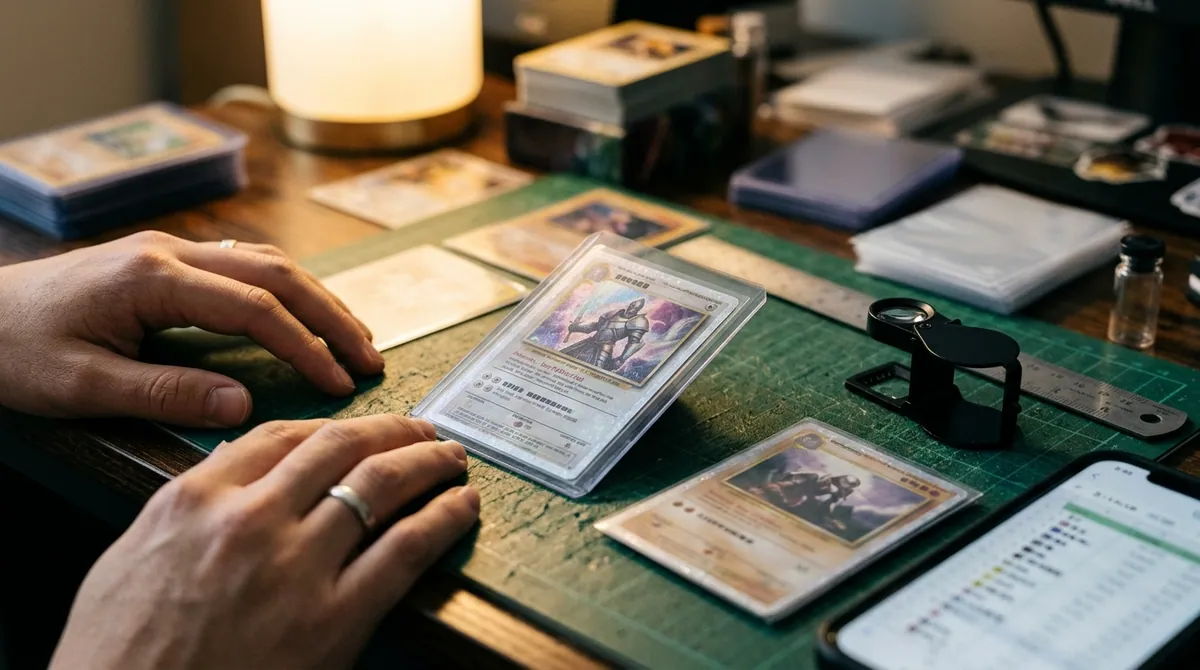
- Textured full arts and ultra rares. Genuine modern full-art cards have a fine, fingerprint-like embossed texture across the surface. You can see it when you tilt the card under raking light and feel it with a fingertip. Most fakes are perfectly smooth with a heavy gloss.
- Gold secret rares. Genuine gold cards are textured and have a slightly muted, metallic sheen. Fakes are often mirror-shiny, flat foil with no texture.
- Regular holos and reverse holos. The foil should sit only where it belongs for that rarity. On a holo rare, that’s the art window. On a reverse holo, it’s the card body outside the art. The pattern should match the reference. A common fake tell is a generic rainbow shimmer over the entire card.
- Novelty “metal” and “gold foil” Charizards. Many cheap metal or gold-plated cards sold online have no official equivalent. If you can’t find the product in an official set list, assume it isn’t one.
- Vintage cards. High-value WOTC cards like Base Set holos, 1st Edition, and Shadowless attract the most convincing fakes. Compare the 1st Edition stamp’s size, position, and sharpness against a verified example. Also watch for official reprints. The 2021 Celebrations Classic Collection cards are genuine, but they carry a Celebrations mark and sell for far less than the originals. Make sure your “Base Set Charizard” isn’t one of them.
Loupe check: print pattern and text
Authentic Pokémon cards are printed with offset lithography. Under 30x–60x magnification, colored areas show a neat rosette pattern of cyan, magenta, yellow, and black dots. Here’s what to look for:
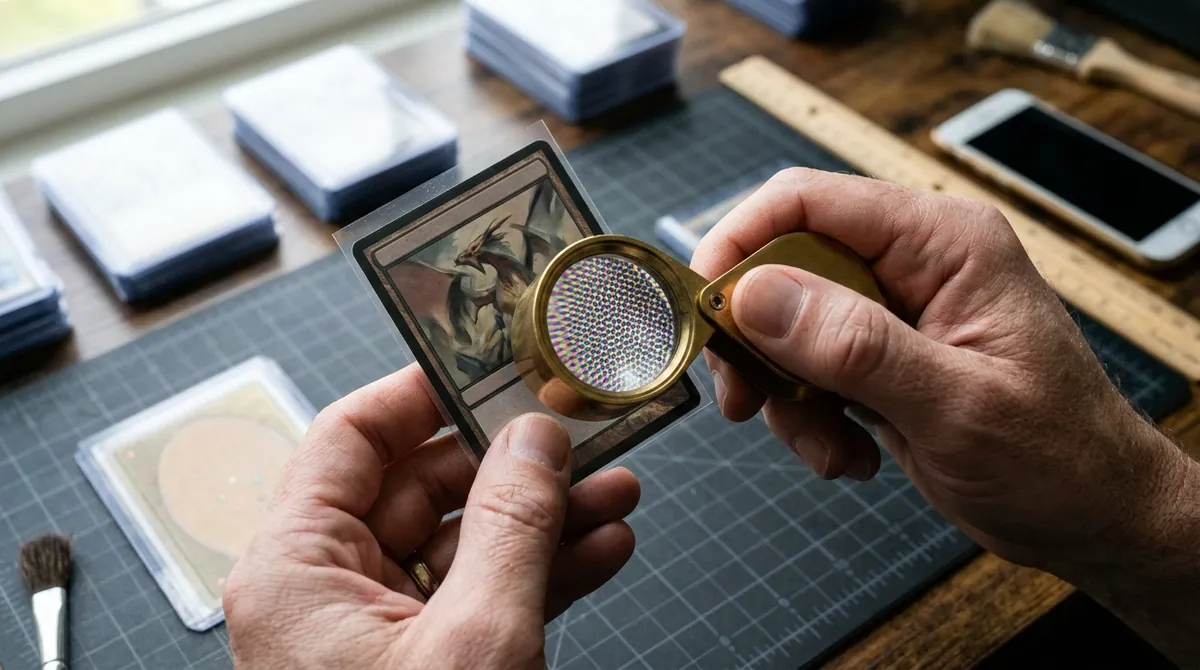
- Text should be crisp and solid black. On genuine cards, small black text and outlines hold sharp edges. On many fakes, text looks fuzzy or slightly doubled, or it’s built from colored dots instead of solid ink.
- Energy symbols and set symbols should be sharp. Blurry or bleeding symbols suggest the image was scanned and reprinted.
- Look for pixelation in the artwork. Counterfeits made from scanned or downloaded images often show jagged edges or muddy gradients.
- Check color balance. Fakes are often oversaturated or have a color cast, especially in skin tones, skies, and the yellow border.
This is also where a known genuine card earns its keep. Look at the same spot on both cards under the loupe, and the difference is usually obvious.
The light test, the rip test, and when to skip them
Genuine English Pokémon cards have a dark inner layer in the card stock. That’s why a flashlight usually produces only a dim, muted glow through a real card. Many fakes light up brightly. The limits:
- Better fakes now pass. Some counterfeiters use layered stock, so a “pass” doesn’t clear a card.
- Results vary with flashlight brightness, card era, and holo layers. Always test your reference card under the same light.
The rip test tears a card to expose that inner layer. It’s destructive and only tells you about the card you just destroyed. Skip it unless the card is already one you believe is a worthless fake, like a bulk common from a suspicious lot you want to confirm. Never rip anything that might be genuine and valuable.
Fake slabs and resealed packs
Counterfeiting doesn’t stop at raw cards.
Graded slabs:
- Look up the cert number on the grading company’s official verification page. PSA, Beckett, and CGC all offer online lookups.
- Confirm that the card name, set, year, and grade match the label exactly. A valid cert number can be copied onto a fake slab. Where the grader shows images for that cert, compare them to the card in front of you.
- Inspect the slab for a sloppy label font, a dull or missing hologram, cloudy plastic, or signs it was pried open and resealed.
Sealed product:
- Booster boxes and ETBs priced well below market from unknown sellers are the biggest red flag.
- Many modern English products use branded shrink wrap with a repeating logo pattern, but not every product does. Compare against photos from trusted retailers.
- Packs that feel loose, have uneven or re-glued crimps, or show wrinkled foil may have been searched and resealed.
When grading is (and isn’t) worth it for authentication
PSA, BGS, CGC, TAG, and other established graders authenticate cards as part of grading. A counterfeit won’t receive a numerical grade. It’s typically returned ungraded, and you generally still pay the fee. Fees and policies change, so confirm current terms on each company’s official site.
Grading makes sense when a card would be valuable if genuine and you can’t settle it yourself. In that case, an expert opinion and a sealed slab are worth the fee.
Skip grading when:
- The card would be worth less than the grading fee plus shipping even if it’s real.
- It clearly fails multiple checks above. You’d be paying to confirm what you already know.
- You bought it from a marketplace with buyer protection and are still inside the return window. Open a return first.
For a fuller look at the economics, see should I grade my Pokémon cards.
Where Card Grading AI fits
To be upfront: Card Grading AI is a condition pre-grading tool, not an authentication service. It won’t certify that a card is genuine, and its results are estimates, not official grades, appraisals, or guarantees.
Here’s what it helps with once you’re confident a card is real:
- Reference comparison. Use the catalog to pull up the exact card and check the layout, set symbol, and numbering against your copy.
- Condition estimates. Scan the card to get an estimated read on centering, corners, edges, and surface before you decide whether a grading fee makes sense. See what’s included on our features page.
- Pokémon-specific guidance. Our Pokémon card grading page covers how condition affects which cards are worth submitting.
Run the authenticity checklist first. When a card passes, scan it with Card Grading AI to get a pre-grade estimate before you spend money on an official submission.
FAQ
What is the fastest way to tell if a Pokemon card is fake?
Put it next to a genuine card from the same set and era and compare the text, the back color, and the holo or texture under a tilted light. Most fakes show a typo, a washed-out or purple-tinted back, or a flat, overly glossy foil within a minute or two. For a stronger read, add the flashlight test and a loupe check. No single test is proof, so stack several.
Does the flashlight test work on every Pokemon card?
No. Genuine English cards have a dark inner layer that usually lets through only a dim glow, while many fakes light up brightly. But results vary by era, card type, and flashlight strength, and better counterfeits now pass. Japanese cards use different stock, so never compare them against English cards. Treat the light test as one data point.
Should I do the rip test to check a card?
Only on a card you are already confident is fake and worthless, such as a bulk common from a suspicious lot. Ripping destroys the card and only tells you about that one card. Never rip a card that might be genuine and valuable. Use non-destructive checks or a grading company instead.
Will PSA, BGS, or CGC grade a fake Pokemon card?
Major grading companies authenticate cards as part of grading and do not assign a numerical grade to counterfeits. The card is typically returned ungraded, and you generally still pay the grading fee. Policies and fees change, so confirm the current terms on each company's official site before you submit.
Can Card Grading AI tell me if my card is fake?
Card Grading AI is built for condition pre-grading, not authentication. It gives an estimated condition read on centering, corners, edges, and surface, and our catalog helps you pull up reference images for comparison. It is not an official grade, an appraisal, or an authenticity guarantee. For valuable cards, rely on PSA, BGS, CGC, or another established grader.
Keep reading
Related guides
Ready to inspect your next card?
Scan your cards instantly with Card Grading AI
Capture a clear front-and-back photo, review an AI-assisted condition estimate, and keep standout cards organized in your collection.