Collector guide
How to Value Sports Cards With AI: A Practical Guide
Learn how to value sports cards with AI: identify the card, estimate condition, read comps, and adjust for grade so you price with confidence.
By Matteo G.
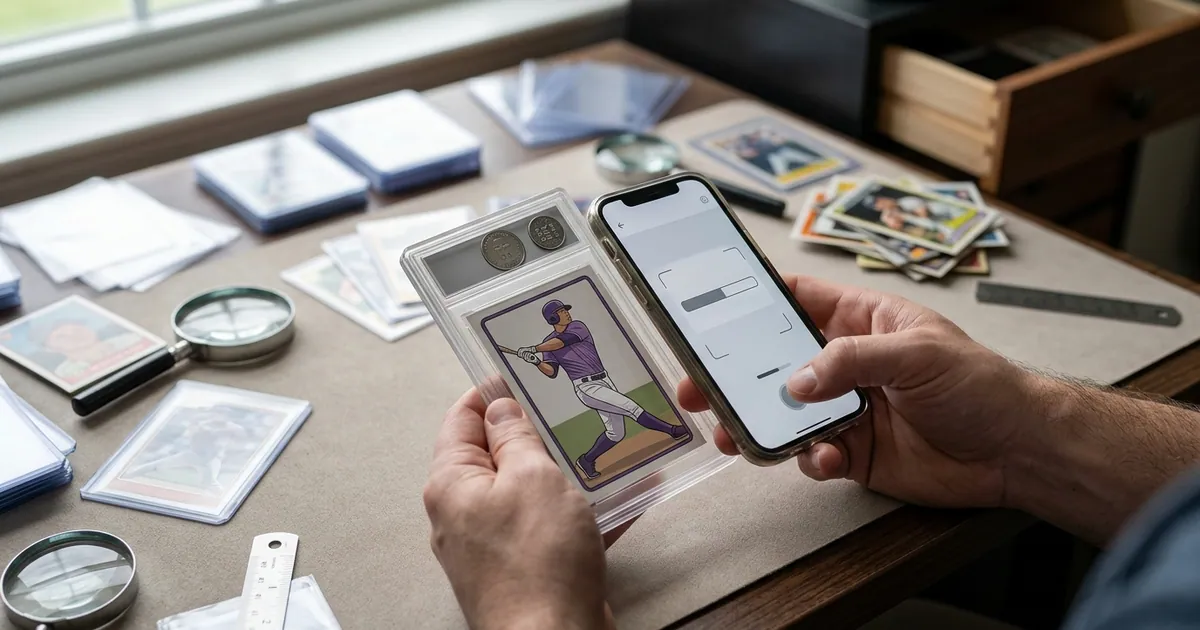
Valuing a sports card sounds simple until you actually try it. A 1989 Upper Deck Ken Griffey Jr. rookie can sell for eight dollars or eight hundred, and the difference is almost entirely condition, grade, and which comparable sale you decide to trust. Most collectors either guess high because they love the card, or guess low because a single eBay listing scared them.
AI changes the workflow more than it changes the math. It handles the tedious parts fast: recognizing the exact card and parallel, flagging condition problems your eye skips, and pointing you toward the right comparable sales for the right grade. You still make the call. This guide walks through a repeatable process for valuing sports cards with AI, plus the places where AI will steer you wrong if you let it.
Why Sports Cards Are Harder to Value Than They Look
Four variables drive nearly every sports card price, and they interact:
- Identity. Base, refractor, numbered parallel, short print, error variation. Two cards can look nearly identical and differ 20x in price.
- Condition. Centering, corners, edges, and surface. This is where AI helps most.
- Grade. A raw card and a PSA 10 of the same card are different products in different markets.
- Demand right now. Player performance, injuries, set nostalgia, and a hobby news cycle that moves in days.
Miss any one of these and your valuation is off. The advantage of an AI-assisted process is that it forces you to handle them in order instead of jumping straight to a price you already wanted to see.
Step 1: Identify the Exact Card, Not Just the Player
Start by scanning the front and back. A good scanner reads the set, year, card number, player, and any parallel or insert markers, then matches it against a card database. This is where most manual valuations quietly fail, because collectors search “Luka Doncic Prizm rookie” and end up looking at comps for a Silver Prizm when they own a base.
When you scan with Card Grading AI, the app pulls the card into your catalog with its set details attached, so the identity is locked before you go price hunting. Verify a few things manually anyway:
- Card number on the back matches the checklist entry.
- Serial numbering, if present (/25, /99, and so on).
- Foil pattern or color for parallels, which photos flatten badly.
- Autograph type: on-card vs. sticker, since the market prices them differently.
If the AI returns two close candidates, that is a signal to slow down rather than pick the more expensive one.
Step 2: Get an Honest Condition Read
Condition is where AI earns its keep, because human eyes are optimistic about cards we own. Photograph the card in even, indirect light on a neutral background, no glare, no sleeve. Then let the analysis run on four things:
Centering. Measurable and objective. AI measures border widths on both axes and reports a ratio like 60/40 left-to-right. This is the single most common reason a card that “looks mint” comes back a 9 instead of a 10. Our centering tool shows the measurement visually so you can see how much margin you have.
Corners. Fraying, soft tips, and whitening show up at high magnification long before they are obvious at arm’s length.
Edges. Chipping on dark-bordered cards is brutal. Modern black-bordered parallels are notorious for it.
Surface. Print lines, scratches, dimples, and gloss loss. This is the weakest area for AI, since some defects only appear when a grader tilts the card under a light.
The output is a pre-grade estimate, usually expressed as a range. Take the range seriously and lean toward the low end when you are estimating value, because the market pays for the grade you actually get, not the one you hoped for. See how the analysis works if you want to understand what each sub-score covers.
Step 3: Pull Comps That Match Your Card and Grade
Now you have an identity and a realistic condition band. Comparable sales are the actual valuation, and the rules are boring but non-negotiable:
- Use sold prices, never active listings. Asking prices are wishes.
- Match the grade exactly. A PSA 9 comp does not price your raw card.
- Stay recent. For active players, 30 to 60 days. For stable vintage, 90 days is fine.
- Throw out the outliers. One auction that ended at 3 a.m. with two bidders is noise. So is one bidding war.
- Take the median, not the average. Median resists outliers better.
For raw cards, the honest approach is a range: what it sells for raw today, and what it would be worth at your two most likely grades minus grading costs.
Step 4: Do the Grading Math Before You Submit
This is the step that separates collectors who profit from grading from collectors who fund it. A simple worked example, using round numbers you should replace with your own current figures:
| Scenario | Market value | Your cost | Net |
|---|---|---|---|
| Sell raw today | $60 | $0 | $60 |
| Grades a 9 | $95 | ~$25 fees + shipping | ~$70 |
| Grades a 10 | $260 | ~$25 fees + shipping | ~$235 |
| Grades an 8 | $55 | ~$25 fees + shipping | ~$30 |
The decision hinges entirely on the probability of the 10. If your pre-grade says centering is 65/35 with a soft corner, that 10 is unlikely and the expected value drops below just selling raw. If centering is 52/48 with clean corners and surface, the submission makes sense.
Run this table for every card you are considering. Then submit the ones where the math survives a pessimistic assumption. Our sports card grading guide goes deeper on choosing between grading companies and service tiers.
Step 5: Track Value Over Time, Not Once
A valuation is a snapshot. Sports card prices move with the season, and a single injury or breakout stretch reprices a rookie in a week. Log every card you value into a collection so you have a baseline to compare against later.
What is worth tracking per card: purchase price, purchase date, current estimated value, grade or pre-grade, and a note about why you bought it. That last field matters more than people expect. Six months later it tells you whether you were speculating on a player or buying a card you actually wanted to keep.
Check your collection quarterly. Check individual cards when something changes: playoff runs, awards voting, retirements, Hall of Fame announcements, or a manufacturer reprinting a design.
Where AI Gets It Wrong
Be clear-eyed about the limits, because overtrusting an AI estimate costs real money:
- Subtle surface flaws. Faint print lines and gloss breaks often need a grader’s light and angle.
- Alterations and trimming. Detecting a professionally trimmed card from photos is not reliable. Authentication is a human and equipment job.
- Thin markets. For a card with three sales in the last year, no algorithm can produce a confident price. Widen your window and accept the uncertainty.
- Hype spikes. Prices during a hot streak are not a floor. Comps from a peak week will overvalue your card a month later.
- Photo quality. Bad lighting produces bad analysis. Glare reads as surface damage; shadows read as edge wear.
None of this makes AI useless. It makes AI a first pass, which is exactly what it should be.
Your Repeatable Workflow
- Scan front and back, confirm the exact set, parallel, and card number.
- Run condition analysis and write down the pre-grade range.
- Pull sold comps matched to that grade, use the median of recent sales.
- Run the grading math with a pessimistic grade assumption.
- Log the card, the value, and the date.
- Revisit quarterly or when news breaks.
Six steps, a few minutes per card once you have the rhythm.
Start With Ten Cards
Do not try to value an entire shoebox on day one. Pick the ten cards you believe are most valuable, run them through the full workflow, and see how your instincts compare to the pre-grades and the comps. Most collectors find two or three surprises in both directions, which is the whole point.
Scan your first cards with Card Grading AI on web, iOS, or Android, build out your catalog, and use the pre-grade estimates to decide what actually deserves a submission slot. Just remember what the estimate is: a fast, useful starting point, never an official grade or an appraisal. The slab still comes from PSA, BGS, CGC, or TAG, and the price still comes from a buyer.
FAQ
Can AI tell me exactly what my sports card is worth?
No. AI can identify the card, estimate its condition, and help you find the right comparable sales, but the final number always comes from the market. Treat any AI output as a pre-grade estimate and a research shortcut, not an appraisal or a guaranteed sale price.
How accurate is an AI pre-grade compared to PSA or BGS?
AI pre-grades are strongest on measurable factors like centering and obvious surface or corner damage, and weakest on subtleties a grader sees under a bright light, such as faint print lines, gloss breaks, or minor recolors. Use the pre-grade to sort submission candidates, then let PSA, BGS, CGC, or TAG issue the official grade.
Which sports cards are actually worth grading?
Generally rookie cards, low-population parallels, autographs, and vintage stars where a high grade multiplies value. Run the math first: if the raw price plus grading fees and shipping is close to the graded comp for a realistic grade, grading is not worth it.
How often should I re-check my collection's value?
For most collectors, quarterly is plenty. Re-check sooner around big events like playoffs, a rookie call-up, a Hall of Fame vote, an injury, or a set reprint, since those move prices faster than anything else.
Does AI work on already-graded slabs?
Yes for identification and value tracking. Scanning a slab lets you log the card, grade, and cert number in your collection so you can follow comps for that exact grade. Condition analysis is less useful once a card is encapsulated, since the grade is already set.
Keep reading
Related guides
Ready to inspect your next card?
Scan your cards instantly with Card Grading AI
Capture a clear front-and-back photo, review an AI-assisted condition estimate, and keep standout cards organized in your collection.