Collector guide
What Makes a Card Gem Mint? The 4 Subgrade Rules
Learn what makes a card gem mint: centering tolerances, corner sharpness, clean edges, and flawless surfaces — plus how to pre-check a card before you submit.
By Matteo G.
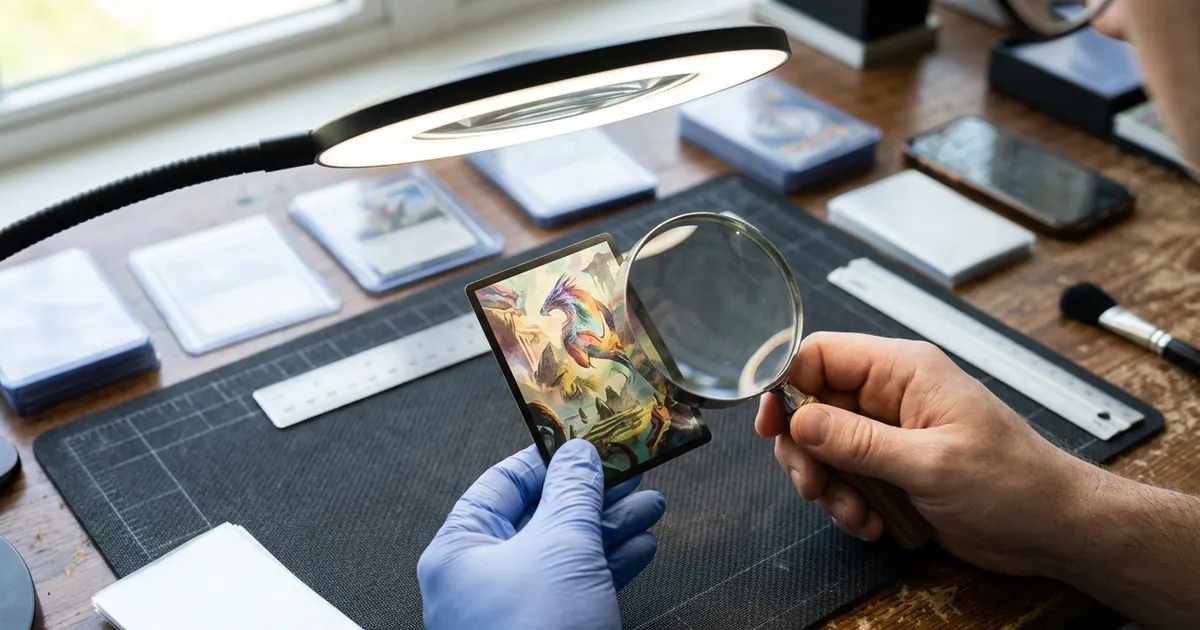
“Gem mint” is the phrase every collector wants to hear, and the one that costs the most money when it goes wrong. Two cards can look identical in a binder, yet one comes back a 10 and the other a 9 — and the price gap between those two slabs can be brutal on modern chase cards. The difference is almost never luck. It comes down to four measurable attributes that every major grading company evaluates, plus a handful of gray-area judgment calls that separate collectors who submit smart from collectors who submit hopefully.
This guide breaks down exactly what makes a card gem mint, what tolerances the big graders publish, and how to sanity-check a raw card at home before you spend money on submission fees.
What “gem mint” actually means
Gem mint is the tier just below theoretically perfect. It describes a card that looks like it was pulled from a pack by a robot, sleeved instantly, and never touched again — sharp corners, clean edges, a flawless surface, and centering that reads as balanced to the naked eye.
Importantly, gem mint does not mean microscopically perfect. All the major graders accept that mass-produced cardboard has manufacturing quirks. Gem mint allows for tiny, non-obvious imperfections that only show up under magnification. The perfect tier lives one step higher: BGS Pristine 10 and Black Label, or CGC Pristine 10.
Here is how the top of each scale compares:
| Company | Gem mint label | Tier above it | Subgrades? |
|---|---|---|---|
| PSA | PSA 10 Gem Mint | None | No (overall grade only) |
| BGS | BGS 9.5 Gem Mint | 10 Pristine, 10 Black Label | Yes, four subgrades |
| CGC | CGC 10 Gem Mint | 10 Pristine | Yes, on request |
| SGC | SGC 10 Gem | 10 Pristine | No |
That table matters because “is my card gem mint?” is really the question “gem mint by whose standard?” A card that comfortably earns a PSA 10 might land a BGS 9 if one subgrade drags it down. If you want a deeper look at how those companies differ in practice, our AI card grading overview walks through how each category is weighted.
The four pillars of a gem mint card
1. Centering
Centering is the most common reason a would-be 10 becomes a 9 — and the only one you can measure objectively with a ruler or a scan.
Centeringis expressed as a ratio of border widths: left/right and top/bottom. PSA’s published Gem Mint 10 standard allows approximately 55/45 on the front and 75/25 on the back. BGS is stricter for a 10 centering subgrade, wanting something in the 50/50 to 55/45 range on the front.
A few practical notes:
- Measure the border, not the artwork. On full-art and borderless cards, graders use the visible printed frame or the card’s design edge.
- Front and back are graded separately. A perfectly centered front with a 80/20 back can still cost you the 10.
- Slight miscuts, factory cut angle, and print shift all show up here. None of it is your fault, and none of it is negotiable.
If you have never measured a card properly, start with our card centering guide — it is the single highest-leverage skill in pre-grading.
2. Corners
Gem mint corners are sharp enough that they look like they could nick your thumb. Under 10x magnification you may see minor fiber texture or a whisper of softness, but at normal viewing distance every corner should come to a clean point.
Disqualifiers include:
- Any visible white showing through on a colored border
- A rounded or “mushroomed” tip from pack pressure or binder storage
- A single dinged corner — graders cap the card on the worst corner, not the average
Corner damage is also the defect most often introduced after the pull, during sleeving, sorting, or shipping. Handle cards by the edges with the card flat, and load penny sleeves from the top with the card supported.
3. Edges
Edges tell you how the card was cut and how it has been stored. Gem mint edges are smooth, with no visible chipping, nicks, or whitening along the perimeter.
Black-bordered and dark-bordered cards are the hardest cases here. Edge whitening on a black border is visible from across the room, and it is extremely common straight out of the pack because of the factory cutting process. If you collect black-bordered sets, inspect every card at a low angle under a single light source — that is how graders catch chipping that flat lighting hides.
Rough-cut edges are a separate issue. Some sets and eras simply have textured factory cuts. Graders generally allow for era-appropriate cutting quality, but heavy roughness will still shave points.
4. Surface
Surface is the broadest and most subjective category. It covers:
- Scratches and scuffs, especially on holo and foil stock
- Print lines, print dots, and roller marks from the factory
- Indentations, dimples, and dents in the cardboard
- Gloss loss, fingerprints, and residue
- Creases and bends — an automatic disqualifier for gem mint at any grader
Holo and full-art cards are punished hardest here because foil shows every scuff. The key test is angling the card under a bright, direct light and slowly rotating it. Flaws that are invisible flat-on will jump out at 30 to 45 degrees.
The gray areas that decide close calls
Once a card clears the four pillars, human judgment takes over. Three things decide close calls:
Visibility over existence. Graders ask how obvious a flaw is at normal viewing distance, not whether it exists under a loupe. A print line buried in a busy foil pattern hurts less than the same line across a white border.
Flaw stacking. One tiny imperfection may be forgiven. Three tiny imperfections — a whisper-soft corner, a faint surface scuff, and 60/40 centering — often combine into a 9 even though no single issue would have done it alone.
Era expectations. A 1989 base card is not held to the same cut and print standards as a 2024 premium insert. Graders calibrate to what was achievable when the card was made.
How to pre-check a card at home
Before you pay submission fees, run this quick sequence:
- Clean your workspace and hands. No oils, no dust, no crumbs.
- Measure centering on both the front and back. Write the ratios down.
- Inspect all four corners against a contrasting background under a bright lamp.
- Rotate the card under direct light at multiple angles to hunt for surface flaws.
- Check edges at a low angle, front and back, all four sides.
- Compare to the grader’s published standard for the tier you are chasing.
If a card fails any single pillar clearly, it is not a gem mint candidate — and that is useful information, because it saves you the fee and the wait.
Where Card Grading AI fits
The hardest part of this process is consistency. Human eyes get tired, lighting changes, and it is genuinely difficult to eyeball a 55/45 versus a 62/38 border.
Card Grading AI is built to handle that repeatable measurement work. Scan a card with your phone or webcam and you get an estimated pre-grade broken into centering, corners, edges, and surface, along with numeric centering ratios you can compare directly against published standards. You can run a whole shoebox in an evening and sort it into “submit,” “maybe,” and “keep raw” piles.
See the full scanning workflow on how it works, or browse the feature list to see what is included in collection tracking and batch scanning.
One important boundary: Card Grading AI produces estimates and pre-grades only. It is not an official grade, an appraisal, or a guarantee, and it does not replace PSA, BGS, CGC, or TAG. Only those companies can issue a real grade on a real slab. What the app does is help you make a better-informed decision about which cards deserve the fee.
The short version
A gem mint card has centering within the grader’s published tolerance on both sides, four genuinely sharp corners, clean unchipped edges, and a surface free of any flaw that is visible without magnification. Miss on one pillar and you are looking at a 9. Measure before you submit, chase the standard of the specific company you are sending to, and let a consistent pre-grade do the sorting so your submission list is full of real candidates instead of hopeful ones.
FAQ
What centering does a card need to be gem mint?
Most graders want roughly 55/45 to 60/40 on the front and around 75/25 on the back for a gem mint tier grade. PSA publishes 55/45 front and 75/25 back as its Gem Mint 10 standard, while BGS reserves its 10 centering subgrade for near-perfect 50/50 to 55/45 measurements. Exact tolerances vary by company and era, so always check the current published standards before submitting.
Can a card be gem mint with a tiny print line?
Sometimes, but it is risky. Faint, hard-to-see print lines on a textured foil surface are occasionally tolerated, while a visible line running across a plain border or portrait usually caps the card at a 9. Because graders weigh how noticeable a flaw is under bright light and at arm's length, a print line is one of the least predictable defects in the whole process.
Is gem mint the same at PSA, BGS, and CGC?
No. PSA 10 is labeled Gem Mint and is a single overall grade. BGS 9.5 is called Gem Mint and requires strong subgrades, while BGS 10 Pristine and 10 Black Label are much stricter. CGC uses a 10 Gem Mint tier plus a tougher 10 Pristine. Treat each company's standard separately when choosing where to submit.
Can Card Grading AI tell me if my card is gem mint?
Card Grading AI gives you an estimated pre-grade with centering measurements and condition notes so you can see how close a card sits to gem mint territory. It is an estimate to help you decide what to submit — not an official grade, appraisal, or guarantee, and only PSA, BGS, CGC, or TAG can issue a real grade.
Keep reading
Related guides
Ready to inspect your next card?
Scan your cards instantly with Card Grading AI
Capture a clear front-and-back photo, review an AI-assisted condition estimate, and keep standout cards organized in your collection.