Collector guide
Trading Card Inventory for Insurance: A Practical Guide
Build a trading card inventory for insurance: what to document, how to value cards, photo standards, backups, and claim-ready records US collectors can trust.
By Matteo G.
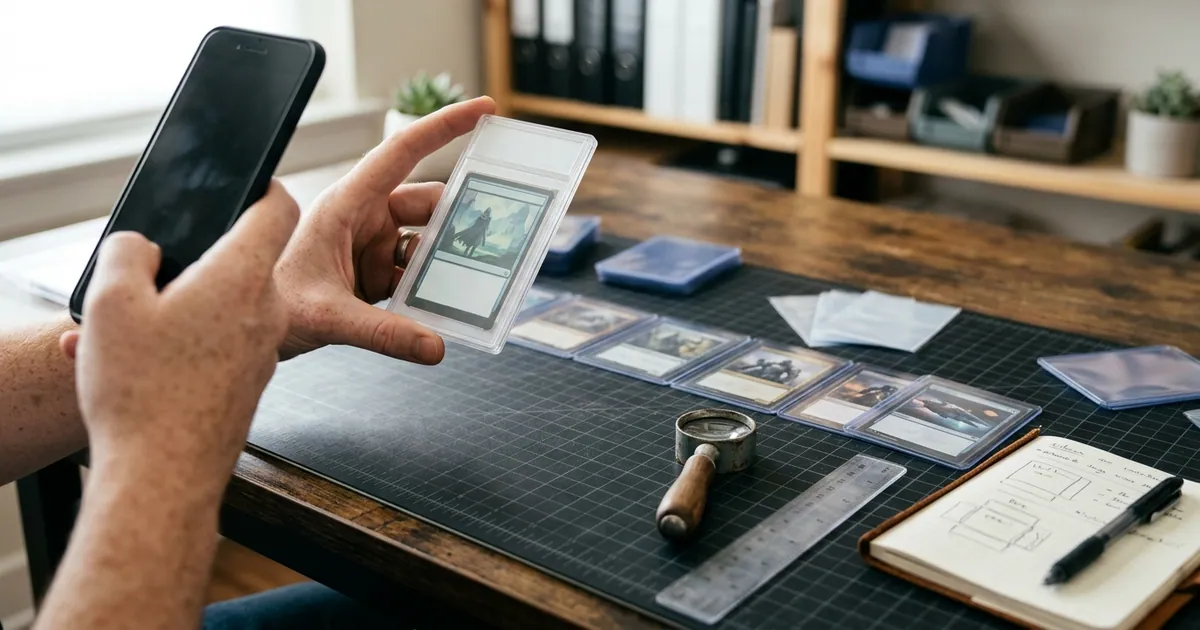
Most collectors discover the gaps in their records at the worst possible moment: after a burst pipe, a break-in, or a move that ends with one box unaccounted for. Insurance pays on proof, not on memory. If you cannot show what you owned, what condition it was in, and what it was reasonably worth, you are negotiating from a weak position.
A trading card inventory for insurance is not the same thing as a casual collection list. It is a defensible record built before anything goes wrong, with photos, identifiers, values, and a date trail. This guide walks through exactly what to capture, how to decide what gets individual treatment, and how to keep the whole thing maintainable instead of abandoning it three hundred cards in.
Why a Casual Collection List Isn’t Enough
A spreadsheet that says “Charizard base set” or “Jordan rookie” tells an adjuster almost nothing. There are multiple printings, variants, and condition tiers behind both of those phrases, and the value spread between them can be several thousand dollars.
An insurance-grade record answers four questions for every entry:
- What is it, exactly? Player or character, set, year, card number, variant, language, serial number if applicable.
- What condition is it in? Grading company, grade, and cert number if slabbed. A documented condition assessment if raw.
- What is it worth, and how do you know? A value plus the basis for it (recent comps, purchase price, appraisal).
- Can you prove you owned it? Receipts, order confirmations, shipping records, or dated photos.
Miss any of those and you are relying on an adjuster’s goodwill. Capture all four and your claim becomes an arithmetic exercise.
Decide on a Documentation Threshold First
The single biggest reason card inventories get abandoned is that collectors try to document every common with the same rigor as their best card. Set a value threshold before you start.
A practical three-tier approach:
| Tier | Typical value | Documentation level |
|---|---|---|
| Headliners | $500+ | Individual entry, front and back photos, cert number, comps saved, receipt attached |
| Mid-tier singles | $25–$500 | Individual entry, one or two photos, value estimate with date |
| Bulk | Under $25 | Lot-level entry: container photo, count, description, estimated per-card value |
Adjust the dollar figures to your collection. The point is that effort should scale with exposure. A 5,000-card bulk box documented as a lot takes ten minutes; documented card by card it never gets finished.
What to Record for Every Insured Card
For each individual entry, capture:
- Identification: set name, year, card number, player or character, parallel or variant, language, print run or serial
- Condition: grading company, numeric grade, cert number, and slab serial for graded cards; a written condition note for raw cards covering corners, edges, surface, and centering
- Acquisition: date acquired, source (shop, show, marketplace), price paid, and a link or scan of the receipt
- Current value: your estimate, the date of that estimate, and the comps or source behind it
- Storage location: which binder, box, safe, or deposit box it lives in
- Photos: front and back, plus a close-up of any flaw or the cert label
Storage location matters more than people expect. If a loss affects one room or one container, a location field lets you isolate affected items instantly instead of auditing the entire collection.
Photo Standards That Hold Up Later
Claim photos have one job: proving the item existed in the condition you claim. Shoot with these rules and you will not need to reshoot.
- Use even, diffuse light with no direct glare on the slab or sleeve
- Shoot straight on, filling most of the frame, with the full card and all four corners visible
- Capture front and back; for slabs, include the label with the cert number legible
- Keep the original full-resolution files, not compressed social media exports
- Leave timestamps and metadata intact
For raw cards, a second close-up of any known flaw actually helps you. It shows the adjuster you documented honestly, which makes your condition claims on other cards more credible.
If you want a repeatable capture workflow rather than improvising each time, the scanning tools in Card Grading AI are built around consistent framing and lighting, which is exactly what an insurance file needs.
Establishing Values You Can Defend
Value is where claims get contentious. Three sources carry weight, roughly in this order:
- Recent comparable sales of the same card, same grade, within a reasonable window. Save screenshots with dates.
- A written appraisal from a qualified appraiser, which many insurers require for scheduled items above a certain amount.
- Your purchase price with receipt, which establishes a floor but may understate a card that has appreciated.
Record the date next to every value. A number with no date is just an opinion. A number with “based on three sold comps, March 2026” is evidence.
AI tools help here as a triage layer, not an authority. Card Grading AI can estimate condition and surface likely value ranges so you know which cards deserve real comp research and which can sit in a bulk lot. Those estimates are pre-grades and estimates only — never official grades, appraisals, or guarantees, and never a substitute for PSA, BGS, CGC, or TAG.
Raw Cards Need Extra Care
Graded cards are easy: the slab carries the identification and the condition, and the cert number is independently verifiable. Raw cards are where documentation discipline pays off.
For anything raw and valuable, write a short condition note using consistent language — centering, corner sharpness, edge wear, surface condition — and back it with photos. An honest, specific description like “sharp corners, faint edge whitening on back right, centering approximately 60/40 left-right” is far more useful at claim time than “near mint.”
If you intend to grade some of these cards eventually, that same note doubles as your submission shortlist. Running them through a pre-grade first gives you a repeatable condition baseline across the whole collection. Browse how cards are identified and matched in the catalog to see how much of the identification work can be automated.
Storage, Backups, and the Off-Site Rule
An inventory stored only on the laptop sitting next to the collection is not an inventory. Fire and theft take both.
Use the 3-2-1 approach: three copies, on two types of media, with one off-site. In practice that means a cloud-synced app or drive, a local export (CSV or PDF), and a copy somewhere physically separate — a relative’s house, a work drive, or a safe deposit box.
Export a dated snapshot at least quarterly. A static export is tamper-evident in a way a live, constantly-edited spreadsheet is not, and it shows the state of the collection at a specific point in time.
Talk to Your Insurer Before You Need To
Documentation only matters if the coverage exists. Before you finish your inventory, get clear written answers on:
- The sub-limit for collectibles or trading cards under your current policy
- Whether the policy pays replacement cost or actual cash value
- Which perils are excluded (flood is commonly excluded; so is gradual damage like humidity)
- Whether cards at shows, in transit, or at a grading company are covered
- What the insurer requires for scheduling individual items
That last point drives your documentation threshold. If your insurer schedules items above $1,000 with an appraisal, you know exactly which cards need professional valuation.
Cards in transit to a grading company deserve special attention. Many policies treat shipped items differently, and grading companies carry their own declared-value limits. Document and photograph every card the day before it ships.
A Maintenance Routine That Actually Sticks
- At acquisition: add the card and attach the receipt the same day. This is the single highest-leverage habit.
- Monthly: photograph anything new above your threshold.
- Quarterly: export a dated snapshot and push it off-site.
- Annually: refresh values on headliners, review your policy limit, and rescan anything whose condition may have changed.
Thirty minutes a quarter keeps a serious collection claim-ready indefinitely.
Getting Started
Start with your top ten cards tonight. Photograph them properly, record identifiers and cert numbers, save comps with dates, and back the file up off-site. That handful likely represents a large share of your total exposure, and finishing it proves the workflow works before you scale to the rest.
From there, work down by value tier and batch the bulk. Card Grading AI handles the repetitive parts — identification, consistent capture, condition estimates, and a structured collection record you can export — so the documentation burden stays manageable. See what’s included on pricing, and check the FAQ for details on how estimates are generated and what they do and do not represent.
Insurance rewards preparation that looks boring until the day it isn’t. Build the record now.
FAQ
Does homeowners insurance cover a trading card collection?
Standard homeowners and renters policies usually cover personal property, but collectibles are often capped by a sub-limit and may exclude causes of loss like flood or gradual damage. Many collectors add a scheduled personal property endorsement or a separate collectibles policy once the collection passes a few thousand dollars. Ask your agent in writing what limit applies to trading cards specifically, and what documentation they require at claim time.
What documentation do insurers typically ask for after a loss?
Expect to provide an itemized list (card, set, number, year, condition or grade, cert number if graded), proof of ownership such as receipts or order confirmations, photos of each item, and a basis for the claimed value like recent comparable sales. Records created before the loss and stored off-site are far more persuasive than a list reconstructed from memory afterward.
Can an AI pre-grade be used as an insurance appraisal?
No. Card Grading AI produces condition estimates and pre-grades to help you document and prioritize your collection. They are not official grades, appraisals, or guarantees, and they do not replace PSA, BGS, CGC, TAG, or a qualified appraiser. Use AI estimates as internal notes and lean on grading company certs, receipts, and comparable sales for insured values.
How often should I update my card inventory for insurance?
Review values at least once a year and update the inventory any time you add a significant card, submit cards for grading, or sell. A quarterly quick pass works well for active buyers. If a single card's value grows past a few hundred dollars, flag it so your coverage limit keeps pace.
Should I photograph every single card in a bulk collection?
No. Photograph singles above your chosen value threshold individually, then document bulk in lots: a photo of the sealed box or binder, a count, a description of the contents, and an estimated per-card value. Insurers generally accept reasonable lot-level documentation for low-value bulk as long as the methodology is consistent and documented.
Keep reading
Related guides
Ready to inspect your next card?
Scan your cards instantly with Card Grading AI
Capture a clear front-and-back photo, review an AI-assisted condition estimate, and keep standout cards organized in your collection.