Collector guide
How to Organize a Pokemon Card Collection (Step by Step)
A practical system for organizing a Pokemon card collection: sort by set, grade tiers, and storage, then track everything digitally without losing value.
By Matteo G.
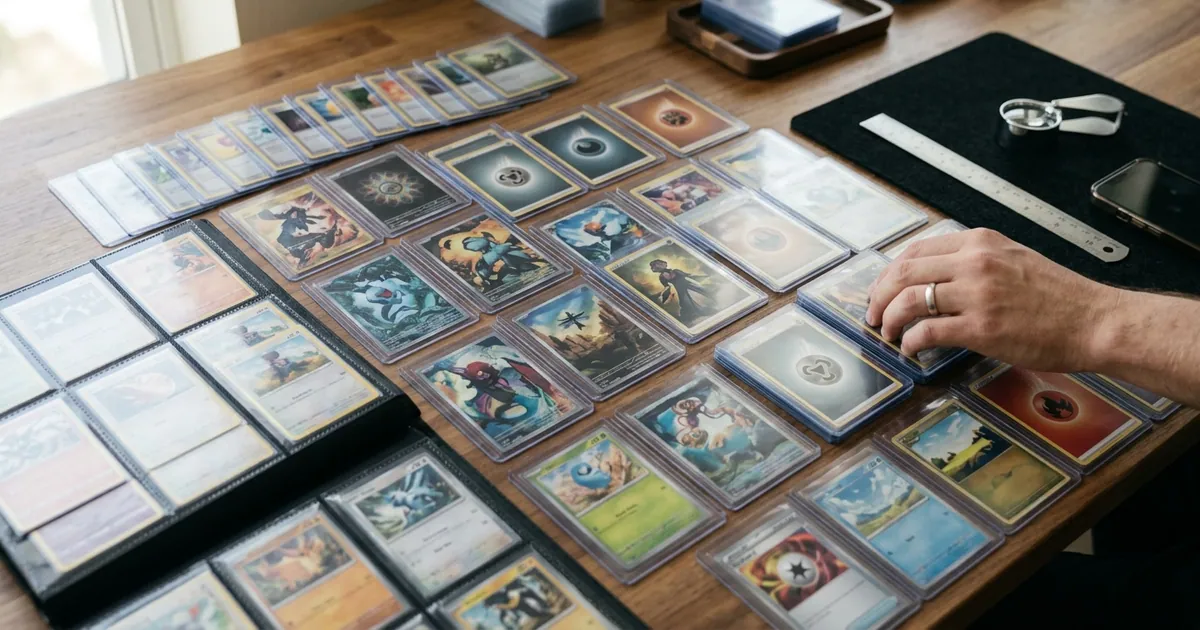
If your Pokemon cards live in a shoebox, three half-finished binders, and a stack of toploaders on your desk, you already know the real cost of disorganization: you can’t find the card you want, you buy duplicates you don’t need, and you have no idea what the whole pile is actually worth. Organizing a Pokemon card collection isn’t about being tidy for its own sake. It’s about protecting condition, making cards findable, and knowing which ones deserve a grading submission.
This guide walks through a system that works whether you have 500 cards or 50,000: triage, sort, store, and track. You can complete the first pass in a weekend and maintain it in a few minutes a week.
Step 1: Triage Before You Sort
The biggest mistake collectors make is trying to sort everything at once. Instead, do a rough triage pass first. Dump your cards onto a clean surface and split them into four piles:
- Grading candidates — high-value or sentimental cards that look sharp: modern alt arts, Japanese exclusives, vintage holos, anything with real upside if it grades well.
- Keepers — cards you want in a binder or set build, regardless of value.
- Trade and sell — duplicates, off-condition rares, cards from sets you don’t collect.
- True bulk — commons, uncommons, energy, and reverse holos with negligible individual value.
Wash your hands before you start, work on a soft mat, and handle cards by the edges. Triage is when most accidental corner dings happen because people are moving fast.
This stage matters because each pile gets a different storage strategy. Sleeving 8,000 bulk commons is a waste of money and time; failing to sleeve a $200 alt art is a much more expensive mistake.
Step 2: Choose a Sorting Logic and Commit to It
Once triaged, pick one primary sorting method for your keepers. The best method is the one you’ll actually maintain.
| Sorting method | Best for | Trade-off |
|---|---|---|
| Set and card number | Set builders, most collectors | Requires knowing set symbols |
| Pokemon species | Character collectors (Charizard, Eevee) | Hard to spot set gaps |
| Rarity or card type | Mixed collections, flippers | Sets get scattered |
| Era or release year | Vintage-focused collections | Too broad for large piles |
| Value tier | Investment-minded collectors | Values shift, so filing shifts |
For most people, set and card number is the winner. Every Pokemon card prints its set symbol and a collector number, so the sort criteria are objective and you’ll immediately see which cards are missing from a set. Character or rarity sorting can live inside that structure as a secondary layer — for example, a dedicated “Charizard” binder pulled out of the main set files.
If you collect multiple games, keep Pokemon physically separate from Magic, Yu-Gi-Oh, and sports. Mixed-game boxes always end up re-sorted eventually.
Step 3: Match Storage to Card Value
Storage is where organization turns into condition protection. Use tiers rather than one-size-fits-all.
Bulk tier. Sort by set into 800- or 1,600-count cardboard storage boxes. Use tabbed dividers labeled with the set name. Don’t sleeve these. Keep cards upright so they don’t bow under their own weight, and never pack a box so tightly that you have to force cards out.
Binder tier. For set builds and character collections, use side-loading, archival-safe pages with no PVC. Nine-pocket pages fit standard Pokemon cards; put each card in a penny sleeve first so the surface never rubs directly against plastic. Avoid ring binders with exposed metal near card edges, and don’t double-load pockets — that’s the fastest way to create surface pressure lines.
Premium tier. Anything valuable or grade-worthy goes in a penny sleeve, then a toploader or semi-rigid holder, or a magnetic one-touch for the top end. Tape the toploader opening if you’re storing long term, and keep these standing upright in a dedicated box rather than loose in a drawer.
Slab tier. Graded cards belong in dedicated slab boxes or foam-lined cases. Stack them flat or file them vertically, and keep them out of direct sunlight, which fades both cards and labels.
Wherever you store cards, aim for a stable indoor environment: roughly room temperature, moderate humidity, no attics, no basements, no garages, no exterior walls prone to condensation. Heat and moisture do more long-term damage to Pokemon collections than handling ever does.
Step 4: Build a Digital Inventory
A physical system tells you where a card is. A digital inventory tells you what you own and what it’s worth. You need both.
At minimum, capture these fields for every card worth more than a couple of dollars:
- Card name, set, and collector number
- Language and print variant (holo, reverse holo, 1st Edition, promo stamp)
- Estimated condition or pre-grade
- Purchase price and date
- Current storage location (“Binder 3, page 12” or “Toploader Box A”)
- Grading status: raw, submitted, or graded
That last field — storage location — is the one most collectors skip and the one that saves the most time. A searchable inventory that tells you exactly which box a card lives in turns a 20-minute hunt into a 20-second retrieval.
Scanning is far faster than typing. With Card Grading AI you can photograph a card, get it identified, and add it to your collection with condition notes attached, so your inventory builds itself as you sort. Browse the card catalog to see how sets and variants are structured, and check the features overview for how collection tracking, pre-grade estimates, and value data fit together in one place.
Step 5: Separate Grading Candidates Properly
Your grading pile deserves its own workflow. Treat it as a short list, not a wish list.
Go through each candidate and check the four things graders weigh most: centering, corners, edges, and surface. Look at the card under bright, indirect light and tilt it to catch scratches and print lines on holo surfaces. Anything with a crease, a soft corner, or heavy edge whitening usually isn’t worth submission fees.
For the cards that survive that filter, a pre-grade estimate helps you prioritize. Card Grading AI scans front and back, flags visible condition issues, and returns an estimated grade range so you can decide what’s worth sending in. Those results are estimates designed to guide your decisions — they are never official grades and don’t replace a PSA, BGS, CGC, or TAG assessment. See the Pokemon card grading walkthrough for how the scan and estimate process works on Pokemon-specific cards.
Keep submission candidates in semi-rigid holders in a clearly labeled box, with a note in your inventory marking them as “pending submission.” Nothing is worse than selling a card you had earmarked for grading.
Step 6: Maintain the System
Organization fails at the maintenance stage, not the setup stage. Three habits keep it alive:
Log on arrival. Every new pack pull, purchase, or trade gets sleeved and logged the same day. Batching creates backlogs, and backlogs become shoeboxes.
Keep an intake tray. A single small box for unsorted new cards prevents them from scattering across your desk. Empty it weekly.
Audit quarterly. Once every few months, spot-check a binder against your inventory, remove sold cards, and update values. This is also a good time to re-scan cards you’re considering grading, since your own eye for condition improves with practice.
A Realistic Weekend Plan
If you’re starting from chaos, here’s how to sequence the work:
- Hour 1–2: Triage into four piles. Don’t sort within piles yet.
- Hour 3–4: Sleeve and protect the grading candidates and keepers.
- Hour 5–6: Sort bulk by set into labeled boxes.
- Hour 7–8: Scan and log everything above your value threshold, and set up your binder layout.
After that, maintenance is a few minutes a week rather than a full reorganization.
Start With One Box
You don’t need to organize your entire collection at once. Pick one box, run it through triage, sort it, store it properly, and log it. The momentum from finishing a single container is what carries you through the rest.
When you’re ready to turn a sorted pile into a searchable, valued collection, scan your first cards with Card Grading AI to get instant identification, condition notes, and estimated pre-grades. Review plans and limits on the pricing page to see which option fits the size of your collection.
FAQ
Should I organize my Pokemon cards by set or by value?
Do both, in layers. Sort physically by set and card number because that's the fastest way to find a card, then use a digital tracker to filter by value, rarity, or grading potential. Value changes constantly, so it makes a poor filing system but an excellent database field.
What's the best way to store bulk Pokemon cards?
Penny sleeves are usually overkill for true bulk. Sort bulk by set into 800- or 1,600-count cardboard boxes with labeled dividers, stored upright in a climate-stable room away from sunlight and humidity. Reserve sleeves, toploaders, and one-touches for holos, rares, and anything you might grade.
How do I know which cards to pull out for grading?
Start with cards that have meaningful raw value, strong eye appeal, and no visible edge wear or creasing. Card Grading AI can scan each candidate and return an estimated pre-grade with condition notes, which helps you decide what to submit. These estimates are guidance only and never replace an official PSA, BGS, CGC, or TAG grade.
Do binders damage Pokemon cards?
Low-quality binders can. Avoid PVC pages, rings that press against card edges, and overstuffed pockets. Use side-loading, archival-safe pages in a strap-closure or zip binder, and keep the binder stored flat or upright rather than leaning under weight.
How often should I update my collection inventory?
Log new cards as they arrive rather than in big batches, then do a quick audit every few months to correct mistakes and remove cards you've sold or traded. A ten-minute weekly habit is far easier than a weekend-long catch-up session.
Keep reading
Related guides
Ready to inspect your next card?
Scan your cards instantly with Card Grading AI
Capture a clear front-and-back photo, review an AI-assisted condition estimate, and keep standout cards organized in your collection.