Collector guide
How to Track Card Purchase Prices (Cost Basis Guide)
Learn how to track card purchase prices accurately: cost basis, fees, shipping, lots, trades, and grading costs — plus a simple system you can keep up with.
By Matteo G.
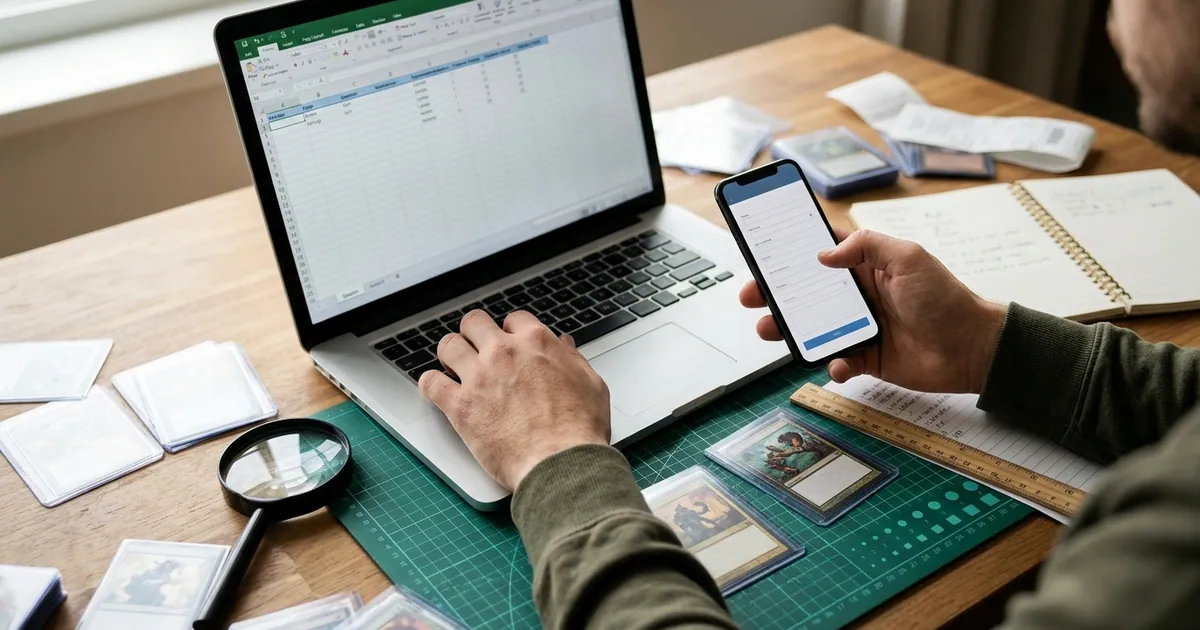
Most collectors can tell you what their best card is worth. Far fewer can tell you what they paid for it. That gap is where portfolios quietly go sideways: you remember the $40 pickup that became a $300 card, and you conveniently forget the twelve $25 buys that never went anywhere. Tracking card purchase prices fixes that. It turns a shoebox of guesses into a record you can actually make decisions with — what to grade, what to flip, what to stop buying.
This guide covers exactly what to record, how to handle messy real-world situations like bulk lots and trades, and how to build a system you’ll still be using in six months.
Why purchase price tracking matters more than value tracking
Market value moves on its own. Your purchase price never changes — it’s the one number you fully control, and it’s the anchor for every other metric:
- Profit and loss. You can’t calculate gain without basis. “This card is worth $120” means nothing until you know you paid $35 or $180.
- Grading decisions. A $12 raw card with a $25 grading cost needs a very different outcome than a $400 raw card. Knowing your basis tells you whether a bump from PSA 9 to PSA 10 actually matters financially.
- Buying discipline. When you can see that you’ve spent $900 on modern sports base cards this year, you buy differently.
- Taxes, if you sell. US collectors who sell regularly need documented basis. The IRS doesn’t accept “I think I paid around fifty bucks.” Keep records; talk to a tax professional about your specific situation.
- Insurance and estate planning. Documented acquisition cost plus photos is far more persuasive than a verbal estimate.
The fields worth recording for every card
You don’t need twenty columns. You need the right eight to ten. Here’s a field set that holds up over time:
| Field | Why it matters |
|---|---|
| Purchase date | Enables holding-period and trend analysis |
| Item price | The base number before anything else |
| Shipping paid | Often 10-25% of basis on low-dollar cards |
| Sales tax | Real money on marketplaces that collect it |
| Buyer fees | Auction house premiums, payment fees |
| Total cost | Sum of the above — your true raw basis |
| Source | eBay, card show, LCS, trade, breaker, friend |
| Condition at purchase | Raw, graded (company + grade), or sealed |
| Grading cost (if submitted) | Fees, shipping both ways, insurance |
| Notes | Lot allocation method, comp link, deal context |
The field collectors skip most often is shipping — and it’s the one that distorts small purchases the worst. A $9 card with $5 shipping is a $14 card. If you track it as $9, your “profitable” $16 sale was actually a loss after marketplace fees.
Build a workflow you’ll actually follow
The best tracking system is the one that survives a busy week. Three rules make that happen.
1. Log at the point of purchase, not later. The moment the order confirmation hits your inbox, enter the card. Reconstructing basis three months later from a cluttered purchase history is miserable and inaccurate.
2. Scan first, type second. Manual entry is where systems die. Scanning a card to auto-identify the set, number, and variant removes the tedious part, leaving you only the financial fields. This is exactly the workflow Card Grading AI is built around — scan, confirm the match, add your purchase details, done. See how the scanning and cataloging tools work on the features page.
3. Batch the cleanup. Once a month, sit down for twenty minutes and fill holes: cash buys from the show, missing shipping amounts, grading invoices. Monthly cleanup beats a yearly archaeology project.
Handling the messy cases
Bulk lots and collections
Buying a 500-card lot for $300 creates an allocation problem. Three workable approaches:
- Equal split. $300 ÷ 500 = $0.60 per card. Fast, fine for commons-heavy lots.
- Value-weighted. Estimate each card’s market value, then allocate the $300 proportionally. More accurate when the lot has a few real hits.
- Hit-and-bulk split. Assign a reasonable individual basis to the two or three cards you actually bought the lot for, then spread the remainder equally across the bulk.
Pick one method, note it in the card’s notes field, and stay consistent. Switching methods between lots makes your portfolio numbers meaningless.
Trades
For a trade, your basis in the card you received is generally the fair market value of what you gave up at the time of the trade — not what you originally paid for the traded-away card. Record the comp you used and the date. Trades are the single biggest source of mystery basis in collections.
Repacks, breaks, and sealed product
If you buy a $120 box and pull six cards worth tracking, allocate the $120 across those cards using the same logic as bulk lots. For group breaks, your basis in each card from your slot is the slot price (plus shipping), allocated across the cards you received.
Graded cards and grading costs
Keep raw purchase price and grading cost as separate line items. You want to be able to answer two different questions: “Was buying this card a good decision?” and “Was grading this card a good decision?” Blending them into one number hides which call was right. If you’re weighing a submission, an AI pre-grade can help you estimate condition before you commit — just remember it’s an estimate, never an official grade or guarantee, and it doesn’t replace PSA, BGS, CGC, or TAG.
Spreadsheet vs. app
A spreadsheet is free, flexible, and totally yours. It’s also slow to populate, easy to break with a bad sort, and offers no card identification help. For collections under roughly 100 cards that you rarely add to, it’s fine.
Once you’re adding cards weekly, the bottleneck becomes data entry, not storage. That’s where an app earns its keep: scan the card, get the identification, fill in three financial fields, move on. You can browse what’s supported in the catalog and compare plan options on the pricing page.
Whichever you choose, protect the data. Export a backup regularly. A collection record that lives in exactly one place is one dead phone away from gone.
Turning records into decisions
Once you’ve got clean basis data, actually use it. Every quarter, run four simple checks:
- Cost by source. Are card show buys outperforming eBay buys? Spend more where your edge is.
- Cost by category. Vintage vs. modern, Pokémon vs. sports, singles vs. sealed. Patterns show up fast.
- Unrealized position. Compare current comps against total cost for your top 20 cards by basis. These drive most of your portfolio outcome.
- Dead weight. Cards with basis above current comps that you have no emotional attachment to. Decide: hold, grade, or sell.
For market values, always use recent sold comps — not asking prices — and note the date you pulled them. A value from eight months ago is a story, not data.
Start small and stay consistent
Don’t try to backfill a 4,000-card collection this weekend. Start with two moves: log every new purchase going forward, and backfill only cards with a basis above $25. That captures most of the financial reality of a collection with a fraction of the work. Everything below that threshold can wait for a rainy afternoon.
Ready to stop guessing what you paid? Scan your next pickup with Card Grading AI, log the full cost, and let your records do the arguing next time you’re deciding whether to grade or sell. Questions about how identification and pre-grading work? The FAQ covers the details.
FAQ
What exactly counts as my cost basis for a trading card?
In practical terms, your cost basis is what you actually paid to get the card in hand: the item price plus shipping, sales tax, and any buyer fees. If you later grade the card, many collectors also track grading, shipping, and insurance as separate 'added costs' so they can see both the raw purchase price and the total invested amount.
How do I assign a purchase price to cards bought in a bulk lot?
Pick an allocation method and apply it consistently. The two easiest are equal split (lot price divided by card count) and value-weighted split (allocate based on each card's share of estimated market value at the time of purchase). Value-weighted is more accurate for lots with one or two chase cards. Always store the original lot price and the method you used in a note.
Can Card Grading AI tell me what my cards are worth?
Card Grading AI helps you scan, identify, and organize cards, log purchase details, and get AI condition pre-grades. Those pre-grades are estimates to help you decide what to submit — they are not official grades, appraisals, or guarantees, and they never replace PSA, BGS, CGC, or TAG. Market values you record should come from your own research on recent sold comps.
How often should I update my purchase price records?
Log purchases within 48 hours of the order confirmation, while the receipt is easy to find. Review the whole collection monthly to clean up missing fields, reconcile card-show cash buys, and add any grading costs you incurred that month.
Keep reading
Related guides
Ready to inspect your next card?
Scan your cards instantly with Card Grading AI
Capture a clear front-and-back photo, review an AI-assisted condition estimate, and keep standout cards organized in your collection.