Collector guide
Trading Card Condition Guide: Grades Explained
Learn how to read trading card condition like a grader: surface, corners, edges, centering, plus grade scales, lighting setup, and pre-grading tips.
By Matteo G.
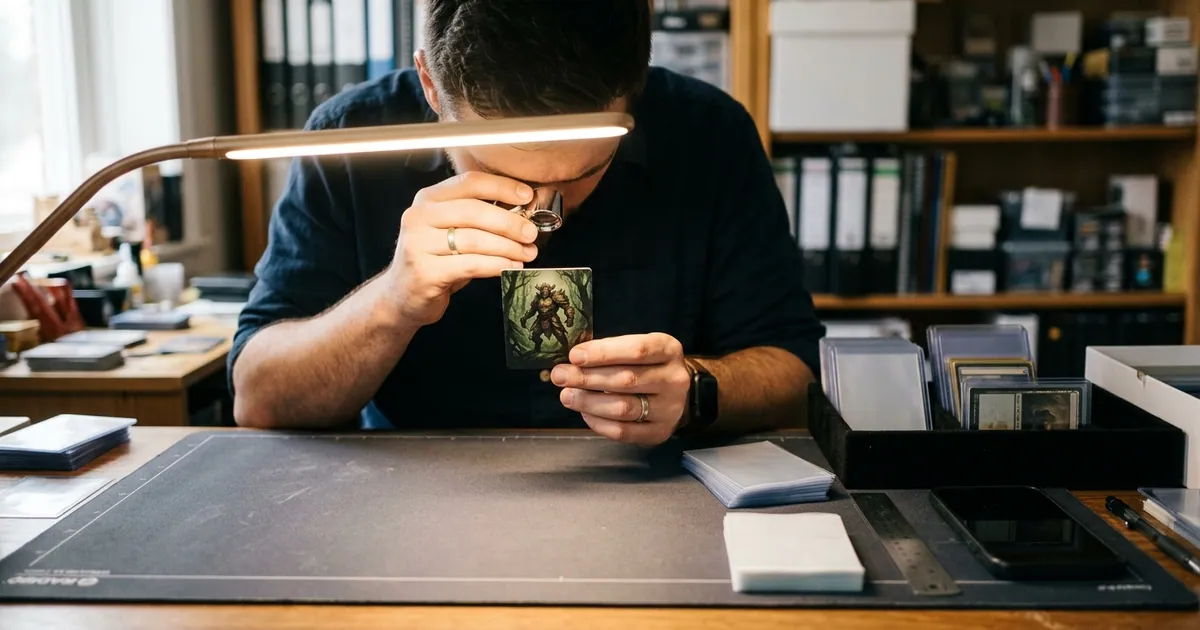
Condition is the single biggest driver of what a trading card is worth. Two copies of the same card, printed the same day in the same pack, can be separated by hundreds of dollars because one has a hair of edge whitening and the other doesn’t. The problem for most collectors is that condition language is vague. “Near Mint” means one thing on a marketplace listing and something completely different to a professional grader.
This trading card condition guide breaks down how graders actually look at cards, what each grade tier really means, and how to build a repeatable inspection routine you can run on your own kitchen table. It applies to Pokémon, sports cards, Magic: The Gathering, and just about any modern or vintage cardboard.
The Four Pillars of Card Condition
Every major grading company evaluates the same four categories. Learn these and you can describe any card accurately.
1. Centering
Centering is how evenly the printed image sits inside the card’s borders, measured left-to-right and top-to-bottom, and it’s evaluated on both the front and the back. It’s usually expressed as a ratio like 55/45 or 60/40.
Centering is the flaw collectors most often underestimate, partly because your eye adapts to it after a few seconds. It’s also the only one of the four pillars you can measure objectively rather than judge subjectively. If you want the full breakdown of tolerances and how to measure without a ruler, see our centering guide.
2. Corners
Hold the card so light rakes across the corner tips. A gem-quality corner comes to a sharp point with no fuzz, no white fibers, and no soft rounding. Common corner problems:
- Fuzz: microscopic fiber lift, visible only under magnification
- Whitening: the white core showing through the colored print layer
- Blunting: the tip is flattened rather than pointed
- Rounding: clear curvature, usually from loose storage or shuffling
A single soft corner is often the difference between a 9 and a 10.
3. Edges
Run your eye along all four edges from a low angle. Look for chipping, nicks, tiny dents, and whitening along the cut line. Dark-bordered cards are brutal here because any white core exposure contrasts sharply. Foil and holo cards can also show edge peeling where layers separate.
4. Surface
Surface is the widest category and includes both handling damage and factory defects:
- Scratches (worst on holo and chrome finishes)
- Print lines, roller marks, and print dots
- Indentations from pressure or a fingernail
- Loss of gloss, scuffing, or dimpling
- Creases, which are usually an automatic drop into the low grades
- Stains, fingerprints, and residue
Tilt the card slowly under a single bright light source. Scratches appear as brief flashes rather than constant marks, which is why static overhead lighting hides them.
What Each Grade Tier Actually Means
Most companies use a 1-10 scale. The exact wording varies, but the practical reality looks like this.
| Grade | Common label | What you’ll typically see |
|---|---|---|
| 10 | Gem Mint / Pristine | Sharp corners, clean edges, flawless surface at a glance, centering roughly 55/45 or better |
| 9 | Mint | One minor flaw: slight print imperfection, very light corner fuzz, or centering around 60/40 |
| 8 | Near Mint-Mint | A couple of small flaws, minor edge whitening, or noticeably off-center printing |
| 7 | Near Mint | Light corner wear visible without magnification, minor surface scuffing |
| 5-6 | Excellent | Obvious corner wear and edge chipping, possible light surface loss |
| 3-4 | Very Good | Rounded corners, surface wear, possibly a light crease |
| 1-2 | Poor to Good | Heavy creasing, major damage, writing, or missing material |
Two things surprise newer collectors. First, the jump from 9 to 10 is often invisible to the naked eye but massive in price. Second, the weakest category tends to cap the grade regardless of how good the rest of the card is.
Raw Marketplace Labels vs. Grading Standards
When you buy a raw card described as “NM,” that’s a trading-card retail convention, not a grading standard. Sellers commonly describe pack-fresh cards as Near Mint even when they’d land a 7 or 8 professionally, because pack-fresh doesn’t mean flaw-free — factory centering and print defects happen before the card ever hits a sleeve.
The practical translation:
- Marketplace “NM” → typically a 7 to 9 if graded, sometimes lower
- Marketplace “LP” (Lightly Played) → typically a 5 to 7
- Marketplace “MP/HP” → typically 3 or below
Don’t assume a raw card is gem-worthy just because it looks clean in a listing photo. Listing photos are usually the least informative images you’ll ever see of a card.
A Repeatable 5-Minute Inspection Routine
Consistency beats intuition. Use the same setup every time so your assessments are comparable across your collection.
- Set up your light. One bright, directional lamp beats overhead room lighting. Natural window light works if it isn’t diffuse.
- Work over a clean, soft surface. A mousepad or clean cloth protects the card if you fumble.
- Front surface pass. Tilt through several angles looking for scratches and print lines.
- Back surface pass. Backs pick up dimples and scuffing more than fronts, and they count.
- Corners and edges. Rotate through all four corners, then sight down each edge.
- Centering check. Evaluate front and back separately. Photograph the card straight-on for reference.
- Log it. Record the grade estimate and the specific limiting flaw. “Est. 8, light whitening on bottom-left edge” is far more useful later than “looks good.”
That last step is what separates collectors who make good submission decisions from those who guess.
Where AI Pre-Grading Fits In
The hardest part of condition assessment isn’t the knowledge — it’s staying objective across hundreds of cards. Your standards drift when you’re tired, and they drift again when the card is one you personally pulled.
This is exactly the problem Card Grading AI is built to help with. You photograph a card, and the app returns a condition estimate broken out by centering, corners, edges, and surface, along with measured centering ratios. Because it applies the same logic to every card, it’s useful as a consistency check against your own eyes — especially on cards you’re emotionally attached to.
Use it for triage. Scan a stack, sort into “strong candidate,” “maybe,” and “keep raw,” then hand-inspect only the top tier before you commit to submission fees. You can see the full scanning and scoring workflow on how it works, and browse the collection, valuation, and portfolio tools on the features page.
One important boundary: pre-grades are estimates to inform your decisions. They are not official grades, appraisals, or guarantees, and they don’t replace PSA, BGS, CGC, or TAG. Only those companies issue real grades. Think of AI pre-grading as the screening step that happens before you spend money.
Protecting Condition After You Assess It
Condition only moves in one direction unless you’re careful.
- Penny sleeve first, then a semi-rigid holder or toploader. Sleeve opening down inside a toploader reduces dust entry.
- Handle by the edges, and ideally over a soft surface.
- Avoid heat, humidity, and direct sunlight. Warping and fading are permanent.
- Store vertically. Stacked boxes create pressure dimples on the cards at the bottom.
- Don’t try to fix flaws. Cleaning, trimming, and pressing can be detected and will get a card flagged as altered.
The Bottom Line
Condition grading is a learnable skill built on four categories, one good light source, and a consistent routine. Learn to name the specific flaw that limits each card, and your submission decisions get sharper immediately.
When you’re ready to check your instincts against something that doesn’t get tired or sentimental, run your top candidates through Card Grading AI for a pre-grade estimate and centering measurement, then submit only the cards that clear your bar.
FAQ
What are the four things graders look at on a trading card?
Centering, corners, edges, and surface. Most grading companies evaluate all four and let the weakest category cap the final grade. A card with flawless corners and edges can still land in the 7-8 range if the surface has a scratch or the centering is badly off.
Can a card be 'Near Mint' and still get a low grade?
Yes. Raw-market condition labels like Near Mint are looser than third-party grading standards. A card sold as Near Mint may still show off-center printing, light edge whitening, or print lines that push a professional grade down to a 7 or 8.
Does a print line or roller mark count as damage?
Graders treat print defects as surface flaws even though you did nothing to cause them. Faint print lines usually cap a card in the 8-9 range, while heavy roller marks or print dots across a focal area can drop it further. Always check the surface under angled light before submitting.
How accurate is an AI condition estimate compared to a real grade?
Card Grading AI gives you a pre-grade estimate based on the photos you upload, and it is useful for triage and centering measurements. It is not an official grade, appraisal, or guarantee. Only PSA, BGS, CGC, TAG, and similar companies issue real grades.
Should I clean a card before assessing its condition?
Only remove loose dust with a clean, dry microfiber cloth. Never use liquids, erasers, or abrasives. Any attempt to alter the surface can be flagged as tampering and may result in a card being rejected or labeled as altered.
Keep reading
Related guides
Ready to inspect your next card?
Scan your cards instantly with Card Grading AI
Capture a clear front-and-back photo, review an AI-assisted condition estimate, and keep standout cards organized in your collection.