Collector guide
Card Grading Scale Explained: 1-10 Grades Made Simple
A clear breakdown of the 1-10 card grading scale, subgrades, half-point grades, and what each number actually means for your cards' value.
By Matteo G.
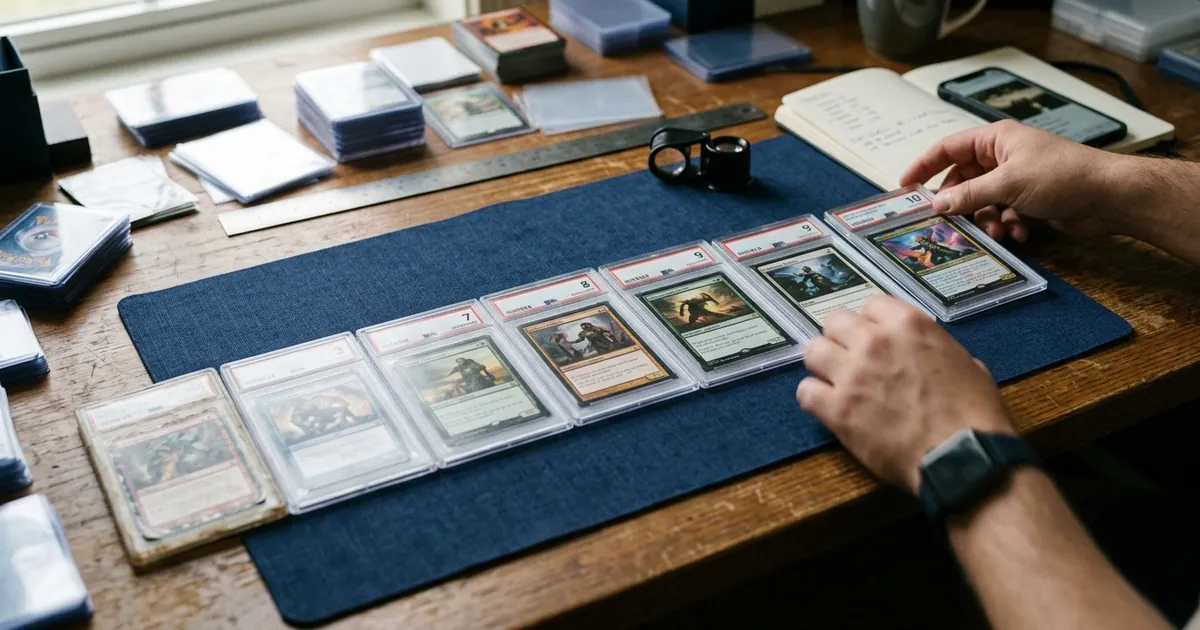
If you have ever looked at a slab labeled “PSA 9 MINT” or “BGS 9.5 GEM MINT” and wondered what separates that card from the identical-looking one in your binder, you are asking the right question. The card grading scale is the shared language of the hobby, and understanding it is the difference between submitting confidently and burning $25 a card on grades you never wanted.
This guide breaks down the 1-10 scale point by point, explains subgrades and half-point grades, shows how the four condition categories interact, and gives you a practical way to estimate where your own cards land before you ship anything.
Why a 1-10 Scale Exists at All
Before third-party grading, condition was described with words: “near mint,” “excellent,” “played.” Those words meant different things to different people, and disputes were constant. A numeric scale, applied by a neutral company and sealed in a tamper-evident holder, turned subjective opinion into a tradeable data point.
That is the real function of a grade. It is not a statement of beauty or rarity. It is a standardized condition assessment that lets a buyer in Ohio bid on a card in California without holding it. The higher the grade, the smaller the population of cards at that level, and the steeper the price curve tends to climb.
The Four Categories Behind Every Grade
Every major grading company evaluates the same four attributes, whether or not they print them on the label:
- Centering — how evenly the image sits inside the borders, measured front and back as a left/right and top/bottom ratio.
- Corners — sharpness under magnification. Graders look for fuzz, whitening, dings, and soft points.
- Edges — chipping, nicks, and whitening along the four sides, most visible on dark-bordered cards.
- Surface — print lines, scratches, dimples, gloss loss, staining, and factory defects.
The overall grade is typically limited by the weakest category. A card with perfect corners, edges, and surface but 70/30 centering will not reach the top of the scale. If you want to dig into that one specific factor, our card centering guide walks through measurement in detail.
The Card Grading Scale, Number by Number
Here is what each level generally means. Wording varies slightly by company, but the intent is consistent across the industry.
| Grade | Common Label | What It Generally Means |
|---|---|---|
| 10 | Gem Mint / Pristine | Virtually flawless to the naked eye; sharp corners, clean edges, clean surface, near-perfect centering |
| 9 | Mint | One very minor flaw, such as slightly off centering or a tiny surface imperfection |
| 8 | Near Mint-Mint | Minor wear on one or two corners, slight edge whitening, or noticeable but not severe centering issues |
| 7 | Near Mint | Light corner wear, minor edge chipping, surface still strong |
| 6 | Excellent-Mint | Visible corner wear on multiple corners, light scratches or edge nicks |
| 5 | Excellent | Rounding on corners, obvious edge wear, minor surface scuffing |
| 4 | Very Good-Excellent | Moderate wear throughout; still fully intact and presentable |
| 3 | Very Good | Rounded corners, noticeable creasing or surface wear |
| 2 | Good | Heavy wear, creases, possible small tears or writing |
| 1 | Poor / Fair | Severe damage: major creases, tears, stains, missing pieces |
One important nuance: a card with any crease almost always caps out in the lower half of the scale regardless of how clean everything else looks. Creases are structural, not cosmetic, and graders treat them accordingly.
Half-Point Grades and Where They Come From
Some companies award half grades such as 8.5, 9.5, or 10 with a qualifier. BGS built its reputation on this granularity, offering 9.5 (Gem Mint) and the rare 10 (Pristine) plus the coveted Black Label 10, which requires four perfect 10 subgrades. CGC also uses half points, and PSA has historically included a 1.5 at the bottom of its scale.
Half points matter economically. On many modern cards, the price gap between a 9 and a 9.5 is meaningful, and the gap between 9.5 and a true 10 can be dramatic. That is exactly why pre-screening matters: submitting a borderline card at full price to chase a half point is a gamble, not a strategy.
Subgrades: The Report Card Inside the Grade
When a slab shows four numbers along the bottom, you are looking at subgrades. They tell you why a card landed where it did. A BGS 9 with subgrades of 9.5 centering, 9.5 corners, 9.5 edges, and 8.5 surface tells a buyer the card has a surface flaw. That same 9 with all 9s reads as a more evenly strong card.
Subgrades are usually not averaged straight across. Most companies weight the lowest score heavily, so a single 8 among three 9.5s can hold the overall number down. When you are self-assessing, always ask which category is your weakest link — that is your realistic ceiling.
Qualifiers: The Letters After the Number
Sometimes a grade comes with a letter code such as OC (off-center), MK (marks), ST (stain), or MC (miscut). A qualifier means the card is technically strong enough for a higher grade in most respects but has one specific disqualifying issue. Qualified grades generally sell at a discount to clean grades at the same number, so factor that in before submitting a card you know has one glaring defect.
How the Scale Plays Out for Pokémon vs. Sports Cards
The scale is identical, but the failure modes differ.
Modern Pokémon cards frequently show factory surface issues — print lines, dimpling from the pack, and holo scratches on full-art cards. Centering on Pokémon holos can also drift noticeably. If that is your focus, our Pokémon card grading guide covers the flaws that most often cost collectors a point.
Vintage sports cards fight a different battle: era-typical rough cuts, print snow, and decades of handling wear on corners. Dark-bordered issues punish edge whitening especially hard. The sports card grading breakdown goes deeper on those era-specific traps.
Estimate Before You Submit
Grading fees, shipping, insurance, and return postage add up quickly. The smartest workflow is to screen your cards first, then submit only the ones with a realistic shot at the grade that justifies the cost.
That is what Card Grading AI is built for. You photograph a card with your phone or upload a scan, and the app returns an estimated pre-grade across centering, corners, edges, and surface, plus notes on the specific flaws it detects. You can see how the analysis pipeline works on our how it works page, and the AI card grading overview explains what the model looks at.
To be explicit: these are estimates meant to inform your decisions. They are not official grades, appraisals, or guarantees, and they do not replace an evaluation from PSA, BGS, CGC, TAG, or any other grading company. Think of it as a pre-flight check, not the flight itself.
A Practical Self-Grading Routine
- Set up light. Use bright, indirect light. Angle the card to catch surface scratches that disappear under flat lighting.
- Check centering first. It is the fastest disqualifier and the easiest to measure objectively.
- Inspect corners under magnification. A 10x loupe or your phone’s macro mode reveals fuzz you cannot see otherwise.
- Run a fingernail-free edge scan. Look for whitening dots along all four sides, front and back.
- Tilt for surface. Rotate slowly under light to catch print lines, dimples, and holo scratches.
- Score each category 1-10, then take your lowest. That is your honest ceiling.
- Compare against fees. If the realistic grade does not clear your break-even, keep it raw.
The Bottom Line
The card grading scale is not mysterious once you separate the number from the four things that produce it. Learn to read centering, corners, edges, and surface independently, understand that your weakest category sets your ceiling, and remember that half points and subgrades exist because those small differences move real money.
Run your cards through Card Grading AI before your next submission to get an estimated pre-grade and a flaw breakdown, then send in only the cards worth the fee. Your submission budget will go a lot further.
FAQ
Is the 1-10 card grading scale the same at every company?
The numbers look the same, but the standards behind them differ. PSA, BGS, CGC, SGC, and TAG all use a 1-10 scale, yet each has its own tolerances for centering, edge wear, and surface flaws. A card that earns a 9.5 at one company may come back a 9 at another, so always read the grader's published standards before submitting.
What is the difference between a grade and a subgrade?
A grade is the single overall number on the label. Subgrades are separate scores for centering, corners, edges, and surface. BGS is best known for showing all four subgrades on the slab. The overall grade is usually driven by the weakest subgrade, not a simple average, which is why one soft corner can cap an otherwise flawless card.
What grade do most raw cards actually receive?
It varies by set, era, and how the card was stored, but modern pack-fresh cards commonly land in the 8 to 10 range while older cards frequently grade lower because of print-era centering and handling wear. The only way to know is to inspect all four categories closely before you pay submission fees.
Can Card Grading AI tell me exactly what grade I will get?
No. Card Grading AI produces an estimated pre-grade based on photos you take, so you can spot problems and prioritize submissions. It is not an official grade, an appraisal, or a guarantee, and it does not replace PSA, BGS, CGC, TAG, or any other grading company's evaluation.
Keep reading
Related guides
Ready to inspect your next card?
Scan your cards instantly with Card Grading AI
Capture a clear front-and-back photo, review an AI-assisted condition estimate, and keep standout cards organized in your collection.