Collector guide
Card Surface Scratches Grading: A Collector's Guide
Learn how card surface scratches affect grading, how to spot them with light, and how to pre-check surface condition before you submit to PSA, BGS, or CGC.
By Matteo G.
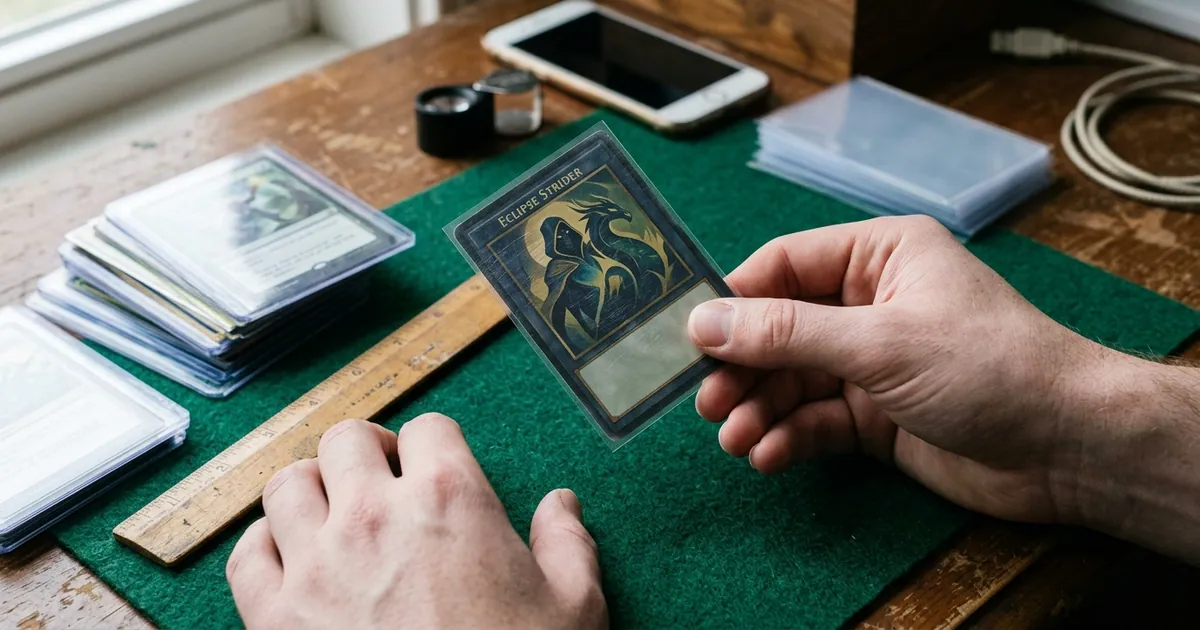
Surface is the quietest grading category and the one that ruins the most submissions. Centering you can measure, corners you can inspect, edges you can see on a white background. But a hairline scratch across a holo panel hides until you tilt the card into the light at exactly the right angle — often after the grader has already seen it and knocked your card from a 10 down to an 8. If you are serious about card surface scratches grading, you need a repeatable inspection routine, not a quick glance under a desk lamp.
This guide covers what graders actually look for on the surface, how to light and inspect a card at home, how scratches map to grade ranges, and how to use a pre-grade check before you spend money on submission fees.
What “surface” actually covers in grading
When PSA, BGS, CGC, or TAG evaluate surface, they are not only looking for scratches. The surface category is a catch-all for anything that disrupts the card’s face or back between the borders. That includes:
- Scratches and hairlines — thin cuts through the gloss or foil layer, usually from sleeve grit, stacking, or a fingernail.
- Scuffs and gloss loss — dull patches where the finish has been rubbed flat, common on the backs of cards pulled from binders.
- Print lines and print dots — manufacturing flaws in the ink or foil, not damage you caused.
- Dents, dimples, and indentations — pressure marks that show as shadowed depressions under angled light.
- Creases and bends — the most severe surface defects, which typically cap a card in the low grades regardless of everything else.
- Stains, residue, and fingerprints — including oils that darken over time.
- Wax, gum, and print residue — common on vintage sports issues.
BGS and CGC assign surface an explicit subgrade. PSA folds everything into a single number, which means a bad surface can quietly drag down an otherwise perfect card with no explanation on the label.
Why scratches hide from casual inspection
A scratch is only visible when light reflects off it differently than the surrounding finish. Under flat overhead lighting — the kind most people use to photograph cards — reflections are even and shallow scratches disappear completely. That is why so many collectors are shocked by a returned grade.
Modern holo, refractor, prizm, and foil-etched cards make this worse. Their reflective layers scatter light in patterns that camouflage fine lines. Meanwhile, the same glossy finish shows every scratch dramatically once you tilt it. Matte or textured stock, like many vintage sports cards, hides hairlines better but shows scuffing and gloss loss more readily.
The at-home inspection routine
Use this sequence every time. It takes about 45 seconds per card once you have the habit.
- Work over a clean, dark surface. A black mousepad or a dark cloth reduces stray reflections and catches the card if you drop it.
- Use a single point light source. A small LED desk lamp or a phone flashlight is ideal. Diffuse room light will not reveal scratches.
- Hold the card at a raking angle. Tilt the card so the light skims across the face at roughly 15 to 30 degrees rather than hitting it head-on. Rotate slowly through a full turn — scratches only flash at certain orientations.
- Check both directions. Scratches running parallel to your light source can vanish. Rotate the card 90 degrees and repeat.
- Inspect the back the same way. Backs get scratched more than fronts because of how cards are stacked, and graders check both.
- Use magnification last. A 10x loupe helps you distinguish a scratch from a print line, but do not grade by loupe alone — graders judge by naked-eye visibility under normal light.
One rule to internalize: if you can see it without trying, a grader will see it too. If you can only find it by hunting at a specific angle with a flashlight, it may or may not cost you. That uncertainty band is exactly where pre-grading helps.
How scratches map to grade ranges
There is no universal formula, and every grading company weighs severity, length, location, and visibility differently. Still, the pattern below reflects how surface defects generally behave across the major services.
| Surface condition | Typical impact | Realistic ceiling |
|---|---|---|
| No visible marks at any angle | None | Gem Mint eligible |
| One faint hairline, only visible under raking light | Minor deduction | Mint range |
| One clearly visible scratch in a border or background area | Noticeable deduction | Near Mint to Mint |
| Scratch crossing the main image, player, or character | Significant deduction | Excellent to Near Mint |
| Multiple scratches, scuffing, or gloss loss | Major deduction | Very Good to Excellent |
| Dent, crease, or scratch that breaks the foil layer | Severe | Low grades |
Location matters more than most collectors expect. A two-inch hairline running through an empty black background is often judged less harshly than a half-inch scratch across a face. Graders assess eye appeal, and anything in the visual center of the card carries more weight.
Scratch versus print line: how to tell
Misidentifying a defect leads to bad submission decisions. Here is how to separate them:
- Direction. Print lines are typically dead straight and consistent with the print or foil-application direction, frequently running the full height or width of the card. Scratches wander, curve, or stop abruptly.
- Depth. Under a loupe, a scratch has an edge where the gloss is broken. A print line sits within the layer and the gloss over it is intact.
- Repeatability. If you own multiple copies of the same card from the same print run and the same line appears in the same place, it is a print flaw.
Both count against surface, but knowing the difference tells you whether the flaw is your fault — which affects whether you should buy a replacement copy or just submit the one you have.
Prevention beats inspection
Most hairlines are self-inflicted after the card leaves the pack. A few habits eliminate the majority of them:
- Sleeve the card immediately with a penny sleeve, then a semi-rigid or top loader.
- Insert cards into sleeves slowly and squarely. Forcing a card at an angle scrapes the corner and drags grit across the face.
- Check sleeves for dust before use. A single grain of grit inside a sleeve will scratch the card every time it shifts.
- Never slide cards across each other when sorting. Lift, do not drag.
- Keep fingers off the face. Oils attract dust, and dust becomes scratches.
- Store upright rather than in tall stacks, which apply uneven pressure and create dimples.
And again: do not attempt to fix a scratch. Buffing, polishing, or applying any product is alteration, and graders are very good at detecting it.
Using a pre-grade check before you submit
Surface defects are the hardest category to self-assess objectively, partly because you already know what the card looks like and your brain filters out flaws. A second opinion — even an automated one — resets that bias.
Card Grading AI analyzes your uploaded photos and returns an estimated pre-grade with condition notes across centering, corners, edges, and surface, so you can see whether a scratch you noticed is likely to matter. To get useful surface feedback, upload one evenly lit shot plus one angled shot that shows reflections across the card face — the app can only evaluate what your photos actually capture. You can see exactly how the analysis pipeline works on how it works, and review the full analysis and tracking toolset on features.
These results are estimates designed to support your submission decisions. They are not official grades, appraisals, or guarantees, and they do not replace PSA, BGS, CGC, or TAG.
For modern sports issues — where chrome, prizm, and refractor finishes make surface the single most common reason a card misses a 10 — see the dedicated guidance on sports card grading. Surface also interacts with centering when you are deciding between two copies of the same card, so it is worth checking both before committing submission fees.
A simple decision framework
Before you submit, run the card through these questions:
- Is the scratch visible under normal room light without tilting? If yes, expect a meaningful deduction.
- Is it in a high-visibility area? Faces, logos, and centered imagery cost more.
- Does it break the foil or gloss layer? Depth matters more than length.
- Is the card valuable enough at a lower grade to justify the fee? A high-value card can still be worth grading at a 9 or 8; a common card usually is not.
- Do you have a cleaner copy available? For modern cards, buying a better raw copy is often cheaper than grading a flawed one.
Surface is unforgiving, but it is also predictable once you know how to look. Build the flashlight routine into your workflow, sleeve everything on the spot, and run a pre-grade check before you pay for submissions. That combination catches the hairlines that would otherwise cost you a grade point and a few hundred dollars.
FAQ
Do small surface scratches prevent a PSA 10?
Usually yes, if the scratch is visible to the naked eye under normal lighting. Graders inspect the surface under angled light, and a clearly visible line across a holo or glossy panel typically caps a card around PSA 8-9. Extremely faint marks that only appear under a strong raking light at a sharp angle sometimes pass, but you should never count on it when the rest of the card is otherwise flawless.
Can I remove scratches from a trading card before grading?
No. Polishing, buffing, wiping with solvents, or applying any coating is considered alteration and can result in the card being rejected or labeled as altered. The only safe cleaning is gently removing loose dust or a fingerprint with a dry microfiber cloth, using light pressure. If the scratch is in the card stock or foil layer, it is permanent.
What is the difference between a scratch and a print line?
A scratch is physical damage added after production, so it cuts through the gloss and often catches light in a slightly different tone or depth. A print line is a manufacturing flaw baked into the ink or foil layer, usually perfectly straight and aligned with the print direction. Graders count both against the surface subgrade, but print lines are frequently more forgivable than deep post-production scratches.
Can Card Grading AI detect surface scratches from a photo?
Card Grading AI analyzes the images you upload and flags visible surface issues such as scratches, scuffs, gloss loss, and dents to produce an estimated pre-grade. Detection quality depends heavily on your lighting and focus, so shoot with diffuse light plus one angled shot. The result is an estimate to help you decide what to submit, not an official grade from PSA, BGS, CGC, or TAG.
Keep reading
Related guides
Ready to inspect your next card?
Scan your cards instantly with Card Grading AI
Capture a clear front-and-back photo, review an AI-assisted condition estimate, and keep standout cards organized in your collection.