Collector guide
How to Store Trading Cards Safely: A Collector's Guide
Learn how to store trading cards safely with the right sleeves, toploaders, boxes, humidity levels, and storage habits that protect condition and value.
By Matteo G.
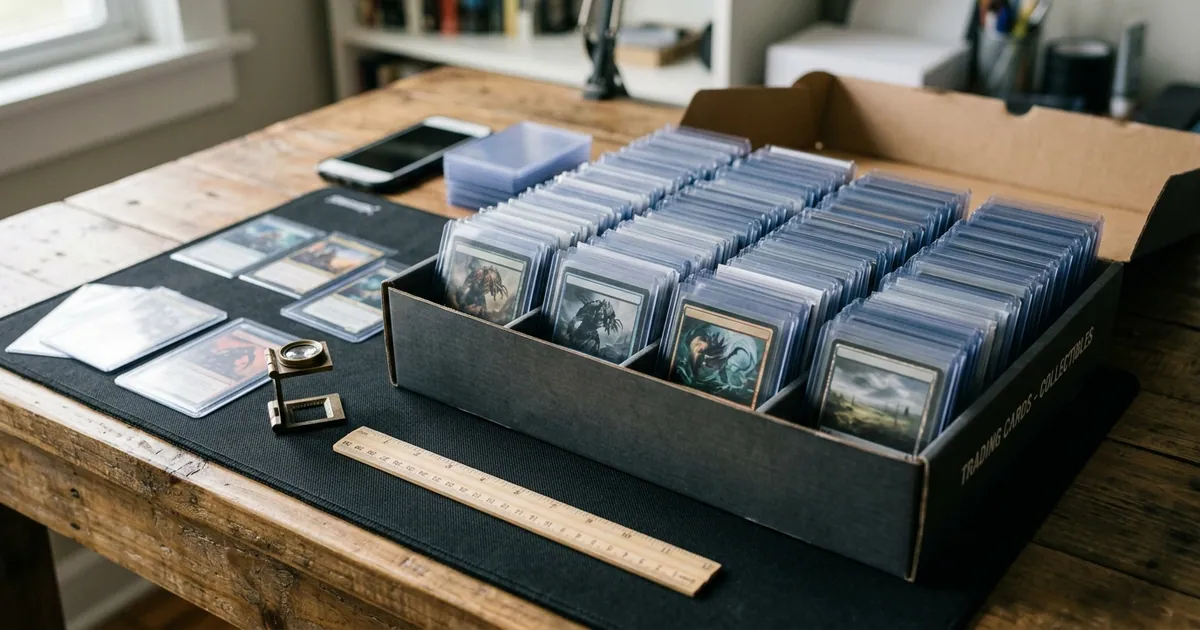
Most condition damage does not happen in the pack or in the mail. It happens on a shelf, in a drawer, or in a shoebox in a garage, slowly, over months and years. Edges whiten from rubbing. Corners soften from loose stacking. Surfaces haze from sunlight. Whole cards warp from humidity swings. By the time you notice, a card that could have graded a 9 or 10 is capped at an 8.
The good news: safe storage is cheap, boring, and extremely effective. This guide covers the supplies that actually matter, how to layer them, where to keep your boxes, and how to build a storage system that scales as your collection grows.
Start by Triaging Your Collection
Before buying supplies, split your cards into three buckets. Over-protecting bulk is a waste of money, and under-protecting your chase cards is how value quietly disappears.
- Tier 1 — Premium: Cards worth grading or already worth real money. Vintage, rookies, numbered parallels, autos, alt arts, graded slabs.
- Tier 2 — Keepers: Cards you care about but wouldn’t submit. Playable staples, favorite characters, set-completion pieces.
- Tier 3 — Bulk: Commons, duplicates, trade fodder.
Each tier gets a different level of protection. If you aren’t sure which bucket a card belongs in, log it first and decide later — a digital catalog makes triage far easier than flipping through binders.
The Protection Stack, Explained
Think of storage as layers. Each one solves a specific failure mode.
| Layer | What it protects against | Best for |
|---|---|---|
| Penny sleeve | Surface scratches, fingerprints, dust | Every card above bulk |
| Perfect-fit sleeve | Edge dirt, sliding inside the outer sleeve | Cards headed for grading |
| Toploader | Bends, corner impacts, pressure | Tier 1 and 2 singles |
| Card saver / semi-rigid | Safe grading submission, gentle flex | Cards being shipped to a grader |
| Magnetic one-touch | Long-term display and impact protection | High-value singles |
| Binder with side-loading pages | Organized browsing, light pressure | Sets, Tier 2 collections |
| Storage box (sleeved rows) | Dust, light, bulk volume | Tier 3 and sorted inventory |
A few practical rules that save cards:
Double-sleeve for grading candidates. Penny sleeve first (opening up), then a snug perfect-fit sleeve, then the toploader or card saver. This keeps the card from sliding and prevents sleeve edges from rubbing the card’s edges.
Never slam a card into a toploader. Insert it slowly, straight on. Most corner dings in otherwise clean cards come from a rushed insertion or a toploader that’s too tight.
Match thickness. A 20pt toploader for a standard card, 55-130pt for thick relics and patches. A card rattling inside an oversized holder will develop edge wear.
Skip rubber bands forever. They dent, stain, and eventually fuse to card stock. Use team bags or painter’s tape across the toploader opening instead.
Where You Store Matters More Than What You Store In
You can do everything right with sleeves and still ruin a collection by putting the box in the wrong room.
Target conditions: roughly 65-72°F and 45-55% relative humidity, stable year-round, away from direct sunlight.
Avoid these spots:
- Attics and garages. Summer heat warps cards and softens gloss. Cold snaps make card stock brittle.
- Basements. Moisture is the enemy. Even “dry” basements spike in humidity during storms.
- Exterior-wall closets. They track outdoor temperature more than you’d expect.
- Window-facing shelves. UV fades ink and yellows white borders, especially on older cardboard.
- Kitchens and bathrooms. Steam and cooking grease travel farther than you think.
Good spots: an interior closet, a bedroom bookshelf away from windows, or a climate-controlled office. Store boxes upright, not stacked flat under weight, so cards aren’t compressed over time. Keep rows full — a half-empty row lets cards lean and bow.
If your climate runs humid, add rechargeable silica gel packs to each box and recharge them on schedule. If it runs dry (desert states, winter forced-air heat), the risk flips to brittleness and static; a humidifier set to a modest level helps.
Binders: Useful, But Choose Carefully
Binders are the best way to browse a set, and the easiest way to accidentally damage cards.
- Use side-loading pages. Top-loading pages let cards slip out when the binder is tilted.
- Confirm pages are PVC-free and acid-free. Old PVC pages can leach plasticizer onto card surfaces.
- Don’t overstuff. A binder crammed past its ring capacity puts constant pressure on the cards near the spine.
- Store binders upright on a shelf, never stacked horizontally.
- Skip binders for your single most valuable cards. Those belong in one-touches.
Handling: The Part People Skip
Storage protects cards at rest. Handling is where most fresh damage happens.
- Wash and dry your hands first; skin oils dull gloss over time.
- Hold cards by the edges, flat sides only.
- Work over a soft surface — a playmat or towel — so a dropped card doesn’t hit a hard desk edge.
- Keep food and drinks on a different surface entirely.
- Don’t “clean” cards. Wiping a surface with a cloth creates micro-scratches that graders catch under angled light, and anything stronger counts as alteration.
If you want to see how graders evaluate those surfaces, our breakdowns on Pokémon card grading and sports card grading walk through what each subgrade is really measuring.
Storing Graded Slabs
Slabs are durable, not indestructible. The case protects the card; nothing protects the case.
- Use slab sleeves to prevent scratches on the plastic.
- Store in graded card storage boxes designed for slab dimensions, upright.
- Don’t stack slabs loose in a pile — the corners scuff each other.
- Keep them out of direct sunlight; labels can fade and cases can yellow.
- For display, choose UV-filtering frames or cases and keep them off sun-facing walls.
Build a Record Alongside the Physical System
Physical storage and digital records should grow together. If a box moves, a card sells, or something gets damaged, you want a record that reflects reality.
A practical workflow:
- Sleeve and protect the card according to its tier.
- Photograph the front and back under even light.
- Log it with set, number, condition notes, purchase price, and storage location (“Box 3, Row B” or “Binder: Base Set”).
- Re-check condition annually when you rotate desiccant packs.
That location field sounds trivial until your collection passes a few thousand cards. It turns “I think it’s somewhere in the closet” into a ten-second retrieval.
Card Grading AI is built for exactly this loop: scan a card with your phone, get an estimated pre-grade with condition notes on centering, corners, edges, and surface, and store it in your digital catalog with photos, values, and your own notes. Those pre-grades are AI estimates to help you prioritize — they are not official grades and don’t replace PSA, BGS, CGC, or TAG.
A Simple Annual Maintenance Routine
Once a year, set aside an afternoon:
- Recharge or replace desiccant packs.
- Spot-check a sample of cards in each box for warping, haze, or edge wear.
- Re-seat any cards that have shifted inside holders.
- Update your catalog: new acquisitions, sales, and current estimated values.
- Re-scan your top cards to see whether condition estimates have shifted.
Fifteen minutes of prevention beats a reholder, a lower grade, or a sentimental loss you can’t undo.
The Short Version
Sleeve what matters, double-sleeve what you’ll grade, match holder thickness to card thickness, store boxes upright in a stable interior room at moderate humidity, keep cards out of sunlight, and handle by the edges. Then back it all up with a digital record so you know what you own and where it lives.
Ready to catalog what you’re protecting? Scan your collection with Card Grading AI and get condition estimates plus a searchable catalog in one place.
FAQ
Do I need to sleeve every card in my collection?
No. Sleeve the cards that matter: holos, rookies, numbered parallels, autos, vintage, and anything you might submit for grading. Bulk commons can live in a sorted box without individual sleeves, as long as the box is full enough that cards don't slide around and the environment is dry and stable.
What is the ideal temperature and humidity for storing trading cards?
Aim for roughly 65-72°F and 45-55% relative humidity, with as little day-to-day swing as possible. Stability matters more than hitting an exact number. Avoid attics, garages, basements, and exterior-wall closets, where temperature and moisture change the most.
Are magnetic one-touch holders safe for long-term storage?
Yes, when used correctly. Use the right thickness for the card, keep the magnet closed, and store holders upright and out of direct light. Never force a thick relic or patch card into a 35pt holder, and avoid stacking heavy holders flat on top of raw cards.
Can I store cards in a safe deposit box or home safe?
You can, but safes can trap humidity. Add rechargeable silica gel or a small desiccant, check it periodically, and keep cards in rigid holders inside a closed box. For high-value cards, also keep a photo and purchase record so your insurance documentation stays current.
Does storage condition affect my grading odds?
Absolutely. Edge whitening, surface haze, corner dings, and warping almost always come from handling and storage, not the pack. Good storage protects the grade you already have. Card Grading AI can give you an estimated pre-grade so you can see where a card stands before submitting, but it is an estimate, not an official grade.
Keep reading
Related guides
Ready to inspect your next card?
Scan your cards instantly with Card Grading AI
Capture a clear front-and-back photo, review an AI-assisted condition estimate, and keep standout cards organized in your collection.