Collector guide
12 Common Card Grading Mistakes (And How to Avoid Them)
Avoid the most common card grading mistakes US collectors make, from bad centering checks to over-submitting, and learn how to pre-screen cards before you ship.
By Matteo G.
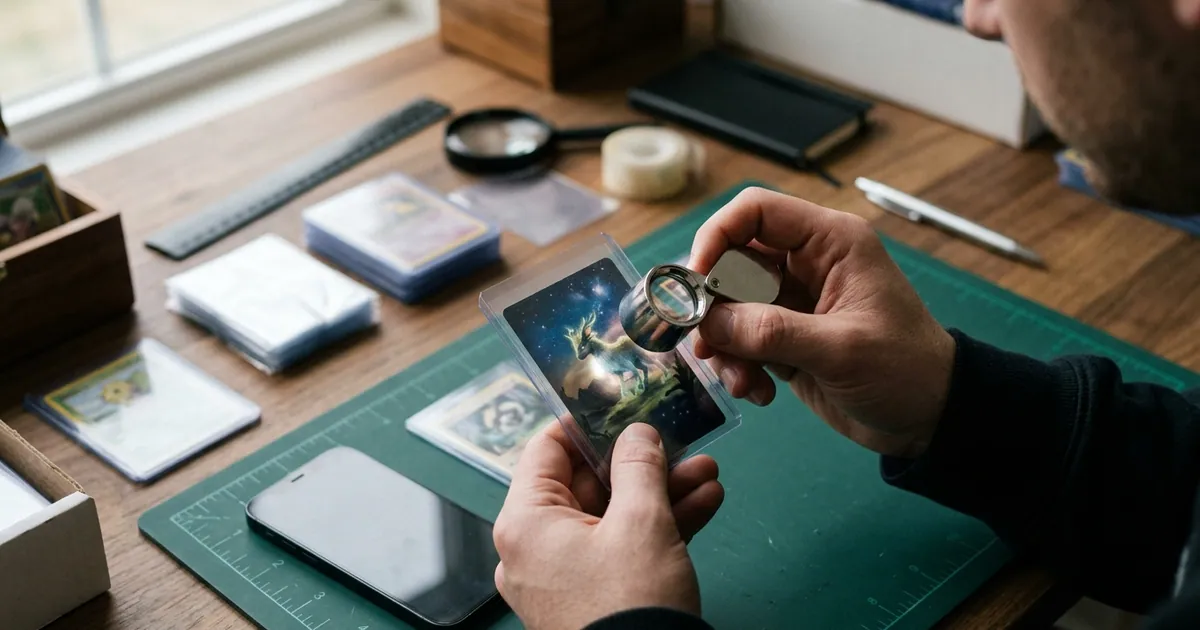
Most collectors do not lose money on grading because they picked the wrong company or the wrong service tier. They lose money because of small, avoidable decisions made before the package ever leaves the house: a card that was never a 10, centering that was never measured, a soft corner that never got a second look under good light. Grading is one of the few parts of the hobby where the fee is fixed and the outcome is not, so the cost of a mistake is immediate and unforgiving.
Below are the most common card grading mistakes we see from US collectors, organized roughly in the order they happen, along with practical ways to avoid each one. None of this requires expensive equipment. It mostly requires slowing down and being honest about what you are looking at.
1. Grading Cards That Do Not Clear the Value Hurdle
The first mistake happens before condition ever enters the picture. Grading only makes sense when the graded price meaningfully exceeds the raw price plus every cost of the submission: grading fee, shipping both ways, insurance, supplies, and your time.
A useful habit is to write down three numbers before you commit: the current raw sold price, the graded price at the grade you realistically expect, and your total all-in cost per card. If the spread between the raw price and the realistic graded price is smaller than your cost, the card stays raw. This single filter eliminates a large share of regretted submissions.
2. Assuming a New Card Is a Gem
Straight-from-the-pack does not mean flawless. Factory cutting, roller marks, print lines, chipping on dark borders, and centering drift all exist before a card ever touches a human hand. Modern high-gloss cards are especially good at hiding hairline surface scratches until you tilt them under a single light source.
Assume nothing. Inspect every new card the same way you would inspect a card you bought sight-unseen from a bulk lot.
3. Skipping the Centering Measurement
Centering is the most measurable factor in grading and the one collectors most often eyeball. That is a bad trade, because centering is also where top grades quietly disappear. A card can have perfect corners, edges, and surface and still land a 9 because the left border is visibly thicker than the right.
Measure both the front and the back. Many collectors check the front, love what they see, and never flip the card over. If you are unsure how to do it consistently, our centering guide walks through the border-ratio approach, and Card Grading AI estimates centering from a photo so you can screen a stack quickly.
4. Inspecting Under Bad Lighting
Overhead room light flattens everything. Corner fuzz, surface scratches, and print defects only reveal themselves when light hits the card at an angle. A cheap desk lamp you can reposition is worth more for pre-grading than almost any other tool.
Use a diffuse light source for overall condition, then a single directional light angled across the surface to hunt for scratches and print lines. Rotate the card slowly. Do the same for the back.
5. Judging Corners With the Naked Eye
Corners are where 10s become 9s. What looks sharp at arm’s length can show white fraying or a rounded tip under 10x magnification. A basic loupe costs very little and instantly improves your accuracy.
Check all four corners on the front and all four on the back. A single soft back corner is enough to cap a grade, and it is the defect collectors most frequently miss.
6. Cleaning, Wiping, or “Improving” a Card
This is the mistake with the worst downside. Any attempt to clean, buff, press, or reshape a card risks an altered or evidence-of-cleaning designation. That label is far more damaging than a surface smudge, because it can make the card effectively unsellable at anything close to market.
Remove loose dust with clean, dry hands or a soft dry cloth at most. Never use liquids, solvents, erasers, or pressure. If the card is dirty, grade it dirty or sell it raw.
7. Bad Handling and Packaging
Cards get damaged on the way to the grader more often than collectors admit. Common causes include sliding a card into a semi-rigid holder at an angle and dinging a corner, using a top loader instead of the required semi-rigid, and packing the box loosely so cards shift in transit.
Use a fresh penny sleeve, then a semi-rigid holder, insert the card straight and slowly, and follow the grading company’s specific packaging requirements. A card that arrives damaged is graded as damaged.
8. Using Photos You Cannot Actually Evaluate
Whether you are pre-screening yourself or using an app, the input matters. Blurry shots, heavy glare, and shadows across the border make centering and surface impossible to assess. Flat, even lighting with the card square to the camera and no glare hotspots is the goal.
If you want your pre-grade estimates to be useful, treat photography as part of the process. See how it works for the capture flow Card Grading AI uses.
9. Filling Bulk Orders With Filler
Bulk tiers reward volume, so collectors pad orders to hit minimums. The result is a box of cards that mostly return 8s and 9s on commons that were worth more raw. The bulk discount does not rescue a card that had no business being submitted.
Build the order from cards that pass your pre-screen. If you are short of the minimum, wait or choose a different tier.
10. Ignoring How Grade Tiers Map to Price
Value is not linear across the grading scale. For many cards, the jump from 9 to 10 is dramatic while the jump from 8 to 9 is modest. That changes your decision entirely: if a card is a likely 9, submitting it may be a break-even move, while a likely 10 is a clear yes.
| Realistic pre-grade | Typical decision | Why |
|---|---|---|
| Likely 10 | Submit | Largest premium sits at the top grade |
| Likely 9 | Check the spread first | Premium is often modest for modern cards |
| Likely 8 or below | Usually sell raw | Fees rarely clear the raw price |
| Any suspected alteration | Do not submit | Risk of a damaging designation |
11. Chasing One Card’s Result Instead of a Process
Grading outcomes vary. One surprising 10 does not mean your eye is calibrated, and one disappointing 8 does not mean the grader was wrong. What actually improves results over time is a repeatable pre-screen: same lighting, same checklist, same measurement method, recorded for every card.
Keeping notes on what you expected versus what came back is how you learn your own blind spots. Most collectors are consistently optimistic about surface and consistently pessimistic about edges, or the reverse.
12. Treating an Estimate Like a Guarantee
AI pre-grading, third-party opinions, and your own inspection are all estimates. They are inputs into a decision, not promises. Grading involves human review and company-specific standards, and two graders can reasonably see the same corner differently.
Use estimates to sort your stack into submit, sell raw, and hold. That is where the money is made, not in predicting a single number perfectly.
A Simple Pre-Submission Checklist
Run every candidate card through this before it goes in the box:
- Raw sold price, realistic graded price, and total cost per card written down
- Front and back centering measured, not eyeballed
- All eight corners checked under magnification
- Surface checked under angled light for scratches and print lines
- Edges checked for chipping, especially on dark borders
- No cleaning, pressing, or alteration attempted
- Fresh penny sleeve and semi-rigid holder, card inserted straight
- Card photographed clearly for your own records before shipping
Where Card Grading AI Fits
Card Grading AI is built for step one of that checklist: fast triage. Photograph a card, get an estimated pre-grade with centering, corner, edge, and surface feedback, and log it in your collection so you can compare candidates side by side instead of relying on memory. It is designed to help you decide what to submit, and just as importantly, what to leave raw.
To be clear about what it is not: Card Grading AI produces estimates, never official grades, appraisals, or guarantees, and it is not a replacement for PSA, BGS, CGC, TAG, or any other grading company.
If you are staring at a stack of cards and trying to figure out which ones deserve a submission slot, start by scanning them. Explore the full feature set or try AI pre-grading on your next batch and see how many cards the checklist saves you from sending.
FAQ
What is the single most expensive card grading mistake?
Submitting cards that were never going to grade high enough to justify the fee. Grading, shipping, insurance, and return postage can easily run $25 or more per card once everything is added up. If a raw card sells for $15 and a mid-grade copy sells for $25, the math rarely works. Pre-screening your cards before you ship, and being honest about surface and centering, prevents most wasted submissions.
Can I clean a card before sending it in for grading?
No. Wiping, buffing, or using any liquid or solvent on a card risks a trimmed, altered, or evidence-of-cleaning designation, which destroys value far more than the dirt you were trying to remove. The only safe handling is a soft, dry removal of loose dust or lint with clean hands, plus a fresh penny sleeve and semi-rigid holder.
Does AI pre-grading replace PSA, BGS, or CGC?
It does not. Card Grading AI produces an estimate, or pre-grade, to help you decide which cards are worth submitting and which are better sold raw. Only a professional grading company can issue an official, slabbed grade. Think of AI pre-grading as a triage tool that happens before you ever fill out a submission form.
How much does centering really matter?
A lot, especially at the top of the scale. A card with flawless corners, edges, and surface can still cap out at a 9 if centering is noticeably off, and BGS subgrades make the penalty very visible. Measuring borders on both the front and back before submitting is one of the fastest ways to filter out cards that will not hit the grade you are hoping for.
Should I grade cards in bulk or one at a time?
Bulk tiers lower the per-card cost, which is helpful for modern cards, but only if each card in the order actually deserves a slot. Many collectors fill bulk orders with filler just to hit a minimum, then pay for a stack of 8s. Build the order around cards that pass your own pre-screen first, then decide whether the bulk tier makes sense.
Keep reading
Related guides
Ready to inspect your next card?
Scan your cards instantly with Card Grading AI
Capture a clear front-and-back photo, review an AI-assisted condition estimate, and keep standout cards organized in your collection.